Keightley
The IPCRESS FileCaptain Keightley, the Military Liaison Officer at the Criminal Records Office, brings an important warning into the investigation: a man in a Metropolitan Police Chief Inspector’s uniform has been stopped, and the records hold a priority file on him despite his lack of a criminal record. Keightley is a point of contact between the records system and the narrator, conveying a lead whose significance lies in the gap between the suspect’s official appearance and the suspicion attached to his identity.
Position and Introduction
Keightley speaks for the Criminal Records Office in a priority telephone call to the narrator. The connection is treated as sensitive: an operator identifies the call as class four priority and asks for the line to be scrambled, after which the narrator activates the recording apparatus. Keightley identifies himself by his rank and Military Liaison Officer role, establishing that his call comes through an official channel rather than an informal tip.
The call interrupts the narrator’s planned evening. Keightley’s first report is not yet the central fact, and the narrator tells him to get to the point. That brisk exchange sets the practical tone of their contact: Keightley has information from the records office, while the narrator needs its operational significance without delay.
The Police-Impersonation Lead
Keightley explains that a constable stopped a man in a car and asked for his licence. The Criminal Records Office has no white card for the man, the ordinary record Keightley distinguishes from a green card for a suspected person without a criminal record. The green card is endorsed to the narrator’s department and marked with a star for top priority. The absence of a conventional criminal record therefore does not mean the man is unknown to the intelligence system.
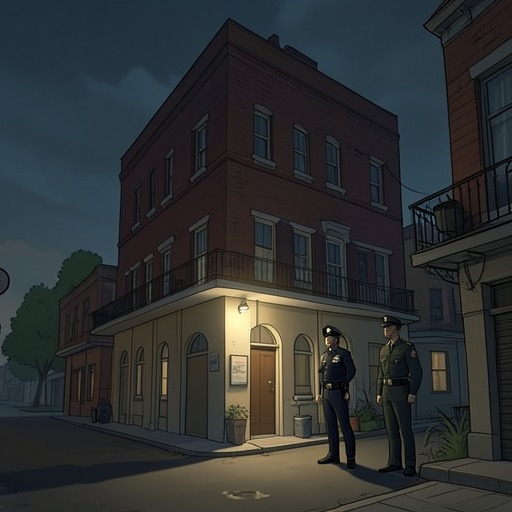
The constable recognizes the man because he previously worked at the Criminal Records Office and remembers the face. More strikingly, the suspect is wearing a Metropolitan Police Chief Inspector’s uniform. Keightley reports that the constable has contacted the office and asks whether the green-card information should be passed to Shoreditch; he also raises the possibility of an Interpol card and asks whether the department wants the man. The passage establishes the question and the stakes, but does not give the answer or the eventual outcome of the stop.
Appearance and Working Manner
When the narrator later meets Keightley in the hallway at Scotland Yard, his appearance seems out of place among the policemen: slick hair, a deeply lined, pale, freckled face, a white moustache, and heavy black spectacles with straight side bars. The glasses become part of his characteristic manner. Before showing or telling something, he pulls them halfway off, peers over them, and snaps them back into place; the narrator observes that his timing is consistently exact.
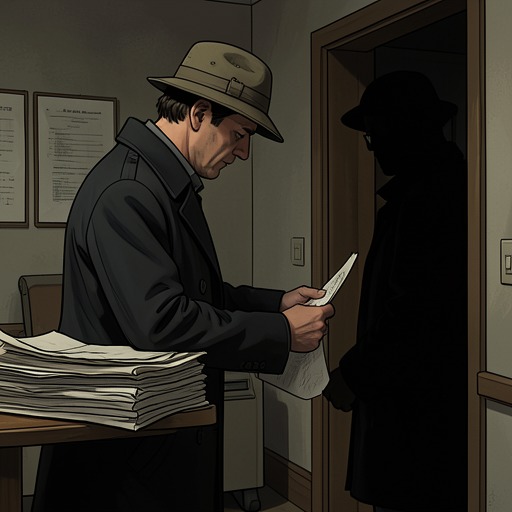
Keightley comes down to meet the narrator carrying a film tin about eight inches across. He rattles it heavily and leads the way to his cramped office, where papers, files, and maps crowd the floor space around the desk. The tin and his announcement that the journey has been worthwhile signal that he has something to present, though this scene does not specify its contents. His carefully managed gestures lend a small performance to otherwise routine office business.
Narrative Role
Keightley’s two appearances give institutional information a human channel. On the telephone, he translates a distinction between a clean criminal record and a priority suspicion file into a concrete lead: a man dressed as a senior police officer. At Scotland Yard, his physical manner and the film tin make the transfer of material into a face-to-face meeting. He is not shown conducting the wider investigation himself; his role is to pass on records and material at moments when they can redirect the narrator’s attention.