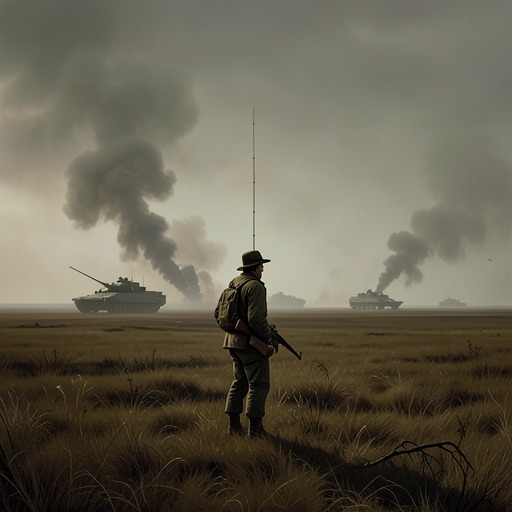
Laboratory Field
The IPCRESS FileLaboratory Field was the American military and scientific installation built across one island of Tokwe Atoll. Constructed in roughly ninety days, it combined the amenities of a self-contained settlement with a secret research site and heavily guarded test ground. Its scale made the island feel less like a temporary outpost than a purpose-built world, while its surveillance systems and nuclear work made clear how little of that world was open to scrutiny.
Setting and Construction
Tokwe Atoll consisted of about a hundred islands in the Pacific. From the air, its small green bays and reefs appeared amid wrecked landing craft, rusting tanks, tracked vehicles, ammunition boxes, and broken crates left along the shore since 1944. The newly made airstrip, Laboratory Field, had not existed ten weeks before the narrator's arrival. The landscape therefore held two military histories at once: the remains of wartime fighting and an immense new installation being assembled among them.
The complex covered the whole island. In ninety days, its builders had provided an airfield for piloted and nonpiloted aircraft, two athletic fields, two movie theatres, a chapel, a clothing store, a library, hobby shops, beach clubs, a maintenance hangar, a landing pier, a mess hall, a dispensary, a post office, a laundry, and a power plant. The infrastructure operated at a scale that made the settlement seem self-sufficient: its telephone exchange could handle more than 6,000 calls a day, one mess served 9,000 meals daily, and a radio station and island buses ran around the clock. The project even had ninety baseball teams divided among ten leagues.
Laboratories and Nuclear Testing
The narrator, Dalby, and Jean toured the project after arriving by helicopter from an aircraft carrier. Their plastic identification badges displayed their photographs and descriptions, and a large Q marked them as authorized to enter even secret laboratory areas. An army major led their initial tour, turning the site into a classroom as he explained the planned bomb's design.
The major described a fractional critical-mass weapon, in which high explosive compressed a small sphere of uranium-235 or plutonium so that less material could produce an explosion. He also outlined a different, still unachieved possibility: using a sufficiently powerful non-atomic trigger to initiate fusion without an ordinary fission trigger. At Tokwe, he said, the bomb used a Super Volt Micro Flash mechanism, or SUVOM. The external mechanism generated the voltage needed to trip the bomb and transmitted it through an umbilical cord; without an atomic trigger, the major claimed, the weapon would produce no fallout. He presented the proposed result as the first entirely clean bomb.
The briefing described a 50-megaton device and projected Type 2 destruction, with severe damage to metal and brick and all flammable material destroyed across a radius of thirty-five miles. The experiment was not merely theoretical: the narrator and the other visitors were taken to the island where the detonation was to occur. There, a 200-foot red-painted shot tower rose among photocells, photomultipliers, ion chambers, and other instruments, with warning notices at its base. The machinery and attendants occupied a sandy arena built to measure the test as well as conduct it.
Later, the American Brigadier disclosed that the activity surrounding the garden party had been connected to a secret experiment on the mountain. The narrator inferred that the Tokwe test involved a neutron device: a team had been brought into the explosion area to modify the bomb. This revelation qualified the earlier technical briefing. The account of the uranium-238 bomb and SUVOM trigger had been true, but it had not disclosed the last-minute insertion that changed what the experiment was intended to do.
Security and Surveillance
The test area was enclosed by a twenty-foot electric fence and guarded by white-helmeted police with dogs. A white amphibious jeep stood by the sole gate, fitted with a machine gun, and access badges identified personnel permitted inside. The shot tower's heat-blistered red girders, cables, and pipelines were thus part of a controlled environment in which movement and technical work were closely watched.
Monitoring extended beyond the fence. Infrared cameras on towers watched the roads and shipping channel; some towers were manned and others remotely controlled. Overlapping camera fields helped preserve coverage when one tower was connected to electric cables and its camera went out of action. The Brigadier showed the narrator processed film in which a car appeared as a moving shape on a distorted map of the island, followed by bands of intense horizontal interference when high-speed television transmission began. The system could transmit hundreds of television pictures per frame, making it possible to capture a moving event rather than rely on a still image.
Vehicles were also monitored directly. A compulsory radio device attached by magnets to a car could send conversations to a receiver up to three miles away and transmit the vehicle's direction and movement by compass signal. Jean drove a convertible; the narrator removed the device from its sunshield and hid it in a tissue box in a nearby car before they left the officers' mess. The act offered a temporary means of evading the island's routine tracking, but it did not make the larger surveillance network disappear. After the test, the authorities displayed the twisted remains of a high-speed television unit and photographs of fingerprints recovered from it. The narrator's prints were on the evidence, although he said he had never touched the equipment.
Narrative Significance
Laboratory Field brings the novel's technical exposition into physical space. Its orderly facilities, access badges, observation towers, compulsory vehicle monitors, and instrument-packed test island show security as an infrastructure woven through ordinary movement, not simply as guards at a perimeter. The site promises access to classified knowledge while dividing that knowledge by clearance and withholding the purpose of the most consequential operation.
That tension also shapes the nuclear project. The major's diagrams and numerical projections make the bomb legible as engineering, while the later disclosure of the neutron-device insertion reveals that the official explanation was incomplete at the point where it mattered most. Laboratory Field is therefore both the location of a scientific demonstration and a contested information environment: devices collect evidence, officials interpret it, and the narrator's fingerprints become incriminating even as he denies handling the unit. The island's immense material order cannot guarantee control over what its systems mean or who will be blamed for what they record.