Metropolitan Police
The IPCRESS FileThe Metropolitan Police is the novel’s most visible civilian law-enforcement institution, shown through its stations, investigators, forensic procedures, and cooperation with the narrator’s secret department. Its reach is substantial, but not seamless: the same force that can mobilize officers, conduct extensive searches, and examine long-held records fails to keep Housemartin alive in custody.
Police procedures and investigative reach
The force enters the investigation through the Criminal Records Office, whose staff recognize Housemartin when a constable encounters him wearing a Metropolitan Police Chief Inspector’s uniform. The constable had worked at the office and remembered Housemartin from a photograph; the recognition is described as an unusually fortunate break. The Criminal Records Office has a green card on him, marked for top priority, rather than the white card the caller expected. That distinction prompts a call to the narrator, who orders that Housemartin be held, searched, and watched continuously, with particular care taken over the possibility of a concealed poison. He also makes the station’s chief personally responsible for the prisoner’s safety and says he is setting out immediately.
The force’s investigative machinery is presented through a mix of routine checks and exceptional scope. After Housemartin’s death, the narrator asks for fingerprint and Identikit checks on the two men involved, while recognizing that Jay’s organization may have left no useful record. Elsewhere, Keightley reports on the examination of a house associated with the investigation. The usual fingerprint check reached back five years, but the inquiry searched the full eighteen-year collection because the matter involved murder or treason. Investigators also checked specialized collections, including scenes of crime, Indian seamen, men who had jumped ship, and sacrilege. Forensic tests found old bloodstains of Group O, a result Keightley cautions is not distinctive because a large share of the population has that blood group.
Housemartin’s custody and death
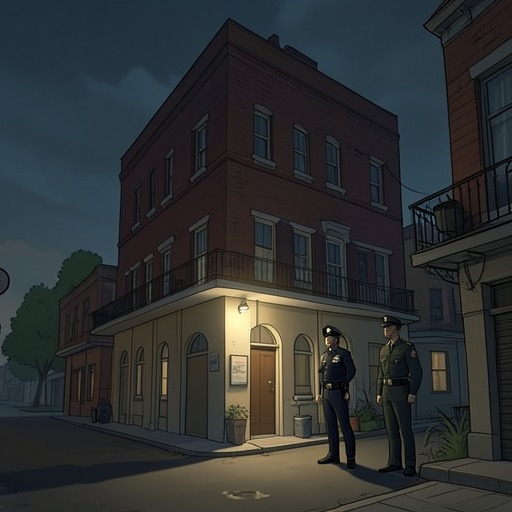
The episode at Shoreditch Police Station exposes the difference between an order and its successful execution. The narrator and Murray arrive in heavy rain and are initially assured that the arrangements are under control. The station’s sergeant explains that the additional people have arrived; when the narrator reaches the prisoner, Housemartin is already dead. The narrator identifies the body and sends for the constable who brought him in, asking for a full account of what happened. The promised watch has not prevented the killing, and the dead man is removed from the investigation as a living source of information. The passage does not explain how the killers gained access or establish which officers were responsible for the failure.
The response shifts quickly from securing the prisoner to organizing an investigation and a larger operation. Keightley, calling from the Criminal Records Office, reacts with alarm to the report of a murder inside a police station. The narrator then uses a private, preferably scrambled, telephone line to reach the information room and speak to Chief Inspector Banbury of CID. Although the two men know one another from earlier work, Banbury insists on completing the required checks. Their exchange shows that personal familiarity does not simply erase institutional procedure, even when the narrator is acting under the authority of WOOC(P).
Mobilization for the Acacia Drive operation
The police also become a force the narrator can assemble for the planned action at 42 Acacia Drive. He requests thirty officers, at least five armed, and four vehicles without police identification. When the garage cannot provide enough plain-finish vehicles, he directs Banbury to borrow private cars from officers and seek larger vehicles elsewhere. The plan includes a radio-linked car for briefings while the group is on the move, hook ladders, and a jemmy. He also orders a complete press blackout and insists that the radio operator be discreet. These preparations show a police organization capable of supplying personnel, transport, communications, and equipment, while the operation’s secrecy depends on limiting what the force’s own channels reveal.
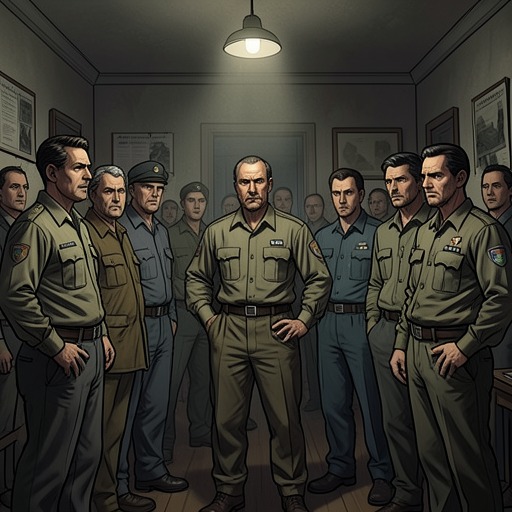
At the station, Murray has already studied a photograph of the street and drawn a deployment diagram showing the heights of garden walls and the positions for twenty-five men. He marks in five more officers with a pencil containing interchangeable colored leads, bringing the plan into line with the thirty-person force requested. The local sergeant and inspector defer to Murray’s arrangements, though the narrator notices that Murray’s apparent authority rests partly on how he presents himself. The narrator allows the policemen to accompany the operation but warns that any leak would be actionable under the Official Secrets Act. A military police vehicle arrives with a radio, and Murray explains that its presence also provides a revolver, ammunition, and other useful equipment. Civilian policing, secret-service authority, and military resources thus converge around one operation without becoming a single institution.
Institutional limits and narrative significance
The Metropolitan Police is neither portrayed as a self-contained answer to the case nor as merely a backdrop. Its Criminal Records Office supplies the fortuitous identification that brings Housemartin into custody; its investigators undertake unusually extensive record searches and forensic work; and its CID and local personnel contribute to the preparations at Acacia Drive. Those capacities are real within the story, but they operate alongside the narrator’s secret authority and the need to conceal the operation from the press and from unauthorized listeners.
The death at Shoreditch gives that institutional competence a sharp limit. Explicit instructions, a named officer’s accountability, and the station’s assurance that arrangements are controlled do not secure Housemartin’s survival. The force responds with further checks and investigation, but the immediate consequence is irreversible: a crucial prisoner is dead, and the narrator must proceed without the information he might have supplied. The police therefore embody both the practical reach of official procedure and its vulnerability when covert violence enters the spaces meant to contain it.