Murray
The IPCRESS FileMurray is introduced as a sergeant assigned to work with Carswell, an efficient assistant whose quiet competence steadily unsettles the narrator’s assumptions about him. At the crisis surrounding Dalby’s house, that ordinary-seeming identity falls away: Murray reveals that his name is Harriman and that he is a lieutenant-colonel in Special Field Intelligence. The reversal makes him more than a resourceful subordinate. He has been working for Ross within the IPCRESS affair, and his intervention helps turn the narrator’s dangerous approach to Dalby into an arrest and a wider roundup.
Identity and Work
Dalby seconded Carswell to work with the narrator and provided the pair with a small private office. Carswell received a temporary promotion to Major and a suit chosen to give him the appearance of an unemployed country officer; Murray, by contrast, remained known as a sergeant. The two worked diligently from nine in the morning until six in the evening, then returned to their wives. Their partnership joined Carswell’s statistical analysis to Murray’s practical contribution.
They examined patterns among groups Carswell called concens: people who concentrated at particular places. Some apparent common factors, including owning two cars, taking long holidays, and travelling to America or North Africa, could be explained by the groups’ similar ages, incomes, and education. Other patterns were harder to dismiss. The concens included an above-average number of people who had belonged to political or quasi-political organizations, nearly all with right-wing aims; they also included many bachelors, none who were left-handed, and a number with serious illnesses in the preceding five years. The findings were suggestive, not conclusive, and the narrator asked Carswell to describe both a concen and an S.1 from the figures. Murray thus appears first in work that depends on caution: a pattern can be real without yet proving what caused it.
Carswell later proposed that Murray handle the action, including telephone calls, and sought approval to describe him as being from the Metropolitan Police Special Branch. The request shows how the investigation’s statistical work was beginning to require operational reach, but it also reinforces the cover under which Murray was working. What looked like a useful police affiliation was not the full account of his position.
Methods and Character
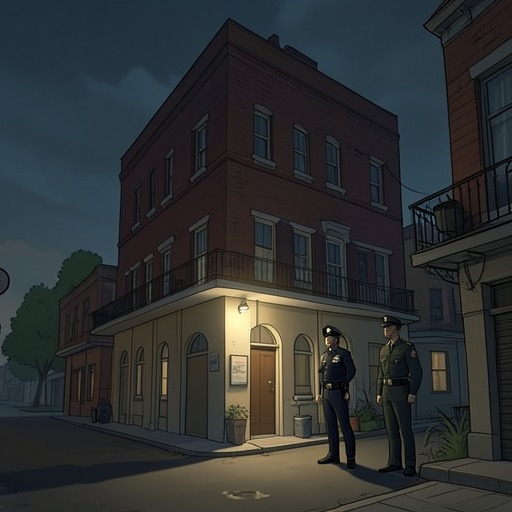
Murray’s practical ability is visible in the preparations for the raid on 42 Acacia Drive. He found a photograph of the street and drew a deployment diagram that recorded the garden-wall heights and placed twenty-five men. He had also, by means the narrator could not identify, led the inspector to defer to his suggestions. The police sergeant addressed Murray with conspicuous respect, while Murray used a propelling pencil with interchangeable coloured leads to add five more men to the plan. His attention extended beyond the map: he arranged for a military police vehicle to enter the courtyard rather than park conspicuously, and thought its radio might be useful for reaching the Scotland Yard wavelength. He also recognized that a Provost vehicle brought a revolver, ammunition, and other useful equipment. The narrator, surprised by this initiative, decided to recheck Murray’s security clearance.
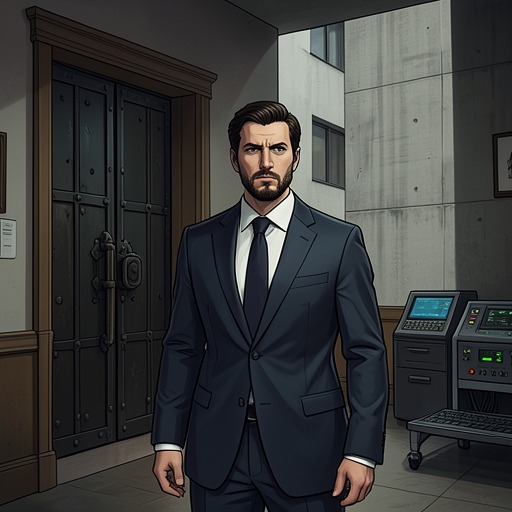
The narrator’s private conversations with Murray disclose a less official aspect of him. Murray was tall and powerfully built, with a broad, square, bony face, tightly arranged hair, and narrow eyes that could crease into a smile. The narrator contrasts that smile with Chico’s: Murray’s did not seem an invitation to fellowship, but a deliberate way of keeping apart. He discussed Bertolt Brecht and the 1937 Firearms Act, and carried a paperback edition of Kierkegaard in his pocket. His intelligence and interests sit awkwardly beside the conventions of the peacetime army, which he disliked. He described its social habits as a world where sergeants tried to speak like officers and officers like gentlemen, while mess conversation revolved around cinema-going and house parties by the river. The mismatch helps explain why the narrator’s simple picture of a sergeant never quite fits.
The Concealed Assignment
Murray’s real function becomes clear when the narrator reaches Dalby’s house. Infra-red detectors alert the household to the approach, and Murray comes out of the darkness, restrains the narrator, and warns him that he has been walking across the alarms. He tells the narrator to keep quiet and leads him away from the house. The encounter initially looks like another obstruction; the familiar formal address of sir even recalls Dalby’s earlier use of the same courtesy while injecting Raven. The narrator suspects that Murray may be helping the people inside, and tries to compel him to obey by invoking the Treason Act and claiming that five Provost platoons are waiting nearby.
Murray answers with the hidden identity: his name is Harriman, and he is a lieutenant-colonel in Special Field Intelligence. He says that the narrator is temporarily subject to his orders and must leave; despite apologizing for what the narrator has endured, he warns that they are not yet safe and that taking Dalby will not be enough. Before he can explain further, Waterman strikes him with a spanner. The narrator and Waterman drag the unconscious Murray into taller flowers and escape, leaving the question of what Dalby’s group will do unresolved. When Dalby’s large car later leaves the drive for London, Murray remains hidden nearby. The scene reveals not a simple change of allegiance, but the collision of two operations whose purposes the narrator has not yet understood.
Ross, Dalby, and the Arrests
After the narrator returns to Charlotte Street, he learns how Murray’s intervention fitted Ross’s plan. Ross had partly guessed what was happening when he transferred the narrator to WOOC(P), and placed Murray to spy out the situation. Once the narrator appeared close to discovering the conspiracy, Murray was concerned that he would act too quickly and jeopardize the operation. He contacted Ross; after speaking to him, Murray went back into the house and arrested Dalby. The narrator later reports that Murray had arrested Dalby shortly after being hit on the head, a detail that confirms his return to the operation after Waterman’s blow.
The arrests quickly widen. At 3:30 in the morning, the planned detention space at Carshalton was full, so Ross arranged an alternative location to keep detainees separated. At 8:09, Murray phoned from Liphook to report that he was holding Swainson, whose real identity was K.K.; the narrator sent a car. Jean later clarifies that the man first described as Chinese was actually Lithuanian. Murray’s call links the clandestine operation at Dalby’s house to the effort to identify and detain people connected with the network.
Murray’s relationship to Ross is therefore specific but not absolute. The narrator tells Jean that Murray was not normally Ross’s man, but had been assigned to him for the IPCRESS business. That distinction explains why Murray could appear to serve one chain of authority while secretly reporting to another, and why his conduct at the house initially seemed so difficult to read. His work depended on keeping both his purpose and his rank concealed until the moment they could be used.
Narrative Role and Significance
Murray’s character is built around a delayed correction of the narrator’s judgment. His apparent rank, his place beside Carswell, and his practical help with police preparations make him look like a capable but subordinate official. The narrator notices that something does not add up, especially after the Provost vehicle arrives, yet even that suspicion does not reveal the scale of Murray’s concealed authority. The disclosure at Dalby’s house retrospectively changes the meaning of his earlier efficiency: the man who drew deployment plans and considered radio access was also an intelligence officer positioned to observe the conspiracy from within.
His importance lies not only in the reveal but in the double nature of his intervention. He restrains the narrator, preventing a premature move against a protected house, and then returns to arrest Dalby after consulting Ross. In a story where apparent loyalties are unreliable, Murray is both an obstacle and an ally, depending on what the narrator knows at that moment. His concealed identity makes that uncertainty operational rather than merely personal: a mistaken reading could have compromised the investigation, while Murray’s restraint and subsequent action help bring the network within reach.