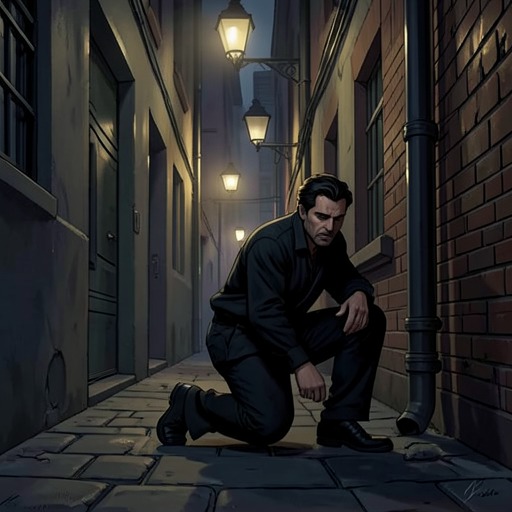
Narrator Tracks Jay and Uncovers Dalby’s Meeting
The IPCRESS FileNarrator Tracks Jay and Uncovers Dalby’s Meeting follows the unnamed narrator’s effort to verify suspicions about Dalby and Jay after a period of imprisonment. A return to Dalby’s home turns a guarded personal visit into covert surveillance: the narrator sees Jay in the same room as the head of the department, while K.K. is also present. The discovery overturns the narrator’s earlier belief that he and Dalby were approaching the same conclusion from opposite directions, but the scene offers no simple resolution. A second encounter with Murray and Waterman forces the narrator to abandon an immediate attempt to confront the gathering and follow Dalby’s car toward London instead.
Background and Return to Dalby
The narrator arrives at Dalby’s house at 6:59 in the evening, in darkness and rain. Waterman has followed him there in a black Ford Anglia with a roof-mounted spotlight, then parks across the road while the narrator backs off the roadway into the small drive. The narrator leaves his own car unlocked, with its keys beneath the seat, and listens to the seven o’clock news before going up the path. He is waiting for news of Charlie, but the bulletin contains no mention of him. That absence helps explain the urgency and uncertainty with which the narrator proceeds, although he has no immediate information about Charlie’s whereabouts.
Dalby’s home is familiar to the narrator from a previous daytime visit, but the darkness changes the circumstances of this return. The small converted farmhouse stands well back from the road; a flower-filled wheelbarrow sits by its mauve front door, beside an electric coach lamp that is not lit. Dalby answers and attempts to appear surprised. The apparently domestic welcome soon becomes an obstacle to the narrator’s plan: Dalby offers him sherry, then has cold ham brought in, leaving the narrator eating and drinking while recognizing that he has lost control of the encounter. Dalby’s easy hospitality contrasts with the narrator’s concern that he might be given time to think or make a telephone call.
What Dalby Reveals
The narrator tells Dalby that he has been incarcerated. Dalby indicates that he already knows, then identifies Jay as the person responsible for trying to sell the narrator back to them. His explanation reframes the narrator’s imprisonment as part of a transaction involving Jay, rather than an isolated ordeal. When the narrator asks why Jay was not seized, Dalby says Jay is difficult to catch and that they did not want to risk the narrator being killed. Dalby’s casual vocabulary for that danger is another sign of the gap between his relaxed manner and the stakes he describes.
The exchange does not settle the narrator’s doubts about Dalby. Later, during his nighttime observation, the narrator recalls that Dalby had once described the two of them as moving toward the same conclusion from opposite directions. Seeing Jay in Dalby’s company makes that confidence seem misplaced. The narrator’s own explanation of his task is that he had been sent to verify information about Dalby; he now interprets the meeting as evidence that Dalby may have betrayed his side or may have been a double agent for years. Those remain the narrator’s suspicions, not a confirmed account of Dalby’s history.
The Meeting in the Lit Room
On returning after dark, the narrator approaches the house without lights and walks across the garden toward the room where he had spoken with Dalby. Gaps in the curtains cast light over the flower beds. Through the window he sees Dalby pouring a drink while Murray sits on the sofa listening. A third person, initially outside the narrator’s view, crosses to the drinks cabinet. From only a few feet away, the narrator recognizes K.K., whose face he has seen repeatedly during screenings. He connects K.K. with Waterman’s earlier description of a man known as his Chinese contact.
Then Jay enters the narrator’s view. The recognition is decisive: after encountering Jay in places including a club, on the street, and at theatre clubs, the narrator now sees him speaking with Dalby. He remembers having seen two men from a restaurant window and concludes that they must have been Jay and Dalby. The juxtaposition of Dalby, K.K., and Jay concentrates several previously separate strands of suspicion into one witnessed gathering. It also overturns Dalby’s earlier suggestion that their investigations were converging. The narrator is so surprised that he remains fixed outside the window, watching rather than acting.
Interruption and Retreat
Waterman has followed the narrator up the path. As they move away from the lit room, Murray intercepts the narrator and warns him that he has been walking over infrared alarms. The narrator tries to assert authority, telling Murray that the people in the house could be prosecuted under the Treason Act and claiming to have five provost platoons in Haslemere. He urges Murray to follow his orders and help assemble the evidence. The claim is a bluff: the narrator admits that his invention is faltering, even as he tries to turn his suspicion into a show of command.
Murray answers that his name is Harriman and that he is a lieutenant-colonel in Special Field Intelligence. He says that the narrator must temporarily obey his orders and warns that removing Dalby is not enough to resolve the danger. The revelation changes the narrator’s reading of Murray, whom he had known as a sergeant, and leaves their respective positions uncertain. Murray tells him to get away from the house. Waterman strikes Murray with a spanner, and the narrator decides that escape is now the necessary course. He and Waterman move Murray’s unconscious body into taller flowers. Waterman repeatedly asks whether he acted correctly; the narrator reassures him, though the circumstances make reassurance difficult.
They wait in Waterman’s car. Within ten minutes, the front door opens and headlights come on. A large Rolls-Royce descends the drive, its lights passing over Murray’s concealed body. Dalby goes back inside, while the car turns onto the road toward London. The narrator orders Waterman to catch up with it because he wants to see the driver. The action therefore ends not with a confrontation or an arrest, but with a new pursuit. Its central reversal is the narrator’s transition from seeking an explanation directly from Dalby to watching him secretly—and then having to follow the evidence beyond the house.