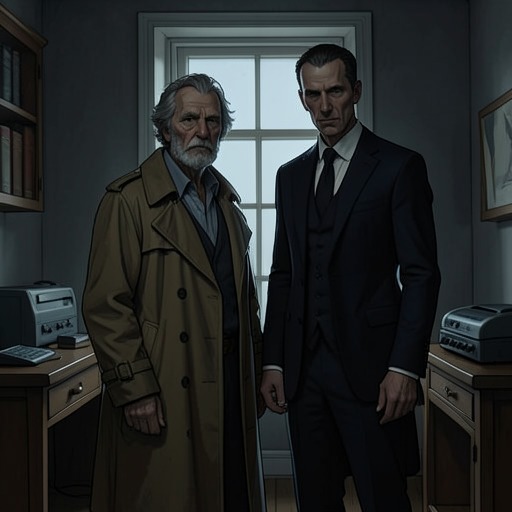
Narrator and Barney Barnes: old friendship
The IPCRESS FileThe relationship between the Unnamed narrator and Barney Barnes turns an old friendship into a fragile test of judgment under surveillance. Their history is first presented as easy familiarity, then revealed to be something Barney must conceal behind fabricated memories. When they meet again on the shot tower, he risks his position to warn the Unnamed narrator that others suspect him of betrayal. The warning makes friendship consequential: Barney’s trust gives the Unnamed narrator a chance to understand the danger, but cannot protect either man from the machinery of suspicion around them.
An Old Friendship Recast as a Cover
At the restaurant, Barney recognizes the Unnamed narrator across the crowded room and responds with a broad smile. He speaks quickly to the blonde beside him, who nods, and the Unnamed narrator suspects that Barney is establishing a plausible explanation for their conversation: that the visitor is his assistant and they have been working late. The exchange shows that their reunion cannot be treated as an ordinary meeting between friends. Even a familiar greeting has to fit the surroundings and withstand the attention of other people.
The Unnamed narrator’s feeling for Barney is deeper than his outward manner suggests. He admits that it is difficult for him to say kind things to people he genuinely likes, and makes clear that Barney is one of those people. This reserve gives their friendship a restrained quality: affection is present, but it is not expressed through an open declaration. Instead, the scene lets recognition, remembered habits, and the narrator’s private appraisal carry its emotional weight.
Barney then invokes a supposed mutual acquaintance, Nat Goodrich, and recalls an old song the Unnamed narrator supposedly sang when drunk. He follows this with invented recollections of spending money together in a Toronto bar and drinking a potent mixture of vodka and Benedictine. The narrator recognizes the claims as false: he had never been to Toronto with Barney, does not know Nat, and doubts Barney knows anyone by that name. The apparent reminiscence therefore does not establish shared history; it performs familiarity. The detail of the remembered song, with its image of climbing alone, gives the performance a pointed echo of the isolation their work imposes, even as the fabricated nature of the memory makes the moment unsettling.
Recognition Under Suspicion
The later meeting takes place at the summit of the shot tower, which is commonly called the mountain. The Unnamed narrator finds Barney waiting there in master sergeant’s stripes, dressed in white coveralls and holding a silenced pistol. Its direction makes clear that recognition alone is not enough: Barney needs to decide whether the old friend standing before him is still someone he can trust. He tells the Unnamed narrator that they once knew each other well, but that people change, and asks whether he has changed. The question makes their shared past an uncertain measure rather than a guarantee.
The Unnamed narrator answers that he probably has changed, then reflects on the unsettling possibility that lifelong friends can become people they once despised, prompting suspicion of one’s own transformation. Barney’s challenge and the narrator’s response meet at the same uncertainty. Neither can rely on the person the other used to be; their renewed connection depends on making a judgment in the present, with very little time and serious consequences attached to getting it wrong.
A Warning That Risks Barney’s Position
Barney explains why the Unnamed narrator is in danger: the intelligence service’s people believe he has walked away, and he is being watched and treated as compromised. The narrator’s apparent predicament is not simply a private disagreement between friends. Barney indicates that the suspicion reaches into the systems and personnel surrounding them, while a woman is assigned to remain close to him. He says that speaking to the Unnamed narrator at all risks leading him toward serious trouble, and that others must not know he has made contact.
Yet Barney does not accept the accusation without question. He allows for the possibility that the Unnamed narrator may not understand what is approaching him, and says that mistakes become difficult to correct once it is too late. He is willing to make his own assessment of character, though he acknowledges that doing so is a risk. The relationship thus becomes an alternative, personal form of judgment within an environment that has already classified the narrator as suspect. Barney does not claim certainty; what he offers is a chance that the official suspicion may be wrong.
His help is practical as well as personal. Barney has arranged for his sergeant to impersonate him on a generator truck, exploiting the fact that observers are unlikely to distinguish the two men. The substitution gives Barney a brief opportunity to meet the Unnamed narrator without drawing the attention he fears. When the narrator asks for the pistol, Barney cautions that it will not enable him to shoot his way out of the installation and advises him to talk his way onto a fast plane. Their exchange holds two forms of help in tension: the weapon is a tangible offer, but Barney’s assessment is that survival depends on escape and persuasion, not a gunfight.
Loss Before the Friendship Can Be Restored
The relationship’s renewed trust is abruptly broken by the report of an accident. A generator truck has gone off the road at Bloody Angle, and its officer is Barney. The young soldier delivering the news is visibly awkward, and the Unnamed narrator accepts his condolences. The later sight of the dark road and Dalby waiting by a car does not make the death easier to absorb: the narrator tells himself it must be a mistake, taking in the fact piecemeal even as he follows Dalby away from the scene.
Barney’s death gives his warning a finality it did not have when he spoke at the summit. He had risked contact because he believed the Unnamed narrator deserved an individual judgment rather than an automatic verdict of betrayal. The narrator’s grief confirms that Barney was not merely a useful source or a former colleague: he was a friend whose character mattered to him. With Barney gone, the protection and trust he had offered cannot be renewed or clarified. The relationship ends not in reconciliation or a settled account of their past, but in a warning received just before the person who gave it is lost.
Narrative Significance
The scenes make the contrast between performed familiarity and genuine loyalty central to the relationship. At the restaurant, Barney invents shared memories to make the meeting look ordinary; on the tower, he speaks plainly about the danger of being seen with the Unnamed narrator. What first appears to be cheerful reminiscence is therefore set against the grave risk of their later encounter. Their friendship survives neither through easy openness nor unquestioned allegiance, but through Barney’s willingness to judge the man before him despite the consequences.
The mountain setting sharpens that change. The shot tower is the focus of the island’s enormous military undertaking, and Barney waits at its summit with a weapon while the Unnamed narrator stands exposed to the suspicion surrounding him. Their private exchange takes place inside a system built around observation, security, and the possibility of betrayal. Barney’s decision to trust the Unnamed narrator for a little while cannot dismantle that system; his death soon demonstrates how little control either friend has over the dangers around them. It does, however, give the Unnamed narrator one last reason to distinguish friendship from the verdict imposed upon him.