Narrator's forced brainwashing and imprisonment
The IPCRESS FileThe narrator’s forced brainwashing and imprisonment turn ordinary routines into instruments of control: food depends on obedience, sleep is restricted, and even the colors of familiar things become unstable under K.K.’s instruction. Held in a small room at a house in Wood Green without initially knowing where he is, the narrator gradually recognizes the danger of remaining there. He escapes before the process can reach its intended breaking point, then later describes its methods to Jay and Jean as part of the exposure of the operation.
Confinement and disorientation
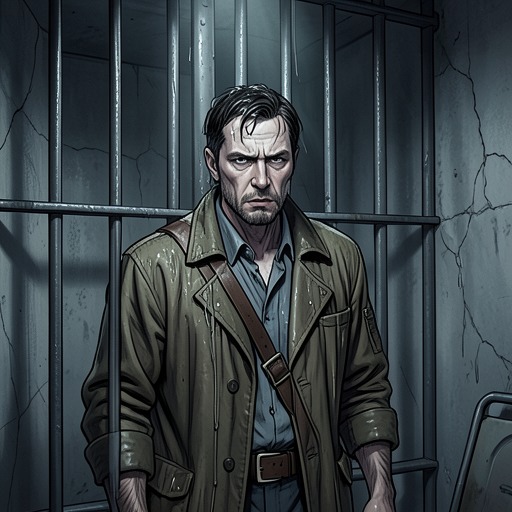
The sequence begins after a medic examines the narrator and prepares an injection. The next sustained account finds him in a confined room, struggling to focus and sleeping for long stretches. Meals consist of a porridge-like food brought by the same short-haired man in a grey tracksuit. The room has no furniture, and the narrator’s first reliable measure of time is the routine of meals and the door opening.
K.K. enters without food and begins a lesson in short statements about colors and textures. The narrator initially refuses to cooperate, but K.K.’s repeated instruction and control over meals make repetition a condition of eating. The exercise is not a stable lesson: the colors assigned to objects can change, and a previously learned response can become wrong. When the narrator gives an incorrect combination, he loses food and his thin blanket. As his strength declines, he moves from jokes and questions to trying to provide the answer K.K. expects. On the day he succeeds well enough to receive a piece of cold meat, he sobs, an involuntary response to relief and exhaustion rather than sadness.
The room’s rules extend beyond the lessons. The narrator marks the passing days with his fingernails on the wooden door, placing the marks where the peephole will not reveal them. Some double marks record nights when he hears sounds from elsewhere in the building that he cannot confidently classify. K.K. also supplies typed instructions governing such things as how the prisoner must sleep. On one occasion, K.K. offers him a cigarette and asks why he smokes; the following day, a deliberately altered color lesson ends in renewed punishment. Small gestures and arbitrary changes keep the narrator uncertain about what will earn relief.
Visitors, routines, and the decision to escape
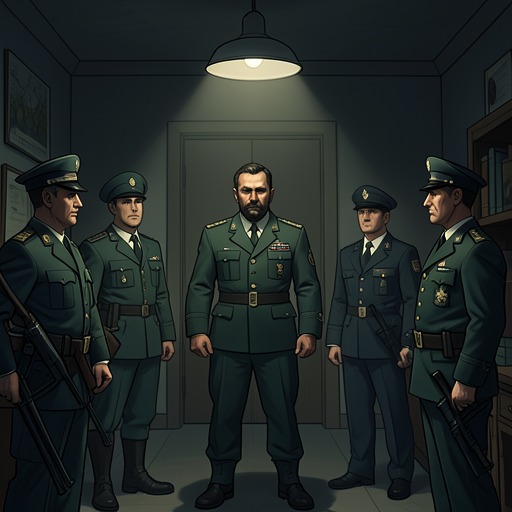
After twenty-five days, K.K. permits a visitor for six minutes. A young Hungarian Army captain enters and speaks English; the narrator understands that he has sought a meeting with the British ambassador. Later, the captain returns every third day and appears to be acting as defence counsel. He reads the indictment in Hungarian and translates selected accusations, including allegations of treason and conspiracy against the state. The narrator cannot assess the proceedings fully from the fragments he understands, and K.K. can still silence him by force.
The old moustachioed guard provides a limited exception to the routine. When the narrator has failed K.K.’s lessons, the guard may be ordered to keep him awake, but he sometimes allows him to lean against the wall and rest while listening for K.K.’s return. He shows photographs of his family and indicates the heights of his four children. This small accommodation gives the narrator brief opportunities to sleep, but it does not change the conditions of confinement. By the thirty-fourth day marked on the door, the narrator describes himself as physically and mentally depleted and recognizes that a direct assault on the main gates is not a realistic option.
He decides that escape must depend on timing and the objects available in the room. The door is the only usable means he can identify, and the guard’s customary kindness therefore becomes entangled with his plan. On an initial attempt, the guard does not come close enough, and the narrator does nothing. A couple of nights later, after the guard brings him a cigarette, the narrator uses the door to render him unconscious and pulls him inside. He hesitates at the point of striking again, recognizing that the man is old and that his own training is nearly giving way. The episode presents escape not as a clean action sequence but as a decision made under exhaustion, with the guard’s humane gestures making the necessary violence harder to carry out.
Escape before the prison becomes the whole world
The narrator later stresses that he did not know from the beginning that the house was in London’s Wood Green. He had only a partial suspicion; prolonged hunger, isolation, and fixation on K.K. steadily eroded his confidence in what lay beyond the room. He believes that another ten days might have made the possibility of England itself difficult for him to comprehend. That narrowing sense of reality explains the urgency of his escape: he acts while he can still imagine a world outside the cell.
Once out of the house, he reaches Mr Keating’s home and gives an account of having fled a fight with a drunken, larger brother-in-law after a neighbor called the police. The episode marks a change in his circumstances, but his later explanation makes clear that getting outside the building was only one part of escaping the system. The captors’ methods were designed to make prisoners believe they might be far from England, so that reaching the street would not necessarily restore a reliable understanding of where they were or what had happened to them.
The method as the narrator later explains it
When he later raises the Wood Green facility with Jay, the narrator identifies it as a place of brainwashing rather than an ordinary prison. He explains to Jean that the so-called haunted house system relied on mental isolation. The operators used false ambassadors to persuade prisoners that they were alone; they had also tried false policemen, but, as the narrator explains, that approach was abandoned after the mistaken capture of a man at Shoreditch. Civilian disguises were safer. At Wood Green, heating and cooling could be adjusted, while lights could be switched to create an artificially short day or an extended night. These controls were intended to unsettle the prisoner’s sense of time and balance, especially when physical weakness had already reduced his resistance.
The narrator describes an initial stage of severing connections, followed by isolation, fatigue, uncertainty, and anxiety about which responses would be rewarded. He says that humor is dangerous to the technique because it can interrupt the uncertainty on which the process depends. He connects the Wood Green procedures with the treatment he experienced after his arrest on Tokwe, noting that the two shared basic characteristics. His account is a retrospective explanation of methods he says he had enough information to recognize; it does not establish that he knew the complete plan while he was confined.
He also sets out what he believes would have followed had he remained at Wood Green. The next stage would probably have required memorizing long passages of dialect. More broadly, the process sought to identify a subject’s weaknesses, preferably with the subject discovering them through self-criticism. The final phase, which the narrator calls Abreaction, would use the information already gathered through intense mental work, indoctrination, meetings, overwork, and stress. He describes it as a point of no return and associates it with a complete nervous collapse. Because he escaped, the account distinguishes the techniques begun against him from the later stage he says he would likely have faced.
Significance of the captivity
The confinement works by making the ordinary unreliable. A meal becomes a reward for repeating lessons; a cigarette can precede a changed test; sleep is governed by rules and by the unpredictable schedule of guards. The narrator’s handmade calendar and his incomplete knowledge of his location register the contest between his effort to maintain an independent account of time and the facility’s power to distort it. His escape matters because it interrupts that contest before isolation can become the prisoner’s only imaginable reality.
The later conversation with Jay and Jean gives the ordeal a second function in the story: it makes the narrator a witness able to explain how the system operates. His account links the personal details of his confinement to a deliberate method of control, while retaining a distinction between what he directly endured and what he infers about the stages he avoided. The escape is therefore both a physical break from the house and a limit placed on the process: the captors had begun to shape his responses, but had not completed the transformation he describes as their objective.