Need-to-know compartmentalization
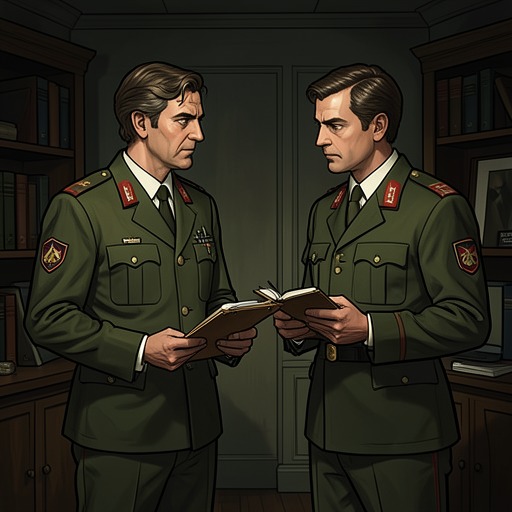
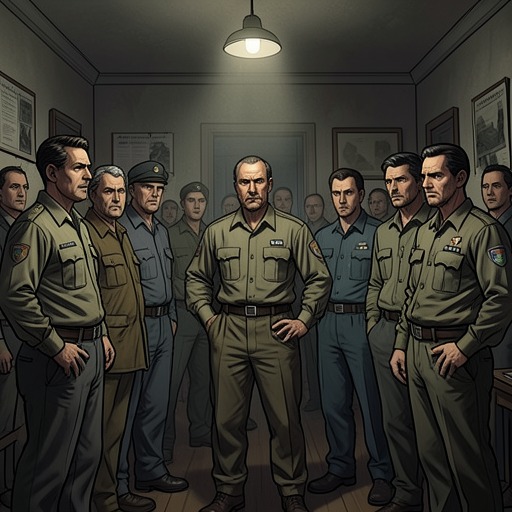
The IPCRESS FileNeed-to-know compartmentalization governs the book’s intelligence work by separating access to information from the larger picture that investigators hope to assemble. It can protect a source or operation, but it also leaves people acting on partial accounts: the same divisions that preserve secrecy make it difficult to recognize how separate clues, agencies, and loyalties connect.
Coded Channels and Operational Secrecy
The Unnamed narrator reaches Dalby through Ghost, the section’s emergency route into the special government telephone exchange. The connection is protected by an eighty-second false unobtainable signal and a weekly code word; once connected, the Unnamed narrator reports the situation without going into details. Dalby responds that the Unnamed narrator will be working with him the following week and orders a change of papers. The exchange shows secrecy operating at the level of routine procedure: identity, access, and the amount communicated are managed together.
The Raven disappearance is likewise kept under a security blackout. Dalby nevertheless lays five passport photographs on his desk and tells the Unnamed narrator that the British Home Office has requested no help. He sees an opportunity in finding Raven: the case might weaken the British Home Office’s intelligence department and allow its files to be added to his own section’s holdings. The episode makes the institutional stakes of restricted information explicit. A blackout protects an inquiry from public exposure, while control of the resulting files is also a source of departmental advantage.
Briefings and Restricted Knowledge
The American investigation into scientific leaks demonstrates that access can be rationed even among cooperating allies. Skip Henderson explains that material received from the East Wing suite is appearing verbatim in files overseas, and that the loss spans an exceptionally broad range of scientific subjects. During the discussion, the Unnamed narrator recognizes that Dolobowski has authority over Skip and is present to ensure that the visitors leave with only the permitted amount of information. The briefing is therefore not simply an exchange between colleagues: someone is monitoring its boundaries as it happens.
Those boundaries shape what the visitors disclose in return. The Unnamed narrator and Jean fence off questions about leaks in the United Kingdom, giving the Americans the impression that they do not know what is happening. The restraint is deliberate and reciprocal: one side limits what it reveals about the scale and reach of the leak, while the other conceals its own knowledge. The Unnamed narrator leaves without a complete account, and Skip is due to return to the United States the next day. The scene shows compartmentalization as both protection and performance, with cooperation proceeding through carefully controlled partial knowledge.
Files, Analysis, and Informal Networks
Compartmentalization also affects how information is found. After the Burgess and Maclean affair, Carswell’s department analyzes missing-person statistics in conjunction with the missing persons registry. Rather than begin with a suspected target, Carswell processes the figures and looks for patterns, eventually comparing combinations among top-grade security clearances. This method crosses the boundaries of individual occupations and locations, allowing a pattern to emerge from material that had not been gathered for that specific purpose.
The formal sharing system has its own limits and competing channels. C-SICH distributes information available in Great Britain to appropriate branches, and large commercial concerns with industrial espionage teams are required to submit monthly reports. One such report helps establish that Jay is not receiving regular payments from the Russian Government, although his income is described as large, irregular, and drawn from diverse sources. The file provides a particular conclusion, not a complete account of Jay’s finances; the distinction between what the system can establish and what remains outside its view is central to the inquiry.
Alongside official channels, the Unnamed narrator describes agents as maintaining several sets of friends across borders and occupations. Such relationships work through implied messages and sensitivity to euphemism rather than a formal arrangement. Two cables illustrate the difference: one warns the Unnamed narrator of impending danger and points toward money held in a Swiss account, while another, sent by Charlie Cavendish, carries a separate message. These personal connections can move information where official channels do not, but their indirectness also means that understanding depends on recognizing the sender, cover names, and context.
Protection, Blind Spots, and Exposure
The concealment of Carswell shows how restricting knowledge can protect a person while obstructing an investigation. Ross has Carswell hidden because he fears for Carswell’s safety. As a result, the Unnamed narrator cannot find evidence of his existence through Charlie at C-SICH. Later, the Unnamed narrator explains that Carswell’s statistical work had begun to expose the broader plot and might provide the only guide to the extent of IPCRESS. The same secrecy that shields a vulnerable analyst therefore deprives another investigator of a route to crucial evidence.
The system’s divisions do not prevent its boundaries from being crossed. While watching Dalby’s house, the Unnamed narrator sees K.K. with Dalby and then sees Jay enter the room. Jay’s presence alongside the head of the department overturns the Unnamed narrator’s expectation that the two men are approaching a shared conclusion from opposing sides. The discovery is powerful precisely because the available pieces had appeared separated: surveillance, prior encounters, and departmental relationships suddenly occupy the same scene.
Operational secrecy can be strict at the level of a single action. For the raid on 42 Acacia Drive, the Unnamed narrator tells the police that the operation is under a complete blackout and that any leak could be actionable under the Official Secrets Act confidentiality obligation. Elsewhere, when Keightley reports that a man dressed as a Metropolitan Police chief inspector has been brought in, the Unnamed narrator orders that he be held, searched, and kept under constant observation, with responsibility for his safety assigned to the local chief. These instructions show controlled access and custody working as immediate safeguards. Across the investigation, however, secrecy also creates blind spots: files remain incomplete, sources disappear from view, and the truth emerges when supposedly separate compartments unexpectedly meet.