Official Secrets Act confidentiality obligation
The IPCRESS FileThe Official Secrets Act confidentiality obligation is presented as a continuing legal duty attached to the narrator’s service, surviving his discharge from the Army. Its clearest practical expression comes during a secret police operation: the narrator warns that any leak would be actionable under the Act. The rule thus reaches beyond the handling of files; it also protects the secrecy of operations whose exposure could compromise an investigation.
Scope and duration
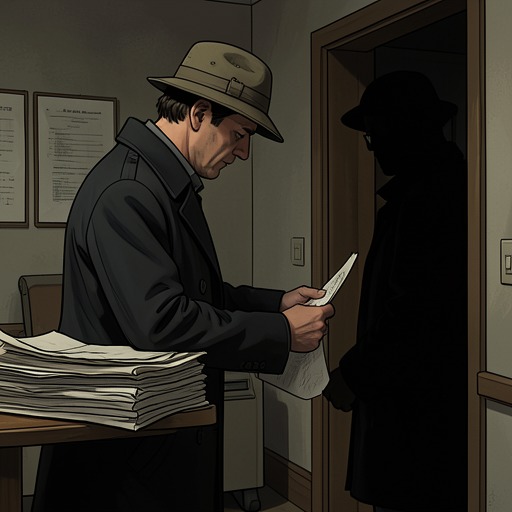
A letter from the War Office confirms the narrator’s discharge and says he has no reserve-training commitments, but remains subject to the Official Secrets Act in respect of information and documents. The contrast is precise: military obligations have ended, while the duty of secrecy has not. The letter places that obligation among ordinary post-service administration, alongside household mail and routine notices, rather than presenting it as an exceptional measure triggered by a particular case.
The stated scope covers both information and documents. That formulation matters in a world where intelligence moves through files, photographs, coded calls and reports. The novel does not supply a detailed account of statutory procedure or penalties; it establishes the duty through the War Office notice and later shows the narrator invoking its consequences in an operational setting.
Secrecy in police operations
During preparations to raid 42 Acacia Drive, the narrator has imposed a complete blackout. He tells the assembled policemen that they may accompany the team, but warns that any leak would be actionable under the Act. The warning turns a broad, continuing obligation into an immediate constraint on everyone involved in the operation. Police participation is permitted, but disclosure is not treated as an informal breach of confidence: it carries the prospect of legal action.
The raid is organized with practical care. Murray has studied a photograph of the street, diagrammed the garden-wall heights and planned the deployment of twenty-five men; he then marks five additional men onto the plan. A military police vehicle arrives with radio equipment, and Murray sees further value in its access to a revolver and ammunition. Against this detailed preparation, the blackout controls what may leave the operation. The Act’s explicit function in the scene is to deter leakage, not to explain the tactical plan or authorize the search.
A wider culture of compartmentalization
The Act operates within an intelligence system already shaped by restricted channels and controlled access. The narrator reaches Dalby through Ghost, a secret section of a special Government telephone exchange, and must give the week’s code-words before being connected. Dalby asks him to change his papers and tells him that they will work together on a potentially difficult job. These procedures are not identified as requirements of the Act, but they show the surrounding culture of secrecy in which the statutory duty takes effect.
That culture responds to real security fears. Dalby reports that the Home Office is alarmed by the disappearance of senior biochemists, and that another man vanished on his way to work. Raven’s disappearance is under a security blackout; Dalby has nevertheless laid five photographs on his desk and counts eight top-rank disappearances in six and a half weeks. Elsewhere, Skip describes material recovered from a United States intelligence room as verbatim information already entering American files: discoveries in laboratories are reaching the other side of the world. These disclosures establish the stakes of protecting sensitive information, while also showing that official secrecy does not itself prevent leaks or resolve the underlying intelligence crisis.
Legal duty and the limits of formal protection
The novel distinguishes the obligation to keep information secret from the question of what protection a person receives from the state. The narrator is later shown a deportation order signed by the Secretary of State and told that he is being sent to Hungary in an exchange for two airmen. In a separate encounter, a man presented as a British official says that there is no record of the narrator being a British citizen, though he concedes that the narrator sounds English. These episodes do not describe enforcement of the Official Secrets Act. Their relevance is the contrast they create: formal state documents can impose duties and direct a person’s fate, while the person’s own status and safeguards remain uncertain.
The Act therefore stands as one part of a broader machinery of secrecy, rather than a complete account of how that machinery works. Its clearest stated rule is narrow and durable: the narrator remains bound to protect information and documents after discharge. The blackout at 42 Acacia Drive shows how that rule can be brought to bear on an operation; the secret exchanges, controlled files and disputed personal status around it reveal the larger world in which confidentiality and state power overlap.