Shot Island
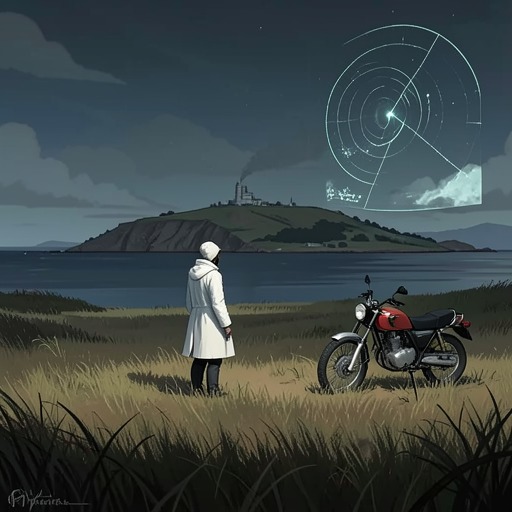
The IPCRESS FileShot Island is the guarded island setting for the Tokwe nuclear project, centered on a 200-foot shot tower that gives the surrounding landscape its operational purpose and its local name, the mountain. The island’s elaborate security and instrumentation make it a working test site, but also a place where the narrator discovers that ostensibly secret scientific work is being transmitted beyond its walls.
Setting and facilities
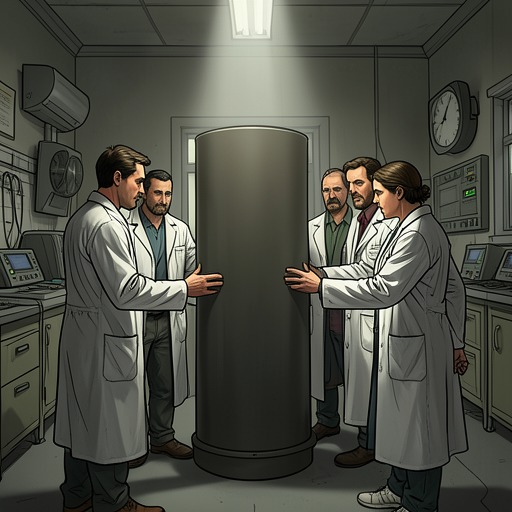
Shot Island lies within the Tokwe atoll. The wider installation, Laboratory Field, occupied an island in the atoll and had been equipped in ninety days with an airfield for piloted and unpiloted aircraft, accommodation, workshops, communications, and services on the scale of a military town. The narrator, Dalby, and Jean enter the project with photographic badges marked with a Q, granting access even to secret laboratory areas. That broad access brings them close to the test machinery, while the island’s controlled approaches keep the surrounding work under close guard.
The shot tower stands in a sandy arena crowded with instruments, including photocells, photo-multipliers, ion chambers, and mass and beta-ray spectrographs. Painted red and rising 200 feet, it is surrounded by warning notices and a security perimeter. An electric fence encircles the tower, with police, dogs, and a guarded gate; cameras and other equipment cover the approaches. The contrast is central to the setting: the site is presented as a highly organized scientific project, but its instruments and barriers also make it a space of military surveillance.
The tower and the bomb project
During a briefing, an army major explains the project’s nuclear designs. One device is described as a fractional-critical bomb, in which explosives compress a small sphere of uranium-235 or plutonium so that less fissile material is needed. The explanation establishes the technical sophistication of the test program before the narrator sees the tower and its instrumentation at close range.
The later account of the Tokwe device introduces a proposed alternative to a conventional atomic trigger. The major describes a Super Volt Micro Flash mechanism, or SUVOM, intended to supply the voltage needed to initiate the process through a connection to the bomb. The device is presented as a route to a clean bomb, one that would operate without an atomic-bomb trigger and therefore without the associated fallout. The claimed scale is enormous: a fifty-megaton explosion, with severe damage across a radius of thirty-five miles. These claims make the tower more than a landmark; it is the focal point of a project whose technical promises carry immense consequences.
That account proves incomplete. The narrator later learns that the garden party coincided with a secret experiment at the tower and that a neutron device was to be inserted into the bomb. The earlier explanation of the uranium-238 bomb and SUVOM trigger had been true, but the planned modification changed what the test would do. The island’s apparently settled scientific narrative is thus revised by information withheld from the visitors.
Security, surveillance, and the breach
The security system is visible in the physical landscape. An electric fence, police patrols, a guarded gate, cameras, and restricted roads regulate access around the tower. On the night of the party, the narrator drives along a coastal road beside Shot Island, past regularly spaced towers used for infrared television surveillance. A warning sign stops him at 2:12 a.m.; the road ahead has been closed, while Dalby has already passed through. The episode shows how movement around the island is controlled not only at the test site but along the routes leading to it.
Yet security at the perimeter does not prevent information from escaping. Skip tells the narrator that material returning from the CIA’s East Wing Room 192 is being filed verbatim, and that laboratory discoveries are reaching the other side of the world almost as soon as they are made. The island’s work belongs to a broader intelligence crisis: the problem is not merely unauthorized entry, but the replication and circulation of confidential scientific information.
The television equipment becomes part of the dispute over what happened at the tower. The Brigadier explains that high-speed electrical impulses can transmit a scanned television picture quickly enough to preserve a clear moving image even when the camera is shaken. The transmission would therefore provide a record of a neutron bomb’s progress, for which a still photograph would be inadequate. The following day, officials show the narrator the twisted remains of a high-speed television unit and photographs of fingerprints identified as his, although he denies having touched the device. The instrument that could document the test is also used as apparent evidence against him.
The mountain and its narrative significance
The tower’s nickname, the mountain, gathers the island’s competing meanings into one image: it is the high point of an immense weapons project, a vantage over a carefully watched installation, and a meeting place for concealed knowledge. Barney Barnes waits at its summit and warns the narrator while holding a silenced pistol. The encounter turns the tower from a remote piece of infrastructure into a point of personal danger and uncertain allegiance.
After the party, the narrator’s journey back toward the island is interrupted by the road closure. He gets out into the quiet night as police helicopters approach Shot Island and drop grenades into the sea beneath sweeping searchlights. The episode leaves the island under active aerial surveillance, while the narrator remains entangled in the consequences of the night’s experiment. Shot Island thus links scientific ambition to the novel’s intelligence plot: the tower produces the spectacle of controlled power, but the surrounding systems of secrecy, observation, and accusation prove far less secure.