The narrator’s escape from secret detention in Wood Green
The IPCRESS FileThe narrator’s escape from secret detention in Wood Green is a hard-won break from a regime designed to diminish his body and unsettle his grasp of reality. After weeks of hunger, isolation, arbitrary punishment, and broken sleep, he concludes that he must leave before his captors have worn away the part of him still capable of resistance. His escape is neither a clean dash through a guarded gate nor a triumph of strength: it depends on patience, improvised tools, and a painful decision to strike the one guard who has shown him kindness.
Captivity and disorientation
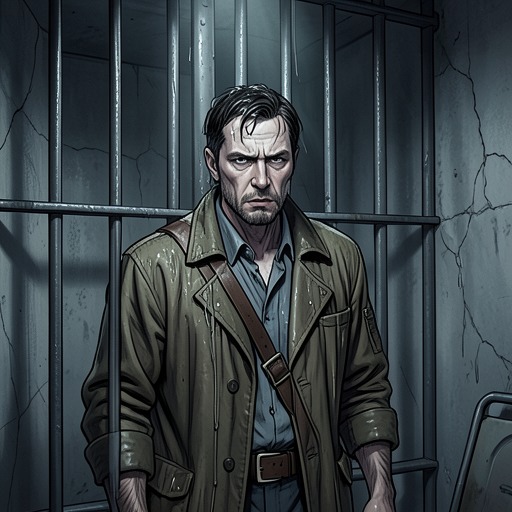
The narrator gradually becomes conscious in a bare, earth-floored room, in heavy, hot, humid air. His eyes struggle to focus; he sleeps for long stretches, and nights seem to last a week. A short-haired man in a light-grey tracksuit brings him rough bowls of porridge-like food. The man is K.K., but at first the narrator does not even know his voice. K.K. offers no explanation of the imprisonment. Instead, he repeats simple statements about the colours of the sky and earth, and expects the prisoner to repeat them. When the narrator answers with a question, K.K. strikes him and leaves him hungry.
The lessons are a means of submission, not instruction. The narrator learns that food depends on echoing K.K.’s words, yet the expected colours change according to K.K.’s choice. A wrong answer can mean a beating, no food, or the loss of his thin blanket. He becomes weaker while trying to work out what is being demanded, and even a day on which he answers correctly ends not in relief but in an hour of tears. The deprivation narrows his world to the cell and his captor; as he later recognizes, continued confinement would have made the thought of London beyond the garden wall increasingly difficult to comprehend.
The cell’s routine is recorded in small, material details. Each morning the narrator passes out a slop pail; each night it is returned. He scratches a crude calendar into the soft wood of the door with his fingernails, keeping the marks out of sight of the peep-hole. Double strokes mark days when noises wake him: human sounds somewhere between groans and screams. K.K. also supplies typed orders about how the prisoner must sleep, including instructions to keep his arms above the blankets and not sleep during the day. The calendar measures time, but the marks also register a system that controls even posture and rest.
The decision to escape
By the time the calendar reaches thirty-four marks, the narrator understands that a direct assault on the bolts and main gates is not possible. On the thirty-fifth day, he reasons that his only chance is a calm, gradual escape. His physical condition is poor, and he knows that he cannot rely on force. The contrast between his deliberate planning and his declining strength gives the decision its urgency: delay is not neutral, because every further day risks leaving him less able to act at all.
The old guard is the one person who breaks the rules. When K.K. is absent, he sometimes stands half in the doorway, listening for the return of the captor while allowing the narrator a few minutes’ sleep. On nights when the narrator has failed the colour tests, the guard may be made to keep him awake. He talks about his family and army service, shows photographs of his children, and uses a small hand movement to let the prisoner lean against the wall and rest. The narrator cannot understand the guard’s words, but recognizes his practical kindness.
That kindness complicates the escape plan. The narrator has no weapon except the door. He considers using it against the guard on an earlier night, but the man does not come close enough, and the narrator does nothing. A couple of nights later, when the guard brings him a cigarette, the narrator strikes him with the door; its bolt mechanism hits the man’s head and leaves him unconscious. He drags the guard inside. The cigarette is still in the old man’s hand, and the sight nearly defeats the narrator’s resolve. The escape begins with an act that is tactically necessary to him but morally difficult precisely because the guard has offered small mercies within an otherwise brutal captivity.
The improvised breakout
The narrator takes the guard’s wooden HB pencil, locks the door again, and puts on the guard’s jacket and cap over his own dark prison trousers. He descends the old wooden stairs softly. The main door is unguarded from inside, but he does not try it. Instead, he opens an unlit room with the pencil. In the moonlight he finds filing cases and books, then traces an electric alarm wire around the window frame. He climbs onto a desk to remove the bulb; the strain makes him shake, and a pencil cracks underfoot. The radio music in the adjoining room stops, but the sound that follows is only someone adjusting its tuning.
He puts an English sixpence, previously given to him by Anthony Eden’s friend, into the bulb socket before replacing the bulb. He then wraps the strong rosary that Snuggle Tooth had brought him around the elements of a two-kilowatt electric fire. With no time for a more elaborate electrical trick, he switches on the wall plug and light. The resulting flash and bang send people stumbling and clicking switches. The main power fuse appears to have blown; there is no emergency lighting, and the window opens without triggering bells or buzzers. He slips outside and closes it behind him, though he cannot lock it.
In the wet grass, he hears the front door open and sees a torch flash in the room he has just left. Nobody checks the window. A car starts, and two people speak nearby, their words lost beneath the engine. The narrator moves toward the rear of the property, relying perhaps too much on his peaked cap as a disguise. He falls into soft earth, catches at thorn bushes, and hears a dog bark close by. The rear wall is about his height, without barbed wire or broken glass, but he is too weak to pull himself up easily. When a powerful light appears in the conservatory, he waits until its beam sweeps across the wall, gets one foot onto the top, and rolls his empty belly over to fall down the far side.
Beyond the wall
For a moment, the ground beyond the wall seems to offer safety: the narrator is soaked, hungry, frightened, and free to breathe the wet night air. He knows he cannot remain lying there. As he starts to walk, however, he becomes caught in a framework of slender wooden rods and wires; each attempt to get loose tangles him further. A lit doorway opens ahead, and a man’s silhouette appears. The man calls out, then, as his eyes adjust to the dark, complains that the fugitive is caught in his runners. The escape has crossed the boundary of the detention house, but it has not placed the narrator beyond discovery.
The narrator later makes clear that he did not know from the beginning that he was being held in a large house in London’s Wood Green. He had partly guessed, but captivity steadily drained that conviction. His recollection stresses the narrow window in which escape remained possible: had he stayed another ten days, the idea that London lay just beyond the garden wall might have become incomprehensible to him. Reaching the wall is therefore more than a physical maneuver; it is an effort to preserve the capacity to imagine a world outside the cell.
Getting away from the householder, Alf Keating, proves comparatively easy. The narrator tells him that he has fought with a drunken, much larger brother-in-law and climbed over garden walls after a neighbour called the police. The account gives Alf an ordinary explanation for the dishevelled stranger, while allowing the narrator to continue away from the detention house. The episode ends not with a secure return to safety but with an improvised cover story and a fragile opening toward freedom. Its central reversal is that the narrator escapes through attention to mundane objects—the door, pencil, sixpence, fire, window, and wall—while the system holding him has tried to make even basic facts, such as colours and the passage of days, unreliable.