Thought reform
The IPCRESS FileThought reform is the systematic coercion through which Jay’s network seeks to weaken people’s judgment and make them obedient. The Unnamed narrator describes it first from inside a prison cell, where food, sleep, temperature, and even the rules of language become instruments of control, and later reconstructs its stages for Jean. The method’s force lies not in one dramatic act but in an organized erosion of certainty: bodily debility narrows resistance, isolation cuts off reassurance, and the captive is trained to seek approval from the very people controlling him.
Coercion through the body and the senses
The account’s physical ordeal begins with medical procedure. A medic arrives with a trolley, an enamel tray, ether, cotton wool, and a hypodermic; after checking the Unnamed narrator’s pulse and chest, he injects him at two-twenty. The next remembered scene is markedly different: the narrator is pressed against damp soil, sick over a broken wristwatch showing 4:22, and hears nearby voices that sound neither quite like groans nor screams. The abrupt movement from orderly medical attention to disorientation and suffering establishes how bodily vulnerability frames the later account of confinement.
In the cell, deprivation becomes a lesson plan. The room has an earth floor and no furniture; the air is hot and humid, and the Unnamed narrator struggles to remain conscious. A short-haired, blond man in a light-grey tracksuit brings the food, while K.K. delivers the verbal exercises. At first, K.K. repeats simple propositions about the colors of the sky and earth. When the narrator refuses to repeat them, K.K. strikes him and leaves him hungry. It takes two days for the captive to work out that repeating the words is the condition for eating. The gruel then becomes delicious to a man weakened by hunger.
The exercise is not a stable lesson in facts. K.K. varies the phrases, sometimes speaking with an accent the narrator cannot understand until hours of repetition have passed. When the narrator gives an answer K.K. considers wrong, he is hit, left without food, and deprived of the thin blanket. Even the assigned colors can change according to what K.K. has decided that day. By the ninth day, K.K. can point and the narrator can recite what he remembers, but successful compliance offers no dependable standard against which to judge whether an answer is actually correct. Obedience, not knowledge, is what the exercise measures.
Isolation and the haunted-house method
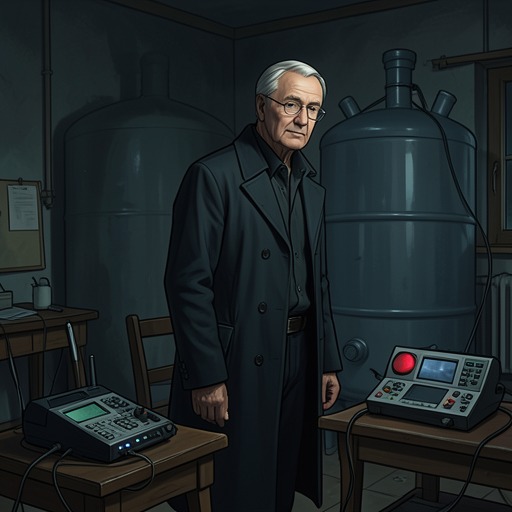
Later, the Unnamed narrator explains that the haunted-house system relies on mental isolation. Fake ambassadors are used to make a subject believe he is alone; the operators also tried fake policemen, but abandoned that approach after a man was accidentally caught at Shoreditch. Civilian clothing, the narrator says, was safer. At Wood Green, heating and cooling equipment could change the temperature at will, while lights could be switched to make a day last an hour or a night last thirty-six hours. These disruptions were intended to unbalance the mind, particularly when physical weakness had already made resistance harder.
The cell’s small routines show how that control governs both time and information. Each morning the Unnamed narrator hands out his slop pail, and each night it is returned. He scratches a calendar into the soft wood of the door, hidden from the peephole, marking some days with a double stroke when the human noises wake him. K.K. also supplies typed instructions governing the prisoner’s sleep: one directs him to keep his arms above the blankets; another forbids daytime sleep. A cigarette briefly appears to offer ordinary conversation when K.K. asks why he smokes, but the next day the narrator gets the colors wrong and is beaten about the head. Even apparent kindness provides no reliable way to understand the rules.
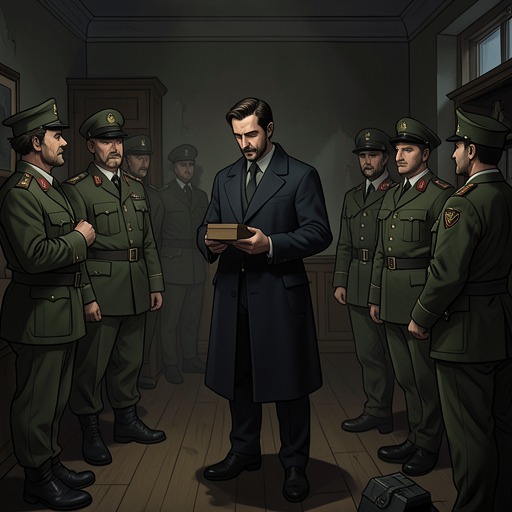
After twenty-five days of calendar marks, K.K. gives the narrator a note limiting a visitor to six minutes. The permission is itself tightly controlled: the cell door opens amid shouting in the corridor, and K.K. admits a young Hungarian Army captain. In retrospect, this detail fits the system’s broader assault on connection. The captive cannot assume that outside help is available, and even an encounter with someone from beyond the cell is bounded by the captors’ procedure.
A process of fatigue, disclosure, and collapse
Explaining what would have happened had he remained at Wood Green, the Unnamed narrator describes a progression rather than a single technique. The opening stage severs connections and produces isolation, physical and mental fatigue, and uncertainty about what will please the captors. He says that humor is dangerous to the method because it can interrupt that pressure. One possible next demand would be the memorization of long passages of dialect, perhaps including the lengthy document concerning his trial. Such work would occupy the mind while leaving the subject dependent on the captors’ judgments.
The process would then move into group therapy. The Unnamed narrator knows that five other inmates were at Wood Green at the same time, and suspects there may have been more. Recordings of moaning, groaning, and people talking in their sleep in a foreign language could intensify the group’s fear. He anticipates meetings in which the captives would be allowed to discover that one of them was an informer, increasing tension among people already deprived of trustworthy information. The subsequent confession and autobiography stage would demand detailed explanations of private conduct: why a person smoked, had love affairs, drank, or associated with particular people. These disclosures would give the operators material with which to identify and exploit individual weaknesses.
The Unnamed narrator calls the culmination abreaction. In his account, captors first gather information through self-criticism and pressure that encourages subjects to identify their own weaknesses; they then use what has been learned in intense mental work and indoctrination meetings. He describes abreaction as a point of no return marked by nervous collapse: dilated pupils, a rigid body, clammy skin, rapid shallow breathing, and finally uncontrolled sobbing and hysteria. If one member of a group collapses, he says, the others soon follow. His comparison with the terms shell shock and battle fatigue locates the episode within a history of naming psychological breakdown, while his description emphasizes how the method makes an individual collapse contagious within a group.
Different settings, shared purpose
The account distinguishes the method from the buildings used to carry it out. The Unnamed narrator initially calls the haunted house one of three basic systems, then clarifies that he means different applications of one system rather than wholly separate processes. Jay also used small private nursing homes, which were less conspicuous and required neither extensive building work nor conversion back to normal before the operators moved out. Carswell’s concens pointed to this nursing-home arrangement; the narrator connects their high fever rate to the physical debility that prepared people for coercion. The settings differ, but isolation, weakness, uncertainty, and control over the subject remain central.
This distinction matters because the conspiracy cannot be reduced to an institutional setting or a single sequence of exercises. The Unnamed narrator says that he was considered difficult and was subjected to the older, more thorough approach at Wood Green rather than being sent to a nursing home. He also recognizes similarities between that treatment and the treatment he experienced after his arrest on Tokwe. His comparison identifies a recurring pattern of coercion across different locations without suggesting that the procedures were identical in every detail.
Jay’s network and the meaning of conversion
Jean asks whether the concens, after brainwashing, returned to work as Russian agents with their convictions reversed. The Unnamed narrator rejects that simple interpretation: the process is more complex, and everything turns on Jay. As he explains it, Jay has lived through repeated changes of government and has learned to accommodate political currents rather than place lasting faith in one ruling order. Jay sold information from Klaus Fuchs, Alan Nunn May, and the Rosenbergs, and later arranged for Otto John, Bruno Pontecorvo, Burgess, and Maclean to travel eastward. The narrator describes money, not political conviction, as the consistent basis of Jay’s dealings.
Jay’s innovation was to brainwash a network of well-placed people who would route information through him and remain loyal to him personally. The distinction changes the significance of the captives’ apparent conversion: their submission need not mean that they have adopted a coherent foreign ideology. It can instead serve a private network organized around Jay’s authority and access to information. Near the end of the confrontation, Jay claims that he has processed nearly 300 people and calls brainwashing a future method of dealing with antisocial elements. The claim makes explicit the method’s intended reach beyond espionage: in Jay’s vision, techniques developed to control a clandestine network could become a model for controlling criminals as well.