Tokwe Atoll
The IPCRESS FileTokwe Atoll is the remote Pacific setting of a major American nuclear test and an immense, rapidly constructed military complex. The atoll’s significance lies in the collision it stages: islands marked by the wreckage of the Second World War are reorganized into a controlled scientific and military landscape, where the narrator’s access to secret laboratories and the danger surrounding the test unfold together.
Atoll and test site
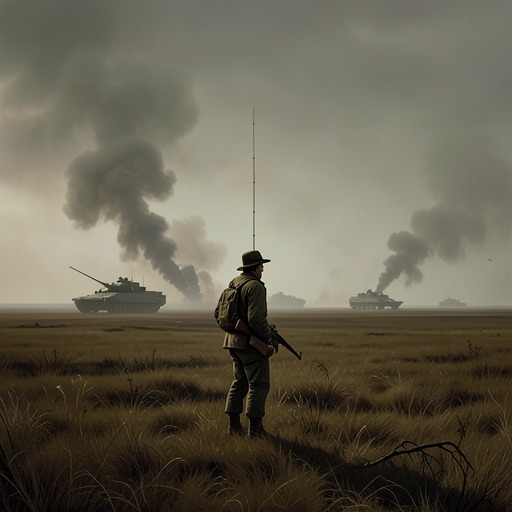
The narrator first sees Tokwe Atoll from the air as a scatter of islands, reefs, beaches and small green bays across the Pacific. Wrecked craft from 1944 remain along the shore, alongside landing craft, rusting tanks and tracked vehicles, ammunition boxes and broken crates. These remnants give the new project a setting already shaped by war, even as the approaching test represents a different scale of military power.
The arriving party is carried from an aircraft carrier by helicopter to Laboratory Field, an airstrip built on an island within the atoll. The narrator, Dalby and Jean wear photographic identification badges marked with a large Q, which allow them into secret laboratory areas. Access is therefore both unusually broad and explicitly credentialed: the visitors can inspect restricted facilities, but only under a security system designed to distinguish authorized observers.
A city built for the test
The Americans have equipped the island in ninety days. Laboratory Field, also called Lay Field, includes an airfield capable of handling piloted and unpiloted aircraft, a maintenance hangar, a landing pier, barracks and a large residence for the commanding general. The complex also has two athletic fields, two cinemas, a chapel, a clothing store, officers’ and enlisted men’s beach clubs, a library, hobby shops, a mess hall, a dispensary, a post office, a power plant and a modern laundry. The scale is not merely a matter of buildings: the narrator is told that the test population includes ninety baseball teams in ten leagues, a telephone exchange capable of handling more than 6,000 calls a day, and a mess serving 9,000 meals daily. Buses and a radio station operate around the clock.
This concentration of ordinary services gives the test site the structure of a self-contained settlement. It is also a pointed contrast with the narrator’s comparison to London: the isolated military project has been provided, at speed, with facilities and communications on a scale he wishes his home city could match. The island’s apparent completeness depends on its purpose, however. Its civic amenities support a temporary population assembled around a single scientific and military undertaking.
The tower and the surveillance perimeter
The shot tower stands at the center of the test’s controlled landscape. It rises from the sand amid cables and pipes and is surrounded by a twenty-foot electric fence, police with dogs and an amphibious jeep fitted to accommodate a machine gun. Automatic cameras operate at a distance, while the narrator’s ascent in a lift carries him roughly 200 feet to the tower’s upper platform. From there he can see the airfield, a departing B-52 and the surrounding islands. The tower is not an isolated piece of equipment: it is the focal point of a larger installation, visible from a landscape organized around the test.
The wider security network extends beyond the fence. Along the road, forty-foot towers stand at intervals of about 300 yards. Most contain infrared television cameras; every third is manned. At night, the narrator drives along the coast road toward Shot Island after Dalby, passing this monitored route and a warning sign that orders vehicles to halt. The arrangement makes movement across the atoll legible to the authorities: observation is built into the roads as well as concentrated around the tower.
Personnel, danger and narrative significance
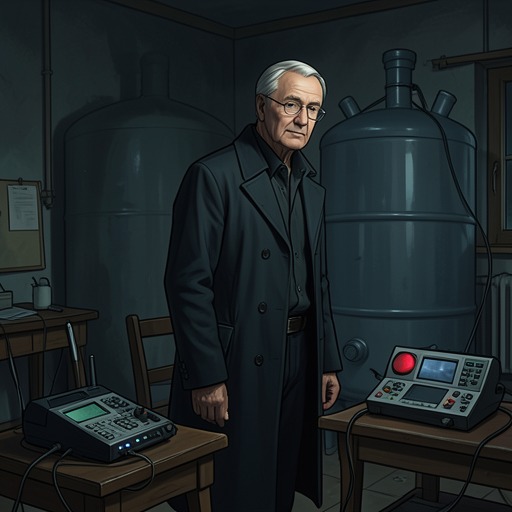
The tower is commonly called the mountain. When the narrator reaches its summit, Barney Barnes is waiting there in lightweight coveralls, holding a silenced pistol that is pointed at him. The encounter brings the personal danger of the intelligence plot into the test’s most symbolically charged place: the apparatus at the center of the operation is also a vantage point for confrontation.
As the explosion approaches, work across the atoll accelerates. The narrator remains an observer, attending conferences, while he and Jean limit their conversations because they may be overheard or recorded. The island’s organized activity thus has a counterpart in the restrictions on private communication. Even personal conduct is shaped by a setting where surveillance and secrecy are ordinary features of the work.
Barney’s death is reported during this period as the result of a generator truck leaving the road at Bloody Angle, a dangerous bend bordered by a low wall and a sheer drop. The narrator then drives through the black night as the test preparations continue, unable to readily accept the news. Tokwe Atoll consequently gathers several strands of the story into one place: a nuclear project supported by extraordinary infrastructure, a dense system of access controls and surveillance, and the human cost of operating within its perimeter. Its ruined wartime equipment and newly built test city make the transformation especially stark: the atoll is at once a landscape, a base and the stage on which the novel’s technological and intelligence conflicts converge.