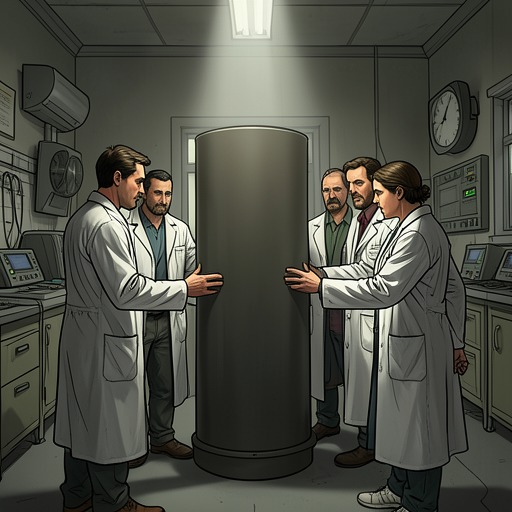
Tokwe nuclear test explosion
The IPCRESS FileThe Tokwe nuclear test explosion is the sudden climax of a night drive by the Unnamed narrator and the revelation of what the island’s guarded roads and surveillance equipment were meant to support. A flash transforms the night into daylight; later, The Brigadier’s explanation and the camera record identify the blast as part of a secret experiment involving a neutron device. The event joins a bodily shock to a technical demonstration: the weapon’s effects had to be watched as they unfolded, not captured in a single still image.
The road to the test
The immediate approach is shaped by darkness, restricted access, and the Unnamed narrator’s effort to follow Dalby. At 2:12 a.m., the narrator reaches a red sign ordering traffic to halt 25 yards ahead. The road section is closed, leaving three miles of forbidden road beyond the barrier; Dalby has already slipped through. Their route has passed the General Guerite highway and continued along a less carefully maintained coastal road, with the sea and Shot Island nearby. The journey is not simply a drive through an empty landscape: towers stand at roughly 300-yard intervals, and some are manned while most carry remotely controlled infra-red TV cameras.
The narrator’s car is stopped at the point where the restriction becomes decisive. In the car, a pair of heavy asbestos insulation gauntlets prompts a question about whether Barney Barnes had been there, performing the “power” act. The narrator is already struggling to absorb the news that Barney is dead, so the gauntlets connect the immediate scene to a loss that still feels difficult to accept. They do not explain the experiment, but they make the car a place where the test’s practical preparations and the narrator’s personal shock briefly meet.
The explosion
Waiting for a cigarette lighter to glow red, the narrator is caught in the interval between an ordinary action and an extraordinary event. The lighter is still being waited on when the sky explodes into daylight. The sudden change is the event’s decisive sensory fact: night does not gradually brighten but gives way in an instant. The narrator’s wry comparison—that neither the daylight nor the narrator had been so bright lately—registers the force of the flash while keeping the account’s sardonic voice intact.
The scene’s suspense rests on how little the narrator knows at the moment of impact. The road has been closed, Dalby is out of sight, and the equipment on the towers has not yet been explained. The blast is first experienced as a transformation of the sky, not as a comprehensible weapons test. The later technical account changes the meaning of that moment: what seemed like a single flash belongs to an experiment whose effects required continuous observation.
The secret experiment explained
When The Brigadier later discusses the previous night, he identifies the party as connected to the work on the mountain and confirms that a secret experiment was planned for that night. The Unnamed narrator had initially mistaken the gathering for a social occasion, then recognizes it as cover or accompaniment for the operation. The account given beforehand—that the bomb was a Uranium 238 weapon with a SUVOM trigger—had been true, but it was incomplete. On the night of the party, a team had been crash-programmed into the explosion area to modify the bomb. The narrator identifies the change as the insertion of a neutron device, and The Brigadier nods.
The distinction matters because the test was not merely an explosion of the weapon as originally described. Its configuration had been altered as part of the operation, and the blast that illuminated the road was the consequence of that concealed intervention. The account places the party, the guarded mountain, and the closed road within the same chain of preparation. What the narrator had read as disconnected details now forms a military experiment whose crucial modification had been concealed until The Brigadier explained it.
Surveillance and the meaning of the flash
The island’s camera system supplies a second record of the event. Each tower camera transmits on the same frequency, and the receiving apparatus renders the monitored area as a distorted map. In the film, the narrator’s car appears as a small white shape moving up the screen. When a manned tower is connected to the electric cables, its camera goes out of action; overlapping camera fields preserve the view. After the narrator’s car stops, intense horizontal bands fill the image. The Brigadier identifies this as high-speed TV transmission and indicates where the flare went off.
The film makes visible both the reach and the limits of the surveillance system. Its overlapping cameras preserve a view when one tower’s camera fails, while the transmission itself breaks the scene into hundreds of pictures per frame. But the neutron weapon requires more than a record of the instant of detonation. As The Brigadier explains, it is designed to hang over a city and bombard it with neutrons; only pictures of its progress would be useful, because a still image would reveal little or nothing. High-speed television is therefore integral to the experiment’s purpose: it is meant to follow an unfolding effect, not simply preserve the moment the sky lights up.
The Tokwe test’s significance lies in this shift from spectacle to evidence. The flash first overwhelms the narrator’s immediate understanding; the later explanation connects it to the neutron-device insertion, and the processed film shows how the island’s cameras registered the event. The test is thus both a concealed weapons experiment and a revelation of the system built to monitor it. What the narrator experienced as daylight breaking into the night becomes, in retrospect, one recorded stage of a carefully watched and secretly modified operation.