Tokwe test tower
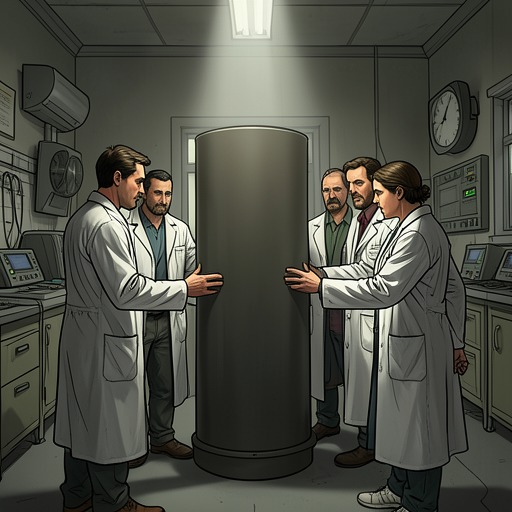
The IPCRESS FileThe Tokwe test tower is the 200-foot red metal structure at the heart of the atoll’s nuclear-test site. Called the mountain because the project’s activity and machinery converge around it, the tower is more than a platform for a detonation: it is a guarded, instrumented machine whose importance makes it a meeting point for scientific spectacle, military secrecy, and personal danger.
Setting and Construction
The tower rises from a sandy arena on an island selected for the detonation. Its red-painted framework stands amid an array of instruments, including photocells, photomultipliers, ion chambers, and mass and beta-ray spectrographs. Cables and corrugated pipelines crowd around its legs, while notices at the base warn of danger from high explosives. The height and exposed position make it the unmistakable center of the test site; from the surrounding machinery to the elevated shot point, the apparatus is organized around the structure.
The tower belongs to a project built on a vast scale across Tokwe Atoll. Laboratory Field, one of the atoll’s hundred islands, had been equipped in ninety days with an airfield, maintenance hangar, power plant, communications and service facilities, and extensive accommodation. Unnamed narrator, Dalby, and Jean wear photographic badges marked with a large Q, granting access even to secret laboratory areas. That authorized access places them close to the machinery without making them privy to what it is ultimately being used to test.
The Test Apparatus and Its Changing Explanation
An army major introduces the bomb intended for the test as a fractional critical-mass device. His explanation describes high explosives compressing a small sphere of uranium-235 or plutonium so that an explosion can be produced with less than a full critical mass. He also discusses eliminating tritium and refrigeration, presenting the design as cheaper and easier to manufacture. The tower is therefore introduced within a technical account that sounds precise, while the machinery around it gives that account a concrete, imposing setting.
At a later briefing, the explanation becomes more elaborate. The major describes a fifty-megaton bomb and a proposed fission-fusion-fission arrangement using uranium-238, then distinguishes the Tokwe device by its Super Volt Micro Flash mechanism. Instead of a conventional atomic trigger, he says, the mechanism supplies an extremely brief, high-voltage pulse through an umbilical cord; he presents the result as a clean bomb without the fallout associated with an atomic trigger. The tower, loaded with instruments and connected to cables and pipelines, is the material center of claims whose significance extends well beyond the island.
Unnamed narrator later understands that the public-facing explanation does not disclose the full operation. The party held on the night of the mountain’s activity was connected to secret experiments, and a team had been crash-programmed into the explosion area to modify the bomb by inserting a neutron device. The earlier account of the uranium-238 bomb and its trigger had been true, but incomplete. The tower consequently marks a shift from technical briefing to concealed purpose: the same apparatus can be described as a clean-bomb test while being used in a secret neutron-device experiment.
Access, Surveillance, and Physical Danger
The tower’s height makes access a controlled procedure. A three-man lift descends with carefully measured accuracy; when it carries Unnamed narrator upward, its motor suddenly cuts out, leaving him suspended before he slides the gate aside and steps onto the top platform. From there he can see across the island, including the runways of Lay Field and a B-52 taking off. The view sets the tower above both the test site and its supporting infrastructure, but the ascent is not an escape from the project’s machinery: at the top, its cables and equipment continue beneath him.
Security surrounds the structure at a distance and at close range. A twenty-foot electric fence, fifty yards from the tower, is patrolled by white-helmeted police with dogs. An amphibious jeep waits by the only gate, modified to allow a machine gun to traverse from beneath its awning. Elsewhere, helicopters search the site with spotlights. When a beam climbs the steel ladder, it reveals a dead soldier hanging partly out of a shattered glass window in the metal tower. The tower is connected to a high-tension power line by angle irons and bolts; Unnamed narrator recognizes the danger of that connection, while the circumstances beyond the body’s discovery are not fully explained.
The structure also becomes a target for observation. The Brigadier explains that a portable camera-transmitter can send television pictures as high-speed electrical impulses, allowing clear images even when the camera is moved. The camera had been directed toward the mountain, and moving pictures mattered because a neutron bomb was designed to bombard a city with neutrons rather than produce a single conspicuous flash. The High-speed TV transmission unit thus turns the tower into the focus of remote surveillance as well as physical instrumentation. Later, officials show Unnamed narrator the unit’s twisted metal remains and say that usable fingerprints were recovered from it. The fingerprints are his, though he insists that he never touched the equipment—a discrepancy that makes the surveillance device part of the case against him.
The Mountain and Its Narrative Role
The name mountain captures the tower’s dominance over the surrounding landscape and over the project’s meaning. From its summit, Unnamed narrator sees not only the island but the scale of the apparatus built to support the test. The view links a single structure to a much wider military undertaking, while the immense instruments below make the test’s technical claims feel both tangible and difficult to control. The planned explosion would transform the sand into glass; the island itself is presented as an environment being remade by the machinery it contains.
At the summit, Barney Barnes waits in white coveralls, wearing master-sergeant stripes and holding a silenced .32 pistol pointed at Unnamed narrator. The tower’s highest platform, otherwise a vantage point above the installation, becomes a site of direct confrontation between the two men. Barney’s armed presence makes clear that access to the mountain carries personal stakes as well as official authorization. The encounter gives the tower a second kind of exposure: beneath the spectacle of the test and the precision of its instruments, loyalties and suspicions are being negotiated at gunpoint.
Across these episodes, the tower gathers the book’s competing versions of knowledge into one physical place. It is a shot structure, a measuring platform, a surveilled target, a dangerous electrical installation, and the setting for Barney’s warning. Its visible engineering lends authority to official explanations, but the concealed neutron experiment and the fingerprints attributed to Unnamed narrator show how incomplete or compromised that authority can be. The mountain’s significance lies in this tension: it stands at the center of the test, yet what happens there cannot be understood from the machinery—or from the first account of its purpose—alone.