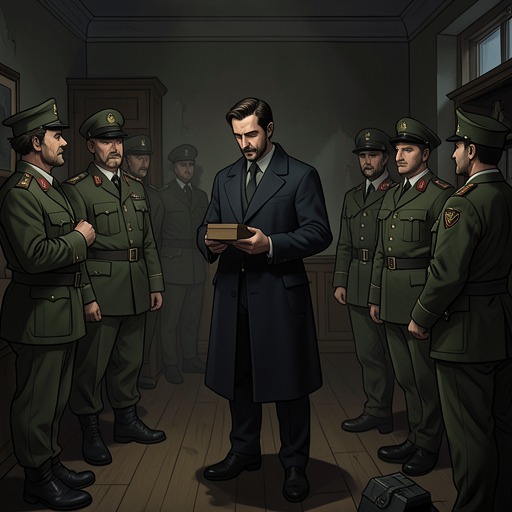
Transfer of Raven to the Royal Navy destroyer
The IPCRESS FileThe Transfer of Raven to the Royal Navy destroyer is the planned extraction of the captive Raven from a mountain house in Lebanon by helicopter, toward a rendezvous with a Battle-class Royal Navy destroyer. The episode turns on the practical uncertainties of that plan: establishing radio contact, finding the ship along a darkening coast, and carrying a weakened prisoner in a small aircraft. It records Raven’s departure from shore, but does not narrate his landing aboard the destroyer or the final handover.
Arranging the rendezvous
The preparations follow three days spent by the narrator and Adem with the old man of the mountains. John then reappears from Beirut with a large radio set. It takes him nearly three hours to establish contact with a Battle-class destroyer moving down the Lebanese coastline as part of a NATO patrol. The delay makes the transfer dependent on a working connection and coordination with a ship already under way, rather than on a rendezvous whose timing and position are effortless to control.
The ship is making good time along the coast as twilight gathers. Visual contact is expected to be difficult, so the aircraft’s fuel capacity matters: the narrator notes that it has enough fuel for more than three hundred miles, giving the search a margin. That reserve makes the meeting feasible, but does not remove the risk of locating the destroyer in poor light. The scene establishes extraction as a problem of navigation and timing as much as transport.
Raven under escort
The captive is Raven, brought to dinner after the destroyer’s rendezvous has been arranged. Painter, an army doctor who has mostly remained in an upstairs room, decides that Raven can join the others for the meal. The narrator observes that Raven looks thinner and weaker than he had only two days earlier, when Dalby had pulled him from a Pontiac. Raven wears a slightly soiled white shirt, loose pin-stripe trousers and a new dark linen jacket; his quick, nervous glances repeatedly turn toward Painter. His good humour is present, but the escort and his condition make plain that he is being moved as a prisoner, not travelling freely.
Dinner offers little discussion of the operation. Conversation stays with ordinary topics such as weather, the garden and horses; Adem finishes eating quickly and goes upstairs to catch the forecast. This quiet interval contrasts with the logistical pressure outside it. The transfer is close enough to require a departure, but the people at the table do not turn the meal into an explicit briefing. Raven’s presence is acknowledged through the arrangements around him and the attention he gives Painter.
Aircraft and departure
The group boards an SE-3130 Alouette 2. Raven sits on a folding seat in the rear with Painter beside him; Dalby takes the front-left observer’s seat. Adem, who is piloting, receives a final short lesson from the old man on the Decca navigation equipment. The landing platform being prepared for the destroyer is temporary and scarcely larger than its forward gun turret, a detail that gives the planned arrival a precise physical constraint. The narrator also notices the aircraft’s safety notices and its small panel of fire instructions, practical details of a machine being prepared for a demanding night flight.
The narrator identifies the engine as a 400-horsepower Turbomeca unit and the rotor blades as thirty feet long. Adem uses the collective lever and adjusts the throttle; the rotor system gathers speed and the helicopter lifts. A rudder input moves the tail rotor sideways, and the aircraft heads toward the sea in fast, low runs. Its reported speed is about one hundred miles per hour. These mechanical particulars keep the departure legible as controlled work: Adem’s handling and the navigation equipment are central to getting the aircraft away and toward a ship that may be hard to see.
What the passage leaves unresolved
As the helicopter sets off, Dalby and Painter remain with Raven, maintaining the escort during the flight. The narrator’s part in the scene is that of an observer on shore: he watches the aircraft depart and thinks of Raven as a troublesome captive finally being taken away. The passage thus establishes the direction and purpose of the flight, but not its completion. The destroyer has been contacted, is moving along the coast, and has a temporary platform under preparation; the aircraft has lifted and is heading seaward. Whether it makes visual contact, lands safely, or transfers Raven aboard is not shown here.
After walking back toward the house, the narrator turns to a crossword clue, deciding that DITHYRAMBE needs a final E to make ten down EAT. The immediate return to a private puzzle places an ordinary mental task beside the hazardous coordination just completed. It does not resolve the extraction, but it marks the scene’s boundary: the helicopter has left shore, while the narrator remains behind with only the departure, not the outcome, in view.