U.S. Central Intelligence Agency
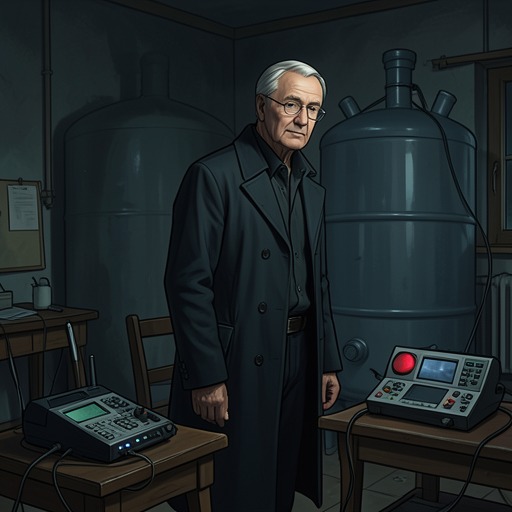
The IPCRESS FileThe U.S. Central Intelligence Agency is presented through case files and intelligence channels rather than through a sustained depiction of its internal leadership. Its clearest connections are a tentative record of postwar recruitment in Europe and a later crisis in which American scientific information appears to be reaching foreign sources with alarming speed. Both strands emphasize uncertainty: the agency’s role in Jay’s history is conjectural, while the leak is evident but its full mechanism remains unresolved.
Recruitment and Jay’s European Record
A file on Jay’s earlier identity, Christian Stakowski, places him amid shifting allegiances in postwar Europe. After wartime service associated with Polish intelligence and a return to Poland in 1945, he held a minor secretarial post in the new government while reporting on industrial espionage, including the movement of German reparations production into Russia. The file records that this reporting had largely petered out by 1947. A note suggests that he may then have been working for the U.S. Central Intelligence Agency, which was recruiting agents in Europe through an eight-year arrangement: after eight years in the field, an agent might receive a small pension, be moved to the United States, and settle there. The file does not establish that Jay was recruited under this scheme, and it records no payoffs from 1955 onward.
In 1950, Jay left Poland for England using a passport obtained through his government employment. British intelligence later described him as doing small-scale espionage for the Americans in London, focused on economic and industrial matters. The account distinguishes this work from the British department’s own interests: it says that the department had not wanted Jay merely for that kind of activity, and that the decision was not its to make. The narrative therefore links him to American intelligence without making him a confirmed agent of the U.S. Central Intelligence Agency in every phase of his career.
Suspicion and the Limits of the Record
Jay’s British file places his movements alongside the Burgess and Maclean defections, but the evidence presented is circumstantial. He was in Cairo twice while Maclean served there, and he travelled with Burgess and Maclean on a cross-Channel sailing in May 1951; of the three, only Jay returned to England. Later payments and the use of the name Mr Aristo added to suspicion about his finances. Yet the British account explicitly says it had no evidence connecting Jay with illegal dealings after 1950. These details establish why his American work attracted scrutiny, not that the U.S. Central Intelligence Agency directed the defections or the transactions.
A separate file records intercepted telephone calls between Jay and the U.S. Embassy, mostly concerning London merchant banks. It also summarizes a report from C-SICH, the body through which information in Britain was shared with appropriate branches, stating that Jay was not receiving regular sums from the Russian government. His income was described as large, irregular, and derived from diverse sources. These records complicate any simple account of allegiance: the available material traces contacts and money, but does not resolve them into a complete or reliable picture of Jay’s loyalties.
The Scientific Intelligence Leak
The agency’s most acute institutional crisis emerges through Skip Henderson’s account of information returning from East Wing Room 192. The room was described as a large suite relaying intelligence from the highest levels of foreign governments, gathered through agents with access to otherwise restricted official information. Skip says that material coming back from the room is appearing verbatim in American files: discoveries made in U.S. laboratories are being transmitted to the other side of the world almost as soon as they are made. The near-exact correspondence between new research and foreign intelligence turns the room into a means of checking the loss of American information, while also exposing the scale of the breach.
The episode gives no complete explanation of how the leak operates or identifies a single culprit. Instead, it shows the agency and its associates confronting a breakdown in the passage of sensitive information: scientific findings are collected, entered into files, and then apparently reproduced beyond the intended circle. The contrast between the room’s privileged access to foreign governments and its role in diagnosing the loss of American research makes intelligence-gathering itself feel vulnerable to reversal.
Narrative Significance
Across Jay’s uncertain recruitment history and the Room 192 crisis, the U.S. Central Intelligence Agency is associated with information that moves through intermediaries, incomplete files, and overlapping networks. The record can suggest recruitment without proving it, and surveillance can reveal patterns without settling their meaning. The agency’s presence thus reinforces the novel’s larger tension between intelligence as a tradable resource and intelligence as an unstable account: access may be extensive, but certainty remains scarce.