Unnamed narrator
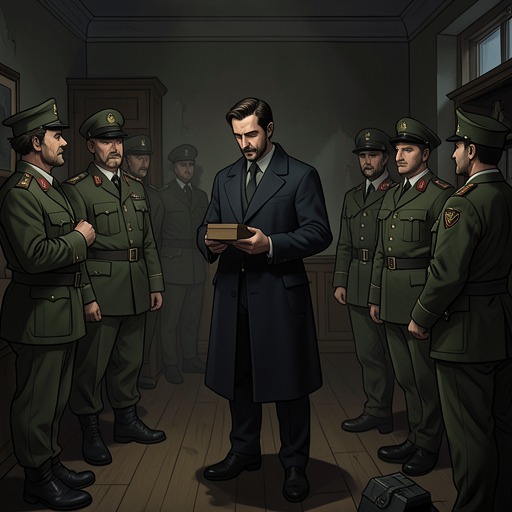
The IPCRESS FileUnnamed narrator is an operative who moves between assumed identities while carrying out a government assignment involving Jay. His account begins not with a dossier but with his own recollection: a personal version of events in which preparation, improvisation, and uncertainty over names are part of the work itself.
Identity and Background
The narrator’s underlying name is never established in these scenes. He introduces himself to Jay as Stanley Beamish, while a driver later greets him as Harry at Rome–Fiumicino Airport. The narrator notes that, in his line of work, it is difficult to remember whether a name like Harry has ever been his. The aliases are not presented as stable personal identities so much as names that may be used, assigned, or mistaken amid covert activity.
Before the assignment, he has just finished three weeks of termination-of-engagement leave. He spent it doing little beyond sorting his collection of military-history books, an activity his friends would not necessarily regard as work. The contrast between this quiet interval and his subsequent assignment gives his account an unceremonious starting point: he moves from private routine into an operation without presenting himself as a grand professional hero.
Assignment and Preparation
The British Government instructs the narrator to pay £18,000 to Jay, whom he sees at a corner table. By then, the narrator has studied film of Jay every day for a month in a small, private cinema on Charlotte Street. The preparation lets him recognize Jay’s physical habits and identifying details, including his slight limp and the way he strokes his eyebrow with his index finger. The close observation is practical reconnaissance, but it also establishes how much of the narrator’s knowledge of Jay has been acquired at a distance before their first meeting.
When a Minister later asks for the personal story of that first encounter, the narrator begins to refer to the dossier. The Minister redirects him toward his own version and identifies Jay by the code name Box Four. This framing places the narrator’s recollection alongside the official record while distinguishing the two: the dossier exists, but the account offered here is shaped around what the narrator remembers and how he tells it.
Cover Identities and Encounter with Jay
At the meeting, the narrator searches his pockets for a suitable visiting card. He has several ready-made alternatives: Bertram Loess, assessor and valuer; Brian Serck of an international news press agency; and a small imitation-leather folder granting him right of entry under the Factories Act as a weights-and-measures inspector. None seems appropriate, so he approaches Jay and improvises the name Stanley Beamish, followed by a request to talk and a financial proposition. The episode shows him selecting and discarding covers in the moment rather than relying on one fixed professional identity.
Jay responds by producing a card identifying himself as Henry Carpenter of Import Export. The exchange turns the approach into a meeting between men presenting business identities, each of which may conceal the purpose of the encounter. Jay does not hurry to discuss the proposition; he consults his watch and says the narrator shall take him to lunch. The narrator’s effort to initiate the contact therefore gives way to Jay’s control of its immediate terms.
Narrative Voice and Significance
The narrator recounts dangerous and secretive work in a dry, self-deprecating register. His account pauses over military-history books, visiting cards, and the awkward search for an opening line, details that make covert practice seem dependent on ordinary objects and quick decisions. The humor does not erase the stakes: the government’s money, the month spent studying Jay, and the need for a plausible identity all belong to a calculated operation.
His shifting names also shape the way the story presents personal identity. Stanley Beamish is an improvised introduction, Harry is a name used by someone who recognizes him, and the narrator cannot confidently treat every name as his own. Against that uncertainty, his decision to tell the Minister a personal version asserts a point of view: the operative whose identity changes still claims authority over the account of what happened.