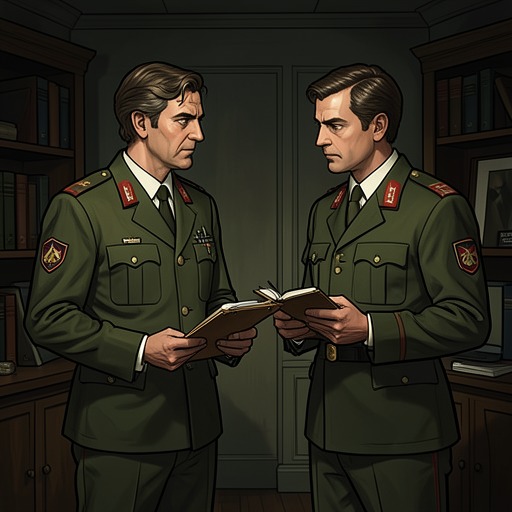
Unnamed narrator and Ross
The IPCRESS FileThe relationship between Unnamed narrator and Ross is a durable partnership in British intelligence defined by antagonism, hierarchy, and practical dependence. For years they treat one another as adversaries, yet their work repeatedly brings them together; when Ross’s attempt to sell a dossier meets Unnamed narrator’s refusal, the conflict exposes their different limits within the same trade. Their later cooperation over Jay does not erase that history, but shows how professional necessity can connect people who have never become friends.
Identity and Early Working Relationship
Unnamed narrator has spent nearly three years in Military Intelligence when the relationship is introduced. Ross is the official with whom the narrator has come to an arrangement of several years’ standing: they have decided to hate one another. The hostility is not expressed through open confrontation. Their English politeness turns it into a ritual of civility, making each courteous exchange a small reminder of their underlying dislike.
Ross’s manner and working habits establish the institutional contrast between them. A regular officer, he is content to operate within strict departmental limits, amid rubber stamps and carbon paper. Unnamed narrator sees Ross as almost synonymous with Military Intelligence: cautious, conventional, and well fitted to the system. The narrator, by contrast, is about to leave the Army and its intelligence department for civilian work with WOOC(P), one of the smallest and most important intelligence units. Ross therefore represents both a personal irritant and the bureaucratic world Unnamed narrator expects to escape.
Their exchanges preserve this antagonistic familiarity through repetition. Ross offers a cigarette even though Unnamed narrator has refused the offer for years, and the narrator recognizes the gesture as another part of their routine rather than a fresh attempt at friendliness. Professional civility is not a disguise that conceals a developing friendship; it is the form their mutual dislike has learned to take.
Rank, Routine, and Reversed Leverage
The relationship changes when Unnamed narrator takes over from Dalby. Ross resents the narrator’s sudden rise, and he brings his department into the investigation at 42 Acacia Drive, apparently through Keightley. Yet he also joins the search with Chico. The moment captures their working connection: resentment does not prevent Ross from entering the operation, and participation does not imply that he has accepted the narrator’s advancement.
Their later weekly meetings make the institutional dependence more explicit. The meetings usually last about ten minutes and cover agreement on the Army Intelligence Memoranda sheet for the Cabinet, alongside financing arrangements where the departments overlap. Unnamed narrator finds these encounters an ordeal, but their regularity shows that the relationship is not merely private animosity. The two officers have recurring administrative business that neither can simply ignore.
When Ross asks to meet during the investigation, Unnamed narrator goes to a drinking club and finds him there early, already drinking pink gin. The setting and Ross’s unusual request for a cigarette mark a departure from their settled routine. Ross begins with talk about his house and its value, then explains that expenses have left him financially constrained, with his son approaching university. He recalls having backed Unnamed narrator’s transfer and presents the narrator as someone he had supported. The appeal is especially uncomfortable because Ross has previously given the narrator dressing-downs; now he is using their history to prepare a request.
The Al Gumhuria Offer and the Refusal
Ross turns from personal circumstances to the Al Gumhuria file. He suggests that Unnamed narrator’s department has more financial freedom and proposes that it buy the dossier from his department. The request is not simply an exchange of administrative assets: Ross has no file number to offer as an ordinary route into the material, and he frames the sale as an irregular transaction. His flattery about the narrator’s growing reputation and the Swiss-bank arrangements serves the negotiation, while his question about whether Unnamed narrator has an insider supplying names and codenumbers probes what the narrator may be able to offer in return.
Unnamed narrator interprets the proposal as a sale of information by an officer in financial difficulty. Ross says he would not offer it to the Russians; when the narrator raises them, Ross replies that he had meant the Navy. He then invokes Dalby and characterizes Unnamed narrator as excessively boy-scoutish, making the narrator’s temporary role as Dalby’s successor part of the pressure. The exchange shows Ross trying several kinds of leverage at once: gratitude for past support, knowledge of the narrator’s access to money, institutional rivalry, and a pointed comparison with Dalby.
The narrator rejects that framing. Unnamed narrator accuses Ross of seeking a buyer on his own side who will not be troubled by the social niceties that keep Ross from selling to an enemy. The narrator also recalls the human consequences behind intelligence reports: people who obtained such material have died, while Ross is proposing to profit from what they gathered. Unnamed narrator says the immediate priority is reducing the department’s six hundred open files, not acquiring the dossier for prestige or ministerial approval. The narrator leaves without buying it. Their confrontation is therefore not a resolution of their hostility but a boundary drawn inside their shared profession: Unnamed narrator refuses to let their rivalry or Ross’s appeal turn the file into a private commodity.
Cooperation Without Reconciliation
After the events at Tokwe, Ross calls Unnamed narrator about Jay. A conference brings together Ross, Carswell, Painter, and Unnamed narrator; its outcome is an arrangement under which Jay receives £160,000 to open a department working directly between Ross and Unnamed narrator. This is a substantial change in their operational relationship. Earlier, their departments’ overlap had been confined to routine memoranda and financing, and Ross had tried to sell Unnamed narrator a separate dossier. Now the two are joined through a costly new intelligence channel.
The arrangement does not establish that the pair have reconciled or that Unnamed narrator now trusts Ross. The narrative records the practical outcome, not a renewed personal intimacy. Their history gives the agreement its force: the men who once met in ten-minute bureaucratic sessions, and later faced one another across an attempted sale, are now connected by a department built around Jay and operating directly between them. Ross and Unnamed narrator remain defined by wary cooperation, with shared work repeatedly overriding but never disproving their mutual hostility.