WOOC(P)
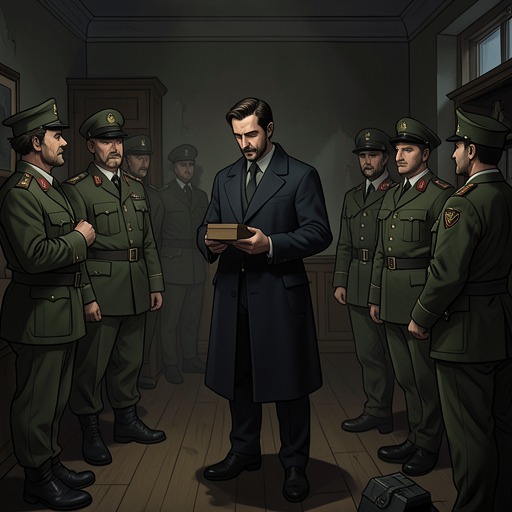
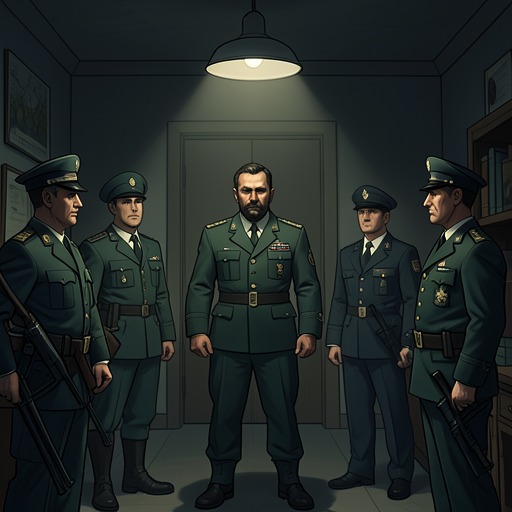
The IPCRESS FileWOOC(P) is a small, provisional intelligence unit with direct responsibility to the Cabinet, set apart from ordinary military service and records. Its significance in the novel lies in the contrast between its secretive institutional power and the compromised loyalties at its center: Unnamed narrator joins it to investigate disappearances, only to discover that its head, Dalby, has been meeting with Jay, the very figure the wider inquiry seeks to understand.
Mandate and Institutional Status
A terse administrative record identifies the Cabinet as the origin of an action assigned to WOOC(P). The narrative gives that terse connection a human and political dimension when Ross explains that Dalby answers directly to the Cabinet. In Ross’s account, WOOC(P) is among the smallest and most important intelligence units, and Dalby is powerful even by the standards of intelligence work. Other services envy, criticize, and oppose him, suggesting that the unit’s influence is matched by institutional rivalry rather than broad acceptance.
The transfer into WOOC(P) marks a sharp break in Unnamed narrator’s career. After nearly three years in British Military Intelligence, he is to leave the Army and work as a civilian among civilians. Ross calls the destination provisional, a label that reflects the Army’s dislike of both provisional arrangements and WOOC(P). Yet the unit is not merely a temporary posting in practice: people assigned to Dalby cease, for most purposes, to be in the Army, and are removed from almost all War Office records. The exceptional procedure underscores how thoroughly the unit is separated from ordinary service structures.
Personnel, Records, and Secrecy
WOOC(P)’s distance from normal military administration is also visible in its personnel procedures. Men returning from the unit to regular duty are enlisted afresh and receive new serial numbers from a batch reserved for civil servants seconded to military duties. Their pay follows a different scale. For Unnamed narrator, the change is immediately practical as well as institutional: he wonders how long the remainder of his current pay will last before the new scale begins. The system makes a posting to Dalby’s organization a form of administrative disappearance, with a possible return requiring a recreated service identity.
The unit’s working environment is presented through Dalby’s shabby inquiry bureau, rather than through an imposing official headquarters. The premises sit on a disreputable street among businesses whose signs include an ex-officers’ employment bureau, film-editing rooms, a theatrical tailor, and Dalby’s own inquiry bureau staffed by former Scotland Yard detectives. Each morning, Unnamed narrator rings for entry and climbs to the third floor. The ordinary, worn surroundings stand against the exceptional authority attributed to Dalby and the Cabinet connection behind his department. The contrast does not establish a formal disguise; it shows how little the unit’s outward setting advertises its importance.
Investigations and Information Flow
The investigation of senior scientists’ disappearances supplies a concrete example of the work conducted under Dalby. At a Senior Intelligence Conference, Dalby reports that the British Home Office is deeply concerned about missing senior biochemists and that another person has vanished after leaving home at 7:45 in the morning without reaching the laboratory. He then gives Unnamed narrator the case of Raven, a man under long-term surveillance whose identity is represented by a bird codename. Dalby lays five passport photographs on his desk and says that Raven’s disappearance is the eighth top-rank disappearance in six and a half weeks. A security blackout has been imposed, but Dalby expects the matter to reach the press regardless.
Dalby is explicit that the British Home Office has not asked WOOC(P) to help. His interest is strategic: if his unit finds Raven, he believes the Home Secretary may disband the confused intelligence department, allowing WOOC(P) to add its files to its own. The case therefore reveals both the unit’s investigative reach and the competitive logic surrounding information. The files are not simply records to be shared for a common purpose; they are also institutional assets whose acquisition could increase Dalby’s department’s power.
Other episodes show how the inquiry depends on material and analysis moving across organizational boundaries. After the Burgess and Maclean affair, Carswell’s department works with the Metropolitan Police’s missing-persons registry, first processing figures and only afterward searching for patterns. Its statistical examination of high-level security clearances produces connections across otherwise dissimilar groups. Later, Unnamed narrator learns that Ross has hidden Carswell because his findings were beginning to expose the larger plot, and because Ross feared for his safety. The episode does not make Carswell a member of WOOC(P); instead, it shows that the unit’s understanding of events depends on analysis produced elsewhere, while the circulation of that analysis can place its source in danger.
Compromised Leadership and Consequences
WOOC(P)’s authority is gravely complicated by the revelation that Dalby has been meeting with Jay. Watching through a window, Unnamed narrator sees Dalby with Murray and K.K., then recognizes Jay, a figure few members of the department have seen. The sight overturns the assumption that Dalby and Jay are approaching the same conclusion from opposite ends. The head of the unit is not merely pursuing an elusive subject: he is in the same room as him, in a meeting that recasts the investigation as a possible breach from within its own leadership.
The later account to Jean clarifies the divided loyalties around the unit. Ross had partly guessed what was happening when he transferred Unnamed narrator to WOOC(P), and had placed Murray there to investigate Dalby. After Unnamed narrator nearly faced arrest at a strip club, Ross let Dalby understand that he was suspicious. Dalby then carried out an effective operation in Lebanon to prove his loyalty; the narrator recalls seeing Ross at the airport after Ross returned from Beirut following a meeting with Dalby. The account leaves uncertain how far Dalby’s actions in Lebanon opposed Jay’s wishes, and says Dalby killed everyone in the car with Raven. The operation could therefore serve Ross’s test of Dalby’s allegiance without resolving the deeper relationship between the two men.
Ross’s protection of Carswell further complicates any simple division between the unit and its opponents. Although Carswell’s statistical discoveries began to reveal the plot by coincidence, Ross concealed him as soon as he could. Unnamed narrator could find no trace of Carswell through Charlie Cavendish at C-SICH, a concealment that both protected the analyst and deprived the investigation of an easy record of his existence. Jean observes that, if Jay says nothing, Carswell may be the only guide to the extent of IPCRESS. The name itself is explained as a distorted construction from a clinical description of the methods used in the haunted house. WOOC(P) thus emerges not as an uncomplicated center of control but as an institution whose knowledge is fragmented, whose personnel can vanish from official records, and whose investigation is shaped by secrecy, protection, and betrayal.