War Office
The IPCRESS FileThe War Office is the point of departure from the narrator’s nearly three years in Military Intelligence and the setting where the machinery of his next identity begins. Its Whitehall offices join the everyday drabness of government work to the highly controlled paperwork behind intelligence service: first in a meeting with Ross, then in the process that replaces the narrator’s personal documents.
Setting and Arrival
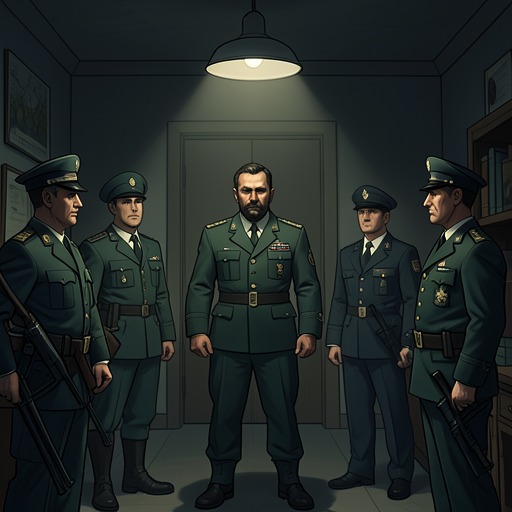
In December, after his termination-of-engagement leave, the narrator travels through rain to the War Office. He is self-conscious about naming it to taxi drivers, and the cab leaves him at the Whitehall Place door; he has to walk around the block to reach the Horseguards Avenue entrance. The approach is marked by a parked Champ vehicle and an army corporal, while inside, long, dark, dirty passages run past green-painted doors identified by small, precisely lettered cards.
Room 134 makes no grander impression than the corridors. Its standard furnishings include four green filing cabinets, two metal cupboards, desks fixed face to face beside the window, and a half-full bag of Tate and Lyle sugar on the sill. The details establish the War Office as a place of routine administration rather than ceremony: even a consequential change in the narrator’s career begins in a plainly equipped room.
Military Intelligence and Ross
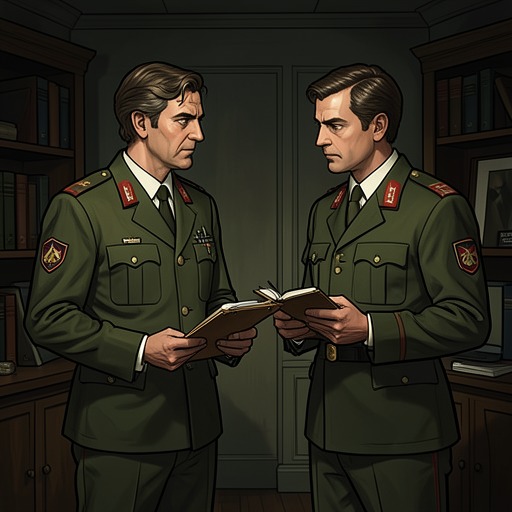
The narrator has come to see Ross, a regular officer whose attention is absorbed by his writing when the visitor enters. Their relationship is an established mutual dislike expressed through formal politeness. Ross’s carefully managed appearance and conventional habits accompany an equally conventional working life, described as a day of rubber stamps and carbon paper beginning with his journey through Waterloo.
The meeting marks a divide between their professional paths. Ross is content to work within the department’s strict limitations; the narrator, by contrast, is about to leave the Army and Military Intelligence. The War Office is therefore not just the institution he is leaving, but the setting in which that departure becomes explicit: he is to work as a civilian with civilians in WOOC(P), one of the smallest and most important intelligence units.
Personnel Reclassification
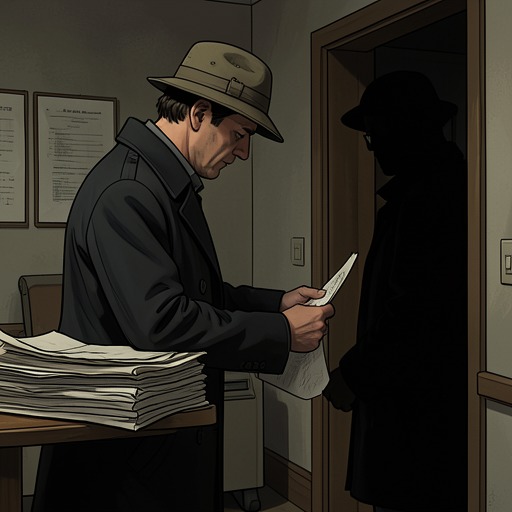
The War Office also houses the process that makes a change of identity administratively real. On a Thursday, the narrator goes to a small room at the top of the building, where Mr Nevinson runs the documents department with a group of civilian clerks. Their work is continuous, and their security clearance is exceptionally high; they are themselves under constant security surveillance. Papers for every important agent in HM Govt employ pass through their hands at some point.
Changing papers is not simply a matter of issuing a new passport. The procedure involves photographs, documents, fingerprints, and other complications. Mr Nevinson’s staff create new records across the narrator’s life, including a birth certificate, radio and television licences, and marriage certificates, while thoroughly destroying the old ones. The narrator is told the process takes four days; on this visit, it begins with a camera, repeated signatures, and the collection of fingerprints.
Records and Erasure
The department’s thoroughness is illustrated by the narrator’s school photographs. His picture appeared in the Burnley Daily Gazette in July 1939 after he won the fifth-form mathematics prize; the following year, a class photograph included the whole sixth form. Attempts to find those newspaper issues at the library, the newspaper’s offices, or Colindale would reveal that Mr Nevinson’s work had reached even these public traces of the narrator’s past.
That example gives the War Office’s paperwork a larger consequence than ordinary record-keeping. The narrator’s new identity requires not only documents that establish a different present but the destruction and recovery-proofing of the old one. In this account, the building’s filing cabinets and clerks connect military administration to the deliberate reconstruction of a person’s official life.