neutron bomb
The IPCRESS FileThe neutron bomb is the secret at the heart of the Tokwe test: a weapon described as a small tactical device that releases penetrating neutrons, destroying living matter while leaving machinery in working order. Its significance in the novel extends beyond its destructive capacity. Its design and effects are initially hidden behind an elaborate explanation of a different kind of bomb, while fragments of technical intelligence, surveillance equipment, and a staged explosion gradually reveal what was really tested.
Design and Claimed Effects
The appendix distinguishes the neutron bomb from a conventional H-bomb by the way its neutron radiation is produced and used. In an ordinary H-bomb, neutrons are released, but the fireball generally absorbs them before they travel far. The neutron weapon described here instead uses a pure-fission type of reaction without a fission trigger. Its explosive force, or “bounce,” comes from a temperature of one million degrees centigrade generated externally.
The released neutrons carry no electrical charge. In the account’s explanation, that allows them to travel far and fast until the air absorbs them, rather than being repelled by atoms. They can penetrate buildings and water, but their destructive effect is directed at living matter; machinery is left in working order. This contrast defines the weapon’s distinctive military purpose: it does not simply reproduce the broad physical destruction associated with a conventional blast, but separates harm to people from damage to equipment.
The appendix identifies the Tokwe explosion as a small tactical-size neutron weapon. For security, the test was presented under the pretence of a huge H-explosion. The disparity between the weapon’s actual scale and the public cover story makes secrecy part of its operating context, not merely a background condition. The text also emphasizes that neutron bombs do not require expensive or rare ingredients, making knowledge of their design attractive to smaller powers as well as larger ones.
Tokwe’s Misleading Briefing
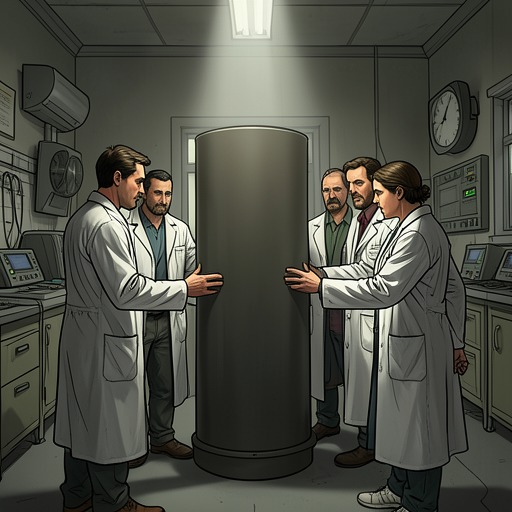
At Laboratory Field, an army major first explains a fractional critical bomb. He describes how compressing uranium or plutonium with high explosives can produce an explosion with less than a full critical mass. He then discusses changes that could dispense with tritium and refrigeration, making a bomb cheaper and easier to produce. This technical lesson gives the visitors a framework for understanding the project, but it does not disclose the secret device that will matter later.
The major’s account of the Tokwe weapon shifts to a fission-fusion-fission design. He describes a uranium-238 layer around a trigger and notes that this arrangement produces substantial fallout as well as a large energy release. He then contrasts it with a hypothetical high-explosive-to-fusion reaction, which he says has not been achieved and may be impossible. The apparent lesson is that Tokwe’s bomb contains nothing inside its central space: instead, a Super Volt Micro Flash mechanism outside the bomb supplies an intense, brief voltage through an umbilical cord. The major calls it the first entirely clean bomb, presenting the absence of an atomic trigger as the reason it would produce no fallout.
The briefing gives the device an immense apparent scale. It is described as a fifty-megaton bomb capable of causing Type 2 destruction across a thirty-five-mile radius, with flammable material destroyed and severe damage to metal and brick. The major illustrates the radius by comparing it with distances between named towns in the United States and England. Those estimates belong to the explanation given to the visitors; the appendix later identifies the weapon actually tested at Tokwe as small and tactical. The mismatch exposes the briefing as an incomplete account of the test rather than a reliable description of its true weapon.
Clues in the Bunker and the Transmission
The hidden intelligence first appears in an apparently ordinary cranberry box inside a Japanese bunker. Beneath an empty crate marked with an American name and date, Unnamed narrator finds a new box containing a short-pattern cathode-ray tube, transistors, an envelope, and a machine-pistol. The envelope holds a slip with a very-low-frequency radio wavelength, a compass bearing, and mathematical symbols. Jean asks whether Unnamed narrator can read Russian; he recognizes the Russian script for neutron bomb. He returns the slip to the box and destroys the envelope rather than keeping it, an action that later proves consequential.
The later explanation makes the slip’s details legible. The very-low-frequency wavelength is a standard means of communicating with submerged submarines, while the compass bearing sets the electro-gyroscope of the camera. The clue links the bomb investigation to a system for transmitting and recording images, not simply to a written description of the weapon. Unnamed narrator’s decision not to put the slip in his pocket is described as his only luck in the affair: retaining it might have connected him more directly to the concealed equipment.
The Brigadier explains how high-speed electrical impulses can carry a television picture for later, slower reading. A camera-transmitter small enough for one person to carry was directed toward the mountain; even when the camera was joggled, the rapid transmission produced clear pictures. The distinction matters because the neutron weapon is described as hanging over a city and bombarding it with neutrons, rather than producing only one large flash like an H-bomb. A still image would show little or nothing of its progress, so the test required moving pictures.
Afterward, the authorities show Unnamed narrator the twisted remains of a High Speed TV unit. The heavy handles are less distorted than its thin metal casing, and investigators have recovered what appear to be his fingerprints from it. He insists in his account that he never touched the unit, yet those prints make the equipment part of the case against him. The transmission apparatus thus serves two opposed functions: it can record the progress of a weapon whose effects unfold over time, and its physical traces can be used to implicate someone in the operation.
The Test and Its Aftermath
The explosion itself is registered through a brief, startling change in the scene: while Unnamed narrator waits for a cigarette lighter, the sky suddenly becomes bright. The moment does not explain what has detonated. Only later does the Brigadier connect the previous night’s party with secret experiments on the mountain and confirm Unnamed narrator’s inference that a neutron device was being inserted into the bomb. The information supplied earlier about a uranium-238 bomb and a Super Volt Micro Flash trigger had been true, but it had not been the whole story. A team was brought into the explosion area to modify the device.
The revelation changes the meaning of the test from a demonstration of the publicly described clean bomb into a concealed neutron-weapon experiment. The huge H-explosion account functions as cover, while the footage and the bunker slip preserve clues to what was actually happening. The object’s identity is therefore disclosed in stages: first as a phrase in Russian script, then as the purpose behind a camera and its transmission system, and finally as the weapon the appendix names outright.
The test’s surveillance apparatus also becomes part of a separate framing scheme. A wooden contraption later shown to Unnamed narrator is fitted with red automobile lights and attached to a motorcycle too small to register on radar. Dalby moved the arrangement across the road and used wires to kill the sole witness. He then used the High Speed TV unit and threw it into the sea near Unnamed narrator’s car, relying on its discovery and the narrator’s proximity to implicate him. The connection does not make the motorcycle part of the bomb, but it shows how the same test environment and recording technology were turned into instruments for manufacturing evidence. The neutron bomb’s secrecy provides the setting for a wider struggle over who can control what the test appears to prove.
Narrative Significance
The neutron bomb is presented both as a technical object and as a contested secret. The major’s chalk diagrams, measurements, and confident explanations give the visitors a detailed picture of the project while leaving its decisive alteration concealed. The later account does not erase those explanations; it reinterprets them, separating information that was accurate from information that was strategically incomplete. That structure makes technical knowledge itself a source of suspense: the facts are present before their meaning is clear.
The weapon’s stated ability to kill living matter while sparing machinery gives the phrase “clean bomb” a sharp irony. Cleanliness describes the claimed absence of fallout in the major’s account, not an absence of human cost. The appendix’s account of the neutron weapon makes that distinction unavoidable. At the same time, the bomb’s tactical scale and the cover story of a huge H-explosion show how the appearance of a test can be made to conceal its actual purpose. The object shapes the plot not only through what it can do, but through the intelligence, images, and false evidence gathered around it.