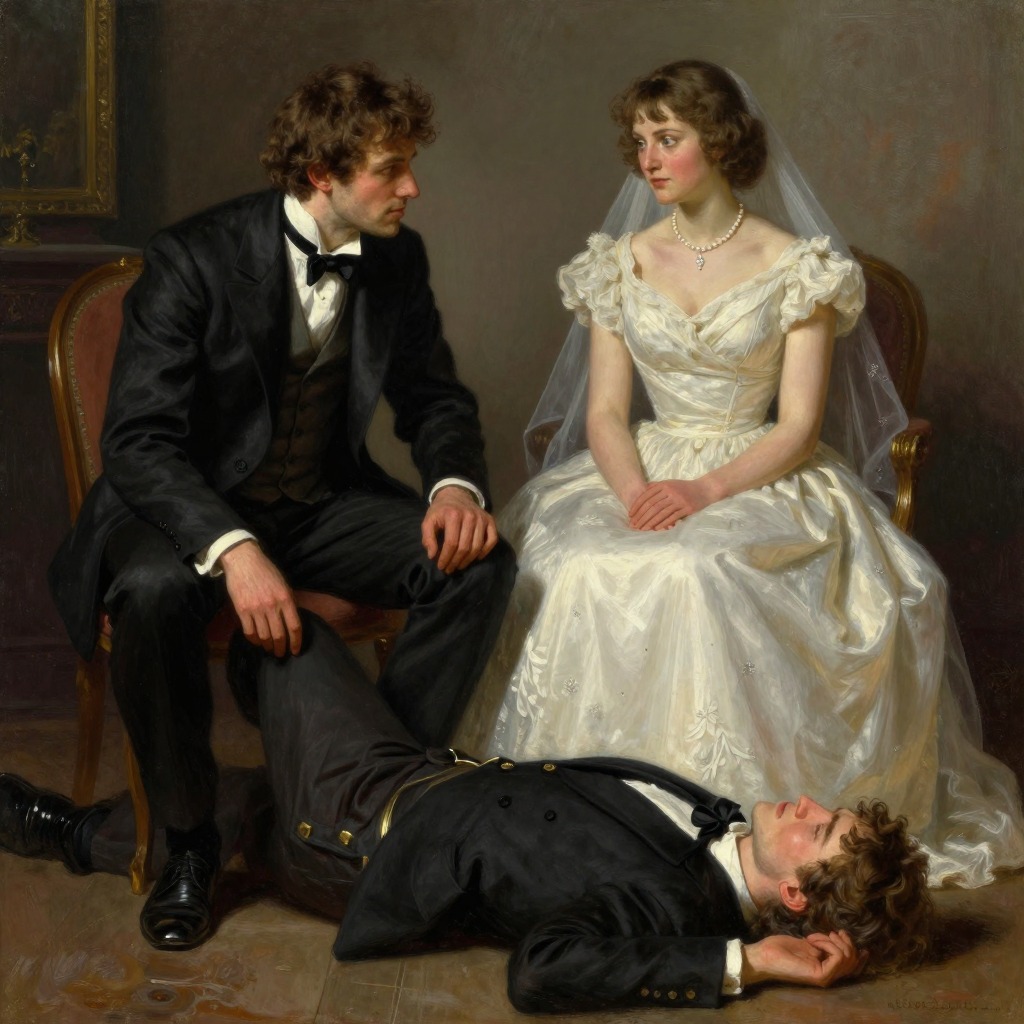
Aglaya's note to Gania
The IdiotAglaya Ivanovna Epanchin, the youngest and most capricious daughter of General Epanchin, wrote a short, unsigned note to Gavrila Ardalionovitch Ivolgin, summoning him to a private meeting at the green bench in the park at seven o'clock the following morning. The note, which Varvara Ardalionovna Ptitsin discovered and showed to her brother, read: "GAVRILA ARDOLIONOVITCH,—persuaded of your kindness of heart, I have determined to ask your advice on a matter of great importance to myself. I should like to meet you tomorrow morning at seven o'clock by the green bench in the park. It is not far from our house. Varvara Ardalionovna, who must accompany you, knows the place well. A. E." This was the same bench Aglaya had pointed out to Prince Muishkin during their walk, telling him she sometimes sat there alone early in the morning. The note was written and folded hastily, probably just before Aglaya came down to the verandah the previous evening, and it represented a decisive, secretive move on her part, bypassing the formal channels of her family's social negotiations.
Context and Background
The note arrived at a moment of intense family and social pressure. Aglaya's parents were anxious about her future, and rumors of her engagement to Prince Muishkin were circulating, though she had publicly denied any such intention. At the same time, Gavrila Ardalionovitch Ivolgin, a proud and ambitious young man from a struggling family, had been nursing hopes of winning Aglaya's hand, encouraged by his sister Varvara's persistent efforts to advance his cause within the Epanchin household. The note thus cut through the web of parental negotiations and social expectations, placing the initiative directly in Aglaya's hands.
The Meeting and Its Aftermath
When Gania arrived at the green bench the next morning, accompanied by his sister Varvara, he found not only Aglaya but also Hippolyte Terentieff, who had come on his own business. Aglaya, blushing and confused at the unexpected audience, quickly dismissed Gania and Varvara with a formal expression of gratitude for their "kind wishes," effectively ending the meeting before it had properly begun. She told them she had only come to thank them and to say that if she needed their services, she would let them know. Gania and Varvara left, looking foolish and defeated. The note, however, had already served its purpose: it had drawn Gania into a compromising position and demonstrated Aglaya's willingness to act independently of her family's wishes.
The Note's Journey and Significance
The note itself became a pawn in the intrigues surrounding the prince and the Epanchin household. It was intercepted by Lukian Timofeyovitch Lebedeff, who stole it from his daughter Vera and attempted to use it to ingratiate himself with Lizabetha Prokofievna Epanchin. Lebedeff brought the note to the prince, suggesting they open it, but the prince refused and instead had it delivered directly to Gania through Colia Ivolgin. The note thus passed through several hands before reaching its intended recipient, a journey that mirrored the complex web of surveillance, suspicion, and manipulation that characterized the relationships among the novel's central characters. For Gania, the note represented a last, tantalizing hope of social advancement through marriage to Aglaya, a hope that was swiftly and humiliatingly dashed at the green bench. For Aglaya, the note was a bold assertion of her own agency, a declaration that she would not be merely a passive object in the marriage market but would take control of her own destiny, even if that meant acting in secret and against the expectations of her family and society.