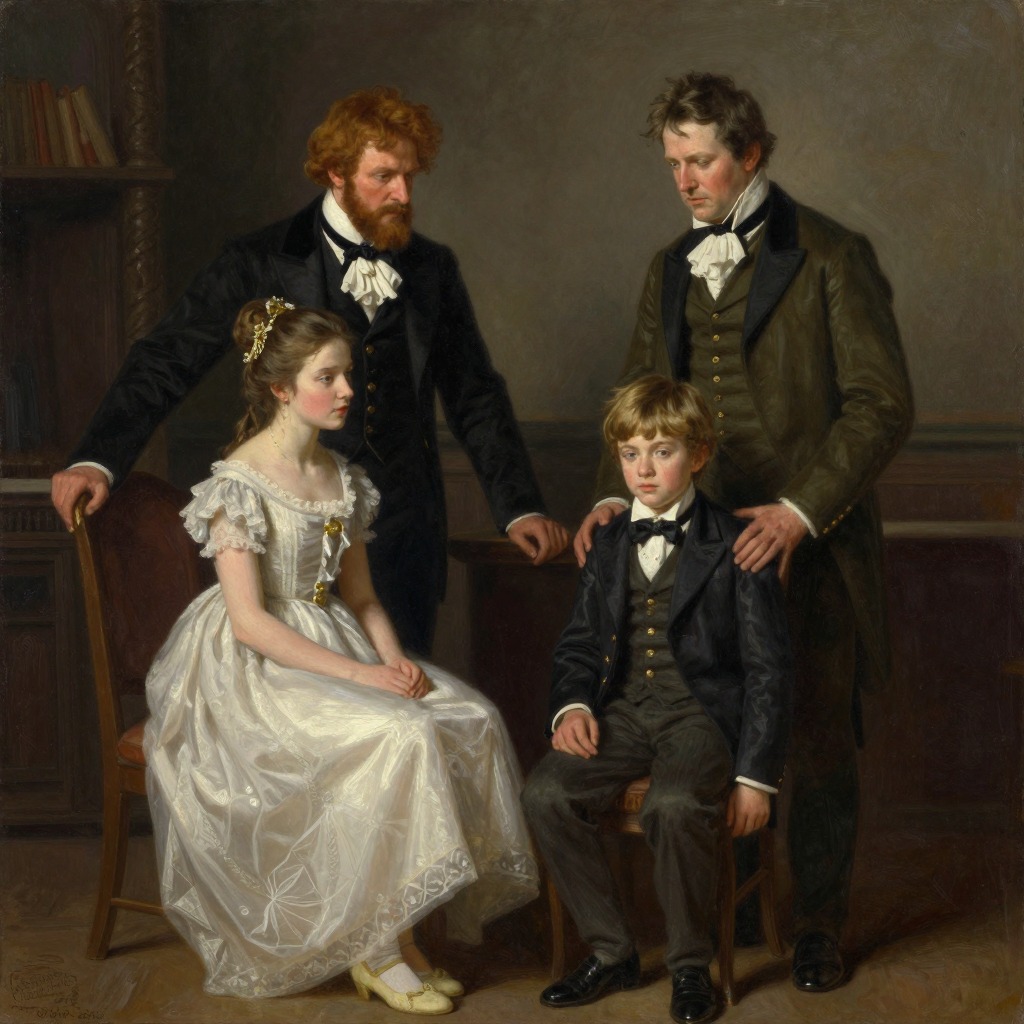
Alexandra Ivanovna Epanchin
The IdiotAlexandra Ivanovna Epanchin is the eldest daughter of General Ivan Fedorovitch Epanchin and Lizabetha Prokofievna Epanchin, a young woman of twenty-five whose quiet, observant nature and hidden depths of feeling set her apart from her more vivacious sisters. Though often dismissed by her mother as a "wet hen" for her calmness and reserve, Alexandra possesses a sharp intelligence, a capacity for deep sympathy, and a secret sorrow that the prince, with his uncanny insight, immediately detects. Her role in the novel is that of a steady, mediating presence within the volatile Epanchin household, and her own thwarted romantic prospects—most notably the broken engagement to Afanasy Ivanovitch Totski—reveal the pressures and compromises faced by women of her class.
Identity and Background
Alexandra is the eldest of the three Epanchin daughters, aged twenty-five as the story opens. She is described as "decidedly pretty, even the eldest, Alexandra, who was just twenty-five years old" . The three sisters are "very fond of one another, and supported each other in every way" . Alexandra is musical, and the world speaks well of the girls, though they are not without their enemies . She is physically robust, like her sisters, with "good shoulders and busts, and strong—almost masculine—hands" and "capital appetites" . Her mother, Lizabetha Prokofievna, often consults her in difficulties, valuing her judgment, yet also calls her a "wet hen" because "she is so calm; nothing rouses her" .
Arc Through the Plot
Alexandra's most significant plot arc involves her near-marriage to Afanasy Ivanovitch Totski. Totski, a wealthy and refined gentleman of fifty-five, seeks to marry well and approaches General Epanchin with a proposal for one of his daughters (E00338-E00339). The sisters, in their private agreement, have decided that all is to be sacrificed for Aglaya's sake, and that one of the two elder girls would probably accept Totski's offer (E00342-E00343). Alexandra is the one who "would very likely be disposed to listen to a proposal" . She is described as "a good-natured girl, though she had a will of her own. She was intelligent and kind-hearted, and, if she were to marry Totski, she would make him a good wife. She did not care for a brilliant marriage; she was eminently a woman calculated to soothe and sweeten the life of any man" . However, the engagement is eventually broken off after the scandalous events at Nastasia Philipovna's birthday party, much to the joy of Mrs. Epanchin, who announces she is "ready to cross herself with both hands" in gratitude for the escape .
Relationships and Conflict
Alexandra's relationship with her mother is complex. Lizabetha Prokofievna, though she respects Alexandra's judgment, is often puzzled and irritated by her calmness. She wonders, "What is the matter with her? Is she a Nihilist, or simply a fool?" . Alexandra's dreams, which are "as innocent and naive as those of a child of seven," annoy her mother, and once, when she dreams of nine hens, it causes a serious quarrel (E02886-E02887). Yet Alexandra also serves as her mother's "confidential adviser" . She is the one who, during the family's crisis over the prince, tries to calm her mother and offer sensible counsel. She also engages in intellectual debate, notably with Evgenie Pavlovitch Radomski, whom she accuses of taking "some accidental case and twisted it into a universal law" .
Change and Ending
Alexandra's fate is left somewhat open at the novel's end. After the family's departure from Pavlofsk and the tragic conclusion of the prince's story, she is present with her family when they visit the prince at Dr. Schneider's establishment in Switzerland (E05539-E05540). She is described as being "deeply grateful" to Evgenie Pavlovitch for his kindness to the prince . There is no final resolution to her own romantic prospects, though the novel hints that she may eventually marry, perhaps to the elderly gentleman who is a friend of the family and who, Lizabetha Prokofievna believes, intends to offer for her .
Thematic Significance
Alexandra represents a type of quiet, intelligent womanhood that is often overlooked in the novel's more dramatic conflicts. Her calmness and reserve are not signs of emptiness but of a deep, unspoken strength. The prince, in his first visit to the Epanchins, reads her face and says, "You too, Alexandra Ivanovna, have a very lovely face; but I think you may have some secret sorrow. Your heart is undoubtedly a kind, good one, but you are not merry. There is a certain suspicion of 'shadow' in your face, like in that of Holbein's Madonna in Dresden" . This observation, which Alexandra does not deny, suggests a hidden depth of feeling and perhaps a resignation to a life that has not fulfilled her deepest desires. Her character serves as a foil to the more passionate and impulsive Aglaya, and her quiet endurance highlights the different ways women navigate the constraints of their society.