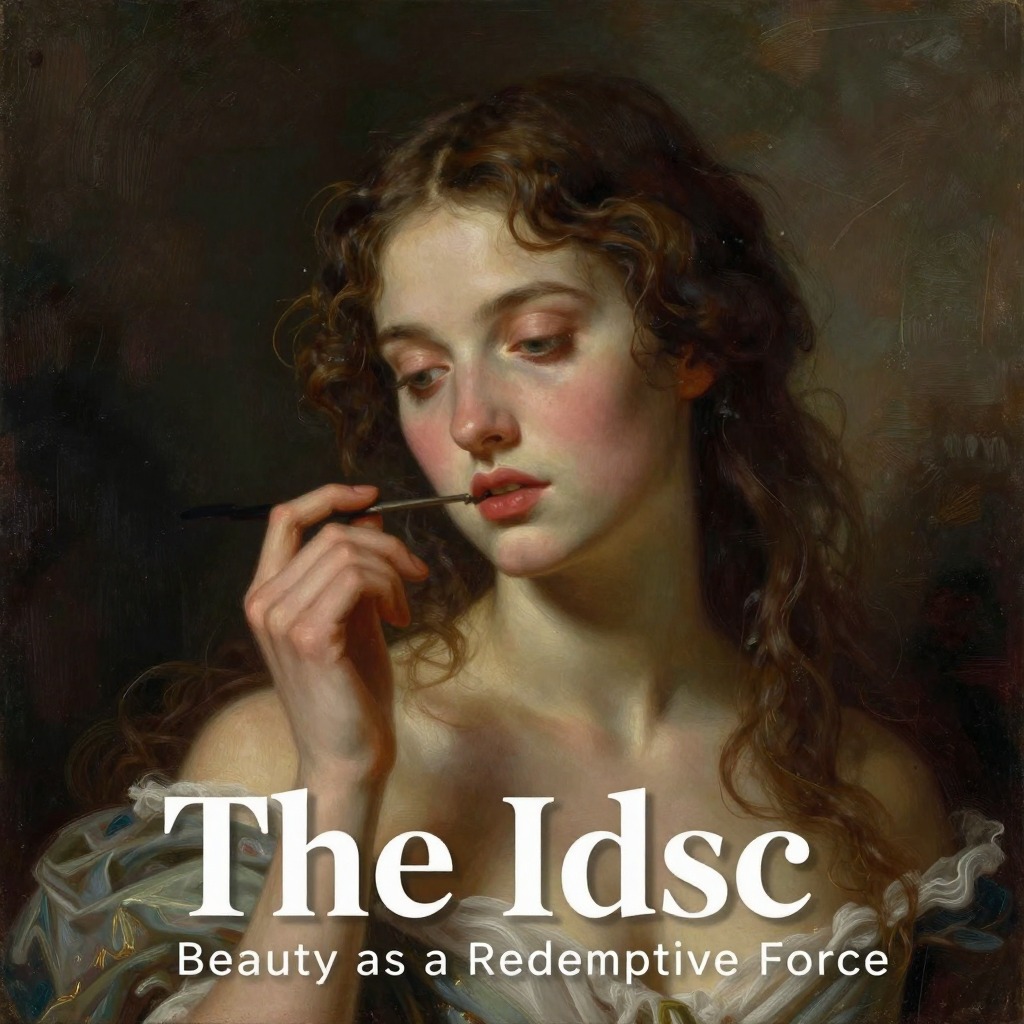
Beauty will save the world
The IdiotBeauty will save the world is a phrase that crystallizes the central philosophical and spiritual vision of Prince Lef Nicolaievitch Muishkin in Fyodor Dostoevsky's novel The Idiot. The expression is first spoken by the prince during a conversation with the Epanchin sisters, when he declares that beauty is a riddle and that Nastasia Philipovna's face, with its combination of pride, suffering, and innocence, embodies a power that could overthrow the world. This idea recurs throughout the novel as a touchstone for the prince's belief that genuine beauty—moral, spiritual, and physical—possesses an inherent redemptive force capable of countering the chaos, cynicism, and despair that pervade human life. Yet the narrative relentlessly tests this conviction, juxtaposing it against the destructive passions of Rogojin, the self-lacerating pride of Nastasia, and the nihilistic despair of Hippolyte, so that the phrase becomes both a luminous article of faith and a source of profound dramatic irony.
Origin and Context of the Expression
The prince first articulates the idea that beauty is a riddle during his initial visit to the Epanchin household, when Adelaida asks him to judge Aglaya's beauty. He responds, "It is difficult to judge when such beauty is concerned. I have not prepared my judgment. Beauty is a riddle," and then adds that Aglaya is "almost as lovely as Nastasia Philipovna, but quite a different type." This moment establishes the prince's characteristic mode of perception: he sees beauty not as a mere aesthetic quality but as a mystery that demands interpretation. Later, when Adelaida examines Nastasia's portrait, she exclaims, "Such beauty is real power. With such beauty as that one might overthrow the world." The prince, who has been gazing at the same portrait, murmurs that there is "much suffering in this face," linking beauty directly to pain and to a destiny that is "not by any means an ordinary, uneventful one." The phrase "beauty will save the world" itself is explicitly invoked by Hippolyte, who mockingly attributes it to the prince: "Is it true, prince, that you once declared that 'beauty would save the world'? Great Heaven! The prince says that beauty saves the world!" This citation, though delivered with sarcasm, confirms that the idea has become a recognizable part of the prince's public identity.
The Prince's Understanding of Beauty and Redemption
For Muishkin, beauty is inseparable from compassion and from the recognition of suffering in others. When he first sees Nastasia's portrait, he is struck not only by her "marvelous beauty" but by the "suggestion of immense pride and disdain in the face almost of hatred, and at the same time something confiding and very full of simplicity." He feels that her face calls out for help, and this perception drives his subsequent actions. The prince's love for Nastasia is explicitly a love of pity rather than passion; he tells Rogojin, "I do not love her with love, but with pity." This pity is the practical expression of his belief that beauty, when recognized as a form of suffering, can inspire the kind of selfless devotion that redeems both the beholder and the one beheld. The prince's own face, described as "decidedly a pleasant one" but "quite colourless," and his epileptic condition, which he calls "idiocy," mark him as an unlikely vessel for such a grand idea, yet his sincerity and simplicity give the phrase its force. He lives the belief that beauty, understood as the radiance of innocence and goodness, has the power to awaken love and to overcome the darkness of the world.
The Irony of Beauty in the Novel's Tragic Arc
The narrative, however, subjects the prince's faith to a devastating critique. Nastasia Philipovna's beauty, far from saving anyone, becomes the catalyst for jealousy, violence, and death. Rogojin is consumed by a passion that mingles love with hatred, and he ultimately murders her. The prince himself, in the climactic confrontation between Aglaya and Nastasia, is paralyzed between two women, unable to act decisively. When Aglaya asks him whether he loves Nastasia, he replies, "No, I do not love her. Oh! if you only knew with what horror I recall the time I spent with her!" Yet he also tells Evgenie Pavlovitch that he loves Nastasia "with all my soul" and that she is "a child." This contradiction reflects the prince's inability to reconcile his ideal of redemptive beauty with the messy, destructive reality of human passion. Hippolyte, in his "Necessary Explanation," directly challenges the prince's optimism, arguing that nature is a "blind, dumb, implacable, eternal, unreasoning force" that crushes even the most beautiful beings. He points to Holbein's painting of the dead Christ, a work that depicts the Saviour's body as a mangled corpse, and asks how anyone could believe in resurrection after seeing such an image. This painting, which hangs in Rogojin's house, becomes a visual counter-argument to the prince's faith: if beauty itself can be so utterly destroyed, how can it save anything?
The Phrase as a Test of Faith and a Measure of Tragedy
Despite the tragic outcome, the phrase "beauty will save the world" retains its power as a measure of what is lost. The prince's final descent into idiocy, sitting beside Rogojin and the body of Nastasia, stroking the murderer's face as if to soothe him, is a scene of utter desolation. Yet even here, the prince's gesture—his trembling hand passing over Rogojin's hair and cheeks—is an act of compassion that echoes his earlier words. He does not condemn; he comforts. The beauty he believed in was not the beauty of physical perfection but the beauty of a soul that refuses to hate. In this sense, the phrase is not refuted by the novel's violence but rather fulfilled in a mode that is tragic rather than triumphant. The world is not saved in any conventional sense, but the prince's unwavering commitment to pity and forgiveness stands as a permanent challenge to the cynicism and despair that surround him. The expression thus functions as both a prophecy and an epitaph, a luminous ideal that the novel's events cannot realize but also cannot entirely extinguish.