Epilepsy
The IdiotEpilepsy is the defining medical and metaphysical condition of Prince Lef Nicolaievitch Muishkin, shaping his narrative identity, his moments of transcendent insight, and the catastrophic social consequences of his seizures. The novel presents epilepsy not merely as a neurological disorder but as a paradoxical state that grants the sufferer a fleeting, ecstatic clarity while simultaneously marking him as an 'idiot' in the eyes of society and precipitating his ultimate collapse.
The Prince's Condition and Its Origins
Prince Muishkin suffers from a severe form of epilepsy with convulsive spasms, a malady that has dominated his life since childhood. He was sent abroad from Russia to Switzerland for treatment, spending more than four years under the care of Professor Schneider at his establishment. The prince himself describes his past state with brutal honesty: his fits were so frequent that they made almost an idiot of him, and he uses the word "idiot" to characterize his former self. Although the treatment did not cure him, it greatly improved his condition. The prince's appearance bears the physical markers of his illness: his large blue eyes have an intent look, yet that heavy expression which some people affirm to be a peculiarity as well as evidence of an epileptic subject. His face is decidedly pleasant, refined, but quite colourless, except when it is blue with cold. The prince acknowledges that his illness prevented him from learning much, as they could not teach him very much on account of his malady. He also states plainly that he cannot marry at all because he is an invalid.
The Epileptic Aura: Ecstasy and the Suspension of Time
The most remarkable feature of Muishkin's epilepsy is the pre-seizure aura, a moment of extraordinary consciousness that he describes with profound intensity. Immediately preceding his fits, he always experienced a moment or two when his whole heart, mind, and body seemed to wake up to vigour and light; he became filled with joy and hope, and all his anxieties seemed to be swept away for ever. These moments were but presentiments, as it were, of the one final second in which the fit came upon him. The prince reflects that these instants, short as they are, when he feels such extreme consciousness of himself, and consequently more of life than at other times, are due only to the disease—to the sudden rupture of normal conditions. Therefore they are not really a higher kind of life, but a lower. This reasoning, however, seems to end in a paradox: what matter though it be only disease, an abnormal tension of the brain, if when he recalls and analyzes the moment, it seems to have been one of harmony and beauty in the highest degree—an instant of deepest sensation, overflowing with unbounded joy and rapture, ecstatic devotion, and completest life? The prince cannot doubt that there is indeed beauty and harmony in those abnormal moments, that they really contain the highest synthesis of life. He feels then as if he understood those amazing words—'There shall be no more time.' He adds with a smile that no doubt the epileptic Mahomet refers to that same moment when he says that he visited all the dwellings of Allah in less time than was needed to empty his pitcher of water. For the rest, the prince thinks the dialectical part of his argument of little worth; he sees only too clearly that the result of these ecstatic moments is stupefaction, mental darkness, idiocy.
The Seizure as a Social Catastrophe
The prince's epilepsy erupts into the social world at the most critical juncture of his life, transforming a moment of personal crisis into a public scandal. During the formal evening party at the Epanchins' house, where he is to be presented to Princess Bielokonski and other eminent guests, the prince delivers a passionate, feverish tirade about Russian spirituality, Roman Catholicism, and the destiny of his class. As he speaks his last words, he rises suddenly from his seat with a wave of his arm, and the huge Chinese vase behind him topples and crashes to the floor. The crash, the cry, the sight of the fragments of valuable china covering the carpet, the alarm of the company—all this overwhelms the prince. He stands still in alarm, in almost superstitious alarm, for a moment; then all mists seem to clear away from his eyes; he is conscious of nothing but light and joy and ecstasy. But the moment passes. Aglaya rushes quickly up to him and is just in time to receive him in her arms, and to hear with dread and horror that awful, wild cry as he falls writhing to the ground. There he lies on the carpet, and someone quickly places a cushion under his head. The fit is slight, but its consequences are devastating: the party breaks up, the guests depart, and the Epanchin family's hopes for the match are shattered. Princess Bielokonski declares that the prince is an invalid, and Lizabetha Prokofievna decides that he is impossible as a husband for Aglaya.
The Attack as a Shield Against Violence
On one occasion, the prince's epileptic fit directly saves his life. Rogojin, consumed by jealous rage, lies in wait for Muishkin in the dark niche of the hotel staircase, a knife in his hand. As the two men stand face to face, Rogojin's right hand is raised, and something glitters in it. The prince does not think of trying to stop it. All he can remember afterwards is that he seemed to have called out: 'Parfen! I won't believe it.' Next moment something appears to burst open before him: a wonderful inner light illuminates his soul. This lasts perhaps half a second, yet he distinctly remembers hearing the beginning of the wail, the strange, dreadful wail, which bursts from his lips of its own accord. Next moment he is absolutely unconscious; black darkness blots out everything. He has fallen in an epileptic fit. The face, especially the eyes, become terribly disfigured, convulsions seize the limbs, a terrible cry breaks from the sufferer, a wail from which everything human seems to be blotted out. Many people cannot behold an epileptic fit without a feeling of mysterious terror and dread. Such a feeling overtakes Rogojin at this moment, and saves the prince's life. Not knowing that it is a fit, and seeing his victim disappear head foremost into the darkness, hearing his head strike the stone steps below with a crash, Rogojin rushes downstairs, skirting the body, and flings himself headlong out of the hotel, like a raving madman.
The Final Collapse
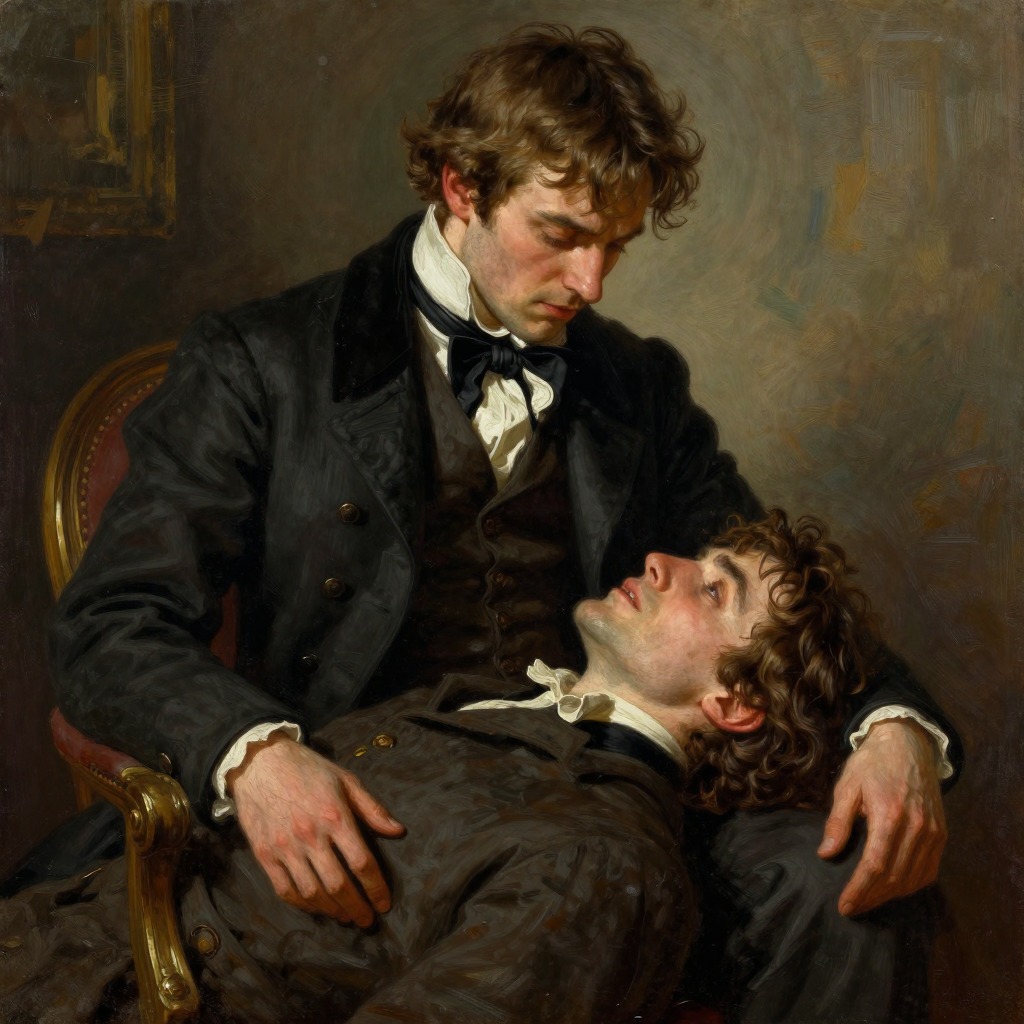
In the novel's final scene, the prince's epilepsy returns with full force, marking the irreversible dissolution of his mind. After Rogojin's murder of Nastasia Philipovna, the prince spends the night beside the body, lying on the cushions next to the murderer. When the door is opened and people throng in, they find the murderer unconscious and in a raging fever. The prince is sitting by him, motionless, and each time that the sick man gives a laugh or a shout, he hastens to pass his own trembling hand over his companion's hair and cheeks, as though trying to soothe and quiet him. But he understands nothing of what is said to him, and recognizes none of those who surround him. If Schneider himself had arrived then and seen his former pupil and patient, remembering the prince's condition during the first year in Switzerland, he would have flung up his hands, despairingly, and cried, as he did then: 'An idiot!' The prince is returned to Schneider's establishment in Switzerland, where Dr. Schneider frowns ever more and more and shakes his head; he hints that the brain is fatally injured; he does not as yet declare that his patient is incurable, but he allows himself to express the gravest fears.