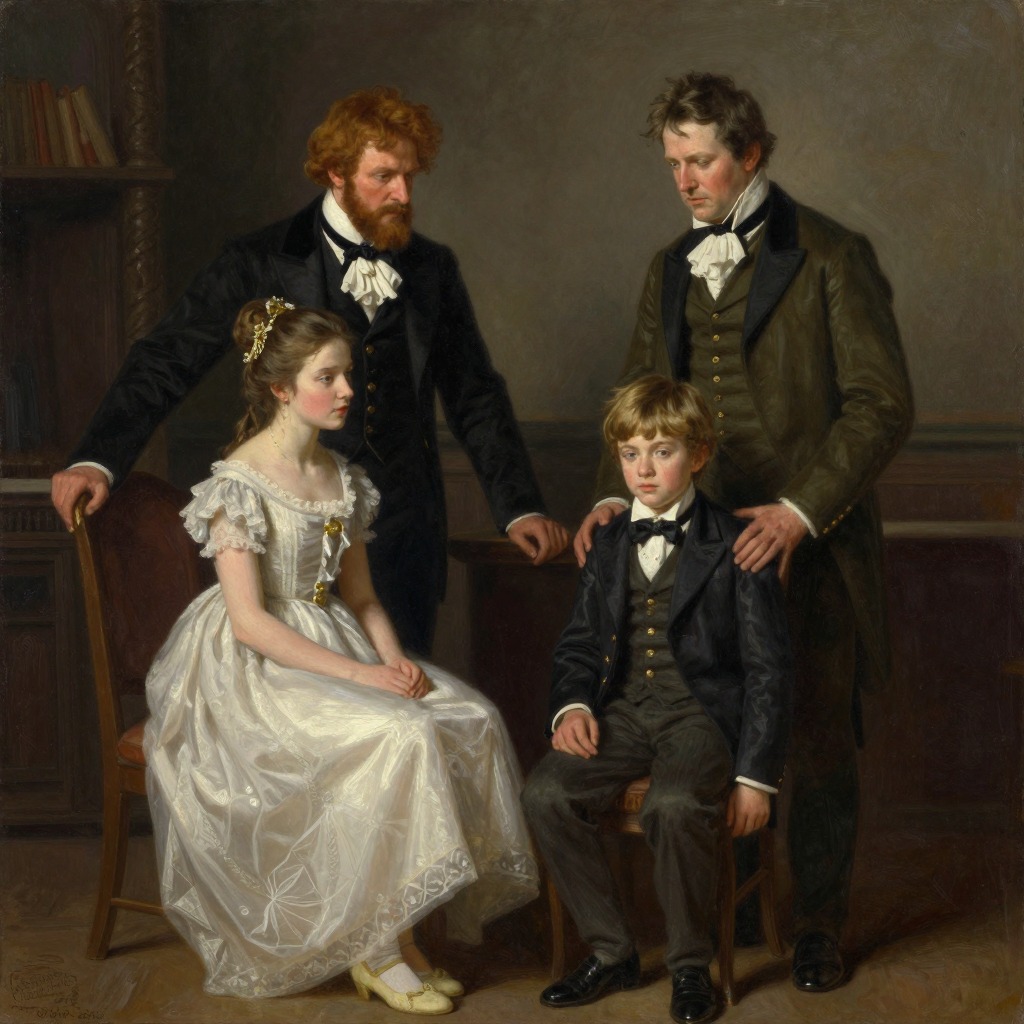
Evgenie Pavlovitch Radomski
The IdiotEvgenie Pavlovitch Radomski enters the novel as a brilliant and enigmatic figure whose sudden retirement from the army and ambiguous financial affairs set the stage for a scandal that exposes the fault lines of Petersburg high society. He is introduced as a young officer of about twenty-eight, tall and well built, with a handsome and clever face and bright black eyes full of fun and intelligence. His arrival at the Epanchin villa in plain clothes rather than uniform causes a stir, for he had always spoken of his intention to leave the service as a joke, and no one had taken him seriously. The general is astonished and nearly falls down with surprise; the sisters pour out questions; Prince S., a relative, appears annoyed. Only Aglaya shows no interest, glancing at him briefly to compare civil with military dress and then turning away. The prince observes that Evgenie is not in Lizabetha Prokofievna's good graces, and that there must be more in the matter than appears.
Social Role and Wit
Evgenie Pavlovitch is a man of the world, witty, well-educated, and extremely wealthy, with a reputation for conquests among the ladies of Moscow. He becomes a frequent visitor at the Epanchin house after Prince S. introduces him, and the general quickly discovers his fortune. His past reputation is the only thing against him. In conversation he displays a sharp, ironic intelligence, particularly in a long disquisition on Russian liberalism, which he characterizes as an attack not on the existing order but on Russia itself. He argues that Russian liberals hate their own country, and that the phenomenon is unique in the world. When the prince responds with naive seriousness, Evgenie is surprised into genuine gravity, and later admits that he is not quite such an ass as he likes to appear. His wit often carries a sting; he mocks Hippolyte's obsession with the blank wall outside his window, and when Hippolyte speaks of blessing everyone before he dies, Evgenie retorts that he will never die eloquently without that wall.
The Scandal and Its Aftermath
Evgenie Pavlovitch's position is shattered when Nastasia Philipovna publicly accosts him at the Vauxhall, announcing that his uncle has shot himself after embezzling government money and that he has retired from the army just in time. The news strikes him like a thunderbolt; he grows white as a sheet. The scandal is compounded by the young officer Moloftsoff, who, after Nastasia strikes him with a cane, declares she ought to be whipped. Evgenie later arranges the matter with Moloftsoff and comes to the prince to relieve his mind, but he is clearly shaken and preoccupied. He tells the prince that he must go to town about his uncle's affairs, and that he has come to beg the prince's friendship, for he needs a true and sincere friend. He laughs, but admits he is among the number of bona fide unfortunates. The prince observes that Evgenie seems to have something else on his mind, and that his manner is less friendly than before.
Moral Seriousness and Final Role
Despite his worldly facade, Evgenie Pavlovitch reveals a capacity for genuine feeling and moral judgment. He is the one who, after the prince's epileptic fit at the Epanchin party, takes the lead in restoring harmony, though the attempt fails. He later visits the prince after the Epanchins have left Pavlofsk, and speaks with remarkable psychological insight about the prince's relations with Nastasia Philipovna and Aglaya, accusing him of having begun with a lie and ended with a lie. He tells the prince that he never loved either woman in reality, and that his love was only intellectual enthusiasm. The prince listens and agrees, but is too anguished to act. Evgenie leaves the house convinced that the prince is out of his mind. In the novel's final pages, it is Evgenie Pavlovitch who takes responsibility for the prince's fate: Colia selects him as friend and confidant, and thanks to his influence the prince is placed once more with Dr. Schneider in Switzerland. Evgenie visits the sick friend every few months, and writes letters giving minute particulars of the invalid's condition to Vera Lebedeff, with whom he has struck up a correspondence. Dr. Schneider shakes his head and hints that the brain is fatally injured, and Evgenie takes this much to heart. The novel closes with his growing friendship and sympathy for the ruined prince, a quiet testament to the heart beneath the irony.