Keller
The IdiotKeller is a retired army officer, boxer, and self-proclaimed man of noble impulses who attaches himself to Prince Lef Nicolaievitch Muishkin's circle, oscillating between drunken confessions of theft and offers of chivalrous service. He first appears among Rogojin's followers, then becomes a lodger at Lebedeff's, and later volunteers as the prince's second in a potential duel and as his best man at the abortive wedding to Nastasia Philipovna Barashkoff. His character embodies a chaotic mixture of genuine sentiment, theatrical bravado, and moral squalor that the prince treats with unexpected patience and insight.
Identity and Background
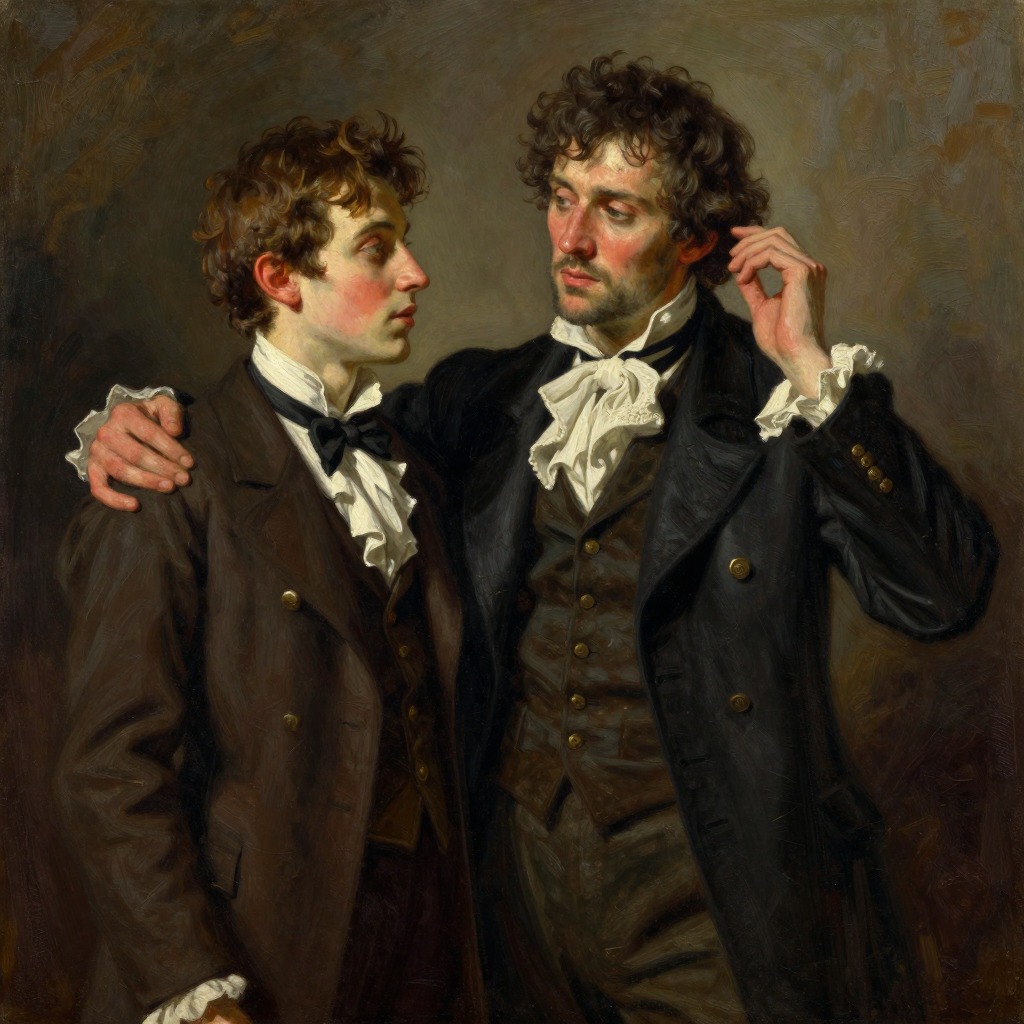
Keller is introduced as a retired officer, a boxer, and a man who in his happier days had given fifteen roubles at a time to beggars. He is one of Rogojin's followers, part of the rowdy band that invades Gania's house and later Nastasia's birthday party. When he formally introduces himself to the prince, he gives his name simply as "Keller" and announces himself as a lodger at Lebedeff's. His appearance is that of a gentleman of about thirty, tall, broad-shouldered, and red-haired, with a red face, thick lips, a wide nose, and small, bloodshot eyes with an ironical expression, as though perpetually winking at someone. His dress is shabby, and his whole appearance gives an idea of impudence.
Life Trajectory and Key Actions
Keller's trajectory through the novel is a series of impulsive, self-dramatizing gestures. After the scandalous scene at Nastasia's birthday party, he offers himself as the prince's second in a potential duel with Lieutenant Moloftsoff, declaring himself ready to sacrifice himself even to die in case of need. He later writes and publishes a scurrilous newspaper article attacking the prince on behalf of Antip Burdovsky's fraudulent claim, an act he half-defends as a matter of public interest. Yet he also becomes a regular at the prince's birthday gathering, where he drinks heavily and engages in the philosophical debates. His most sustained role comes when he volunteers to be the prince's best man at the wedding to Nastasia, a post he accepts with great delight, declaring he won't drink and offering to fire half a dozen shots if a charivari breaks out under the windows on the wedding night.
Relationships and Conflict
Keller's relationship with the prince is the most revealing aspect of his character. He approaches the prince with a confession of his life story, announcing that having ceased to believe in God Almighty, he had lost every vestige of morality and had gone so far as to commit a theft. The prince listens without condemnation, observing that Keller has a child-like mind and extreme truthfulness, which atones for much. Keller is astonished that the prince can read a man's soul like a psychologist while remaining as simple and innocent as a knight of the golden age. He admits that his confession was partly a ruse to borrow money, but the prince's non-judgmental response moves him to accept only twenty-five roubles instead of the hundred and fifty he had planned to ask for. Keller also has a running conflict with Lebedeff, whom he accuses of being a charlatan and a rascal, and he is involved in the general chaos of the Ivolgin household.
Change and Ending
Keller's character does not undergo a fundamental transformation, but he does show a capacity for genuine, if fleeting, loyalty and self-awareness. After the prince's wedding collapses and Nastasia flees with Rogojin, Keller is among those who accompany the prince home and help manage the crowd of curious onlookers. He later testifies that the prince took the news "extraordinarily philosophically." His final appearance is in the aftermath of the catastrophe, when he continues to live as before, one of the many figures in the prince's orbit who remain essentially unchanged by the tragedy.
Narrative Role and Evaluation
Keller functions as a comic and grotesque figure who nonetheless serves as a foil for the prince's extraordinary compassion. His confessions of theft and moral collapse, his theatrical offers of violence, and his drunken philosophizing all provide occasions for the prince to demonstrate his non-judgmental understanding of human weakness. Keller himself recognizes this, telling the prince that he is the only man who judges a fellow humanely. His character illustrates the novel's theme that even the most degraded individuals contain contradictory impulses toward nobility and baseness, and that the prince's peculiar gift is to see and respond to the former without being deceived by the latter.