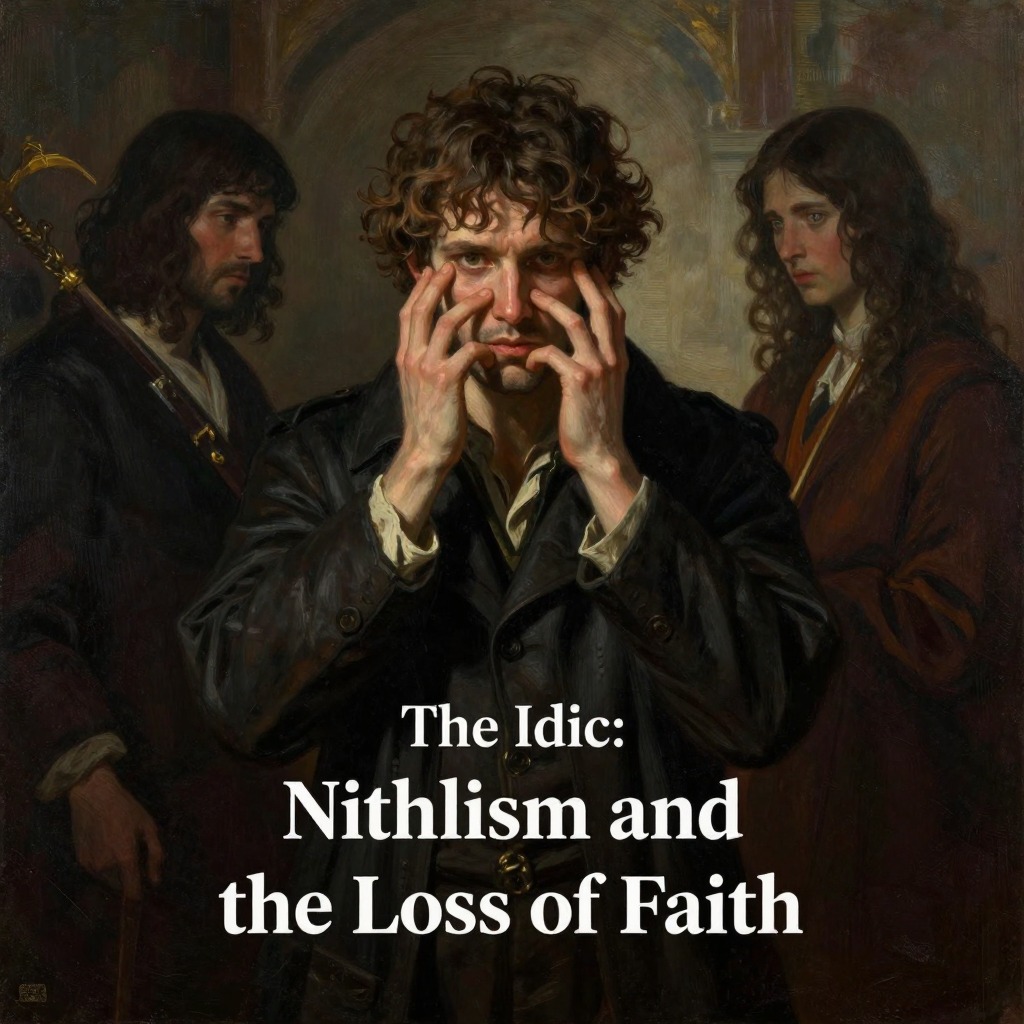
Nihilism
The IdiotIn The Idiot, nihilism appears not as a systematic philosophy but as a diffuse, combustible mood that seizes a generation of young Russians who have broken with traditional faith, family, and social hierarchy. Dostoevsky gives the phenomenon a local habitation and a name through a cluster of characters—Hippolyte Terentieff, Antip Burdovsky, Vladimir Doktorenko, and the boxer Keller—whose words and actions dramatize the spiritual and moral vacuum that nihilism both expresses and deepens. The novel does not argue against nihilism so much as stage its inner contradictions, showing how the rhetoric of negation, far from liberating its speakers, traps them in a fiercer form of the very dependencies they claim to reject.
The Social Face of Nihilism: The Burdovsky Affair
The most concentrated public display of nihilist attitudes occurs in Part II, when Burdovsky and his companions descend on the prince's Pavlovsk villa to press a fraudulent claim for money. Lebedeff, introducing them, distinguishes them from ordinary Nihilists: "This is another lot—a special group. According to my nephew they are more advanced even than the Nihilists" . They are, he says, "men of action" who "go straight to the point" and believe they have "a right to get it even at the cost of the lives, say, of eight persons" . The prince gently corrects him: "You are slandering them, Lebedeff" , but the warning has been planted. Doktorenko, Lebedeff's nephew, articulates the group's credo: they do not come to petition but to "demand"—"a proud and free demand"—grounded not in legal right but in "human law, natural law, the law of common-sense and conscience" . The claim is that Burdovsky, as the supposed son of the prince's benefactor Pavlicheff, deserves compensation not because the law says so but because justice, as they define it, requires it. Yet the entire edifice collapses when Gavrila Ardalionovitch produces evidence that Burdovsky is not Pavlicheff's son at all. The nihilist platform, built on a lie, reveals itself as a vehicle for resentment and extortion dressed in the language of principle.
Hippolyte's "Necessary Explanation": Nihilism as Personal Testament
Hippolyte Terentieff, the consumptive teenager who reads his "Necessary Explanation" aloud at the prince's birthday gathering, gives nihilism its most intimate and harrowing voice. His document is a confession, a manifesto, and a suicide note rolled into one. He has called in a medical student, Kislorodoff, who is "a Nationalist, an Atheist, and a Nihilist, by conviction" , precisely because he wants the unvarnished truth about his remaining time. The student tells him he has about a month to live, and Hippolyte accepts this with a kind of grim satisfaction. His explanation ranges over his contempt for the "commonplace people" who cling to life without knowing how to live it, his rage at the injustice of his own early death, and his determination to die by his own hand as a final act of defiance. He declares that he recognizes "no jurisdiction over myself" and that he is "beyond the power of laws and judges" . The pistol he produces misfires—a bathetic anticlimax that reduces his grand gesture to farce. Yet the failure does not entirely cancel the sincerity of his despair; it only underscores the gap between nihilist rhetoric and the messy, humiliating reality of human weakness.
The Religious Vacuum: Nihilism and the Loss of Faith
Dostoevsky roots nihilism in a crisis of belief that is both personal and historical. Rogojin, in his gloomy house, asks the prince bluntly: "do you believe in God?" . The prince, looking at a copy of Holbein's painting of the dead Christ—a picture so stark in its depiction of a mangled, un-beautified corpse that he says "a man's faith might be ruined by looking at that picture" —recognizes the spiritual abyss that nihilism fills. The painting shows a body that has suffered unbearably, with no hint of resurrection; it is nature as "some huge, implacable, dumb monster" . This is the world that nihilism inhabits: a world from which divine meaning has been evacuated, leaving only brute force and the will to power. The prince himself, in his long speech at the Epanchin party, argues that Roman Catholicism is "worse than Atheism itself" because it preaches "a disfigured, distorted Christ—it preaches Anti-Christ" , and that Atheism is "the child of Roman Catholicism" . In this genealogy, nihilism is the final, logical product of a Western rationalism that has lost contact with the living Christ of Russian Orthodoxy.
The Limits of Negation: What Nihilism Cannot Destroy
For all its ferocity, nihilism in the novel repeatedly fails to achieve its own goals. Hippolyte cannot kill himself; Burdovsky's claim collapses; the radicals' demand for justice is exposed as a shakedown. More tellingly, the nihilist posture of absolute independence—of standing outside all law and all obligation—is undercut by the characters' desperate need for recognition. Hippolyte writes his explanation because he wants an audience; he tosses a coin to decide whether to read it, and when the coin falls "heads" he submits to the result as though to fate . The gesture of supreme autonomy is immediately revealed as a plea for the attention and judgment of others. The prince, who is called an "idiot" precisely because he refuses the nihilist path of resentment and self-assertion, becomes the figure around whom the nihilists' contradictions gather. He does not argue with them; he forgives them, offers them money, and treats them as fellow sufferers. This response—which seems to them like weakness—is in fact the one thing their worldview cannot assimilate: a love that does not calculate, that does not demand, that does not negate. In the end, nihilism in The Idiot is not refuted by argument but dissolved by the presence of a man who, as Aglaya says, "is capable of living up to an ideal all his life" —an ideal that negation alone cannot touch.