Poor knight
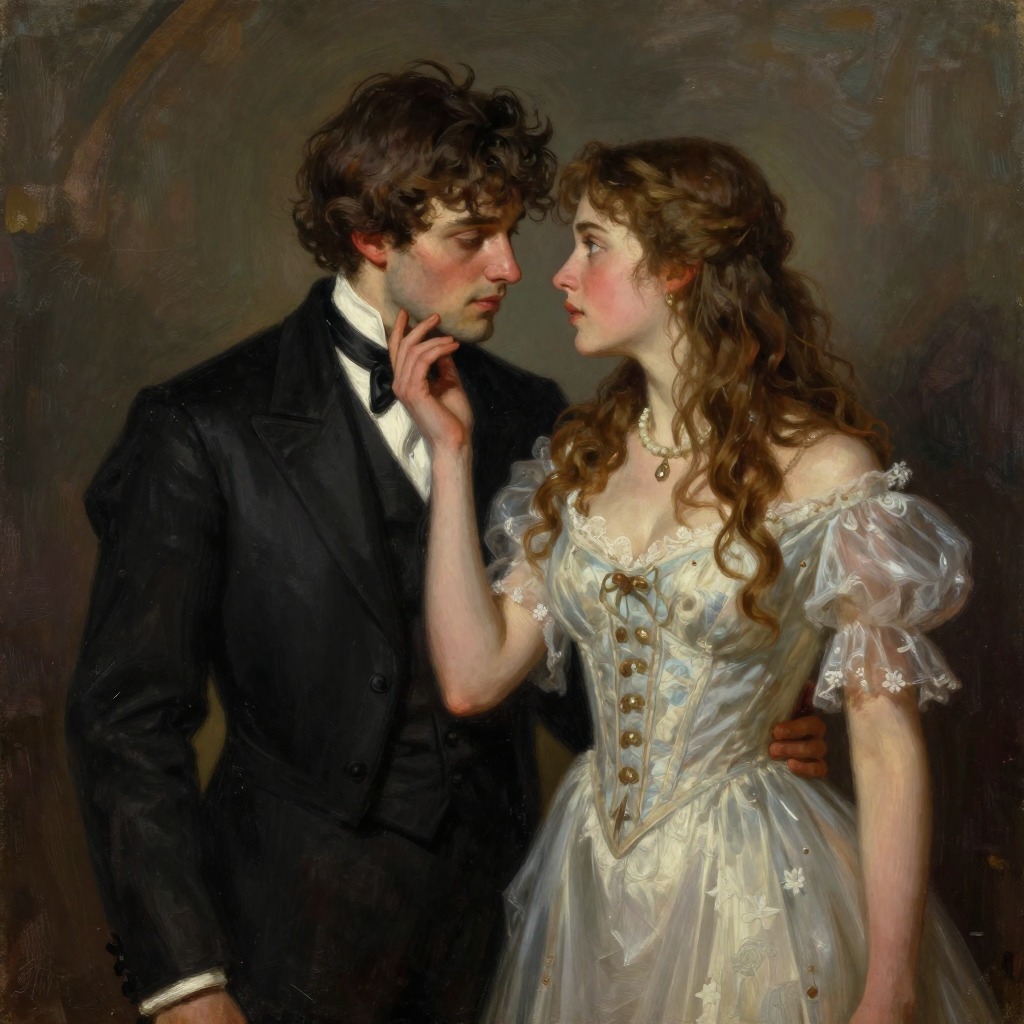
The IdiotThe "poor knight" is a literary allusion that runs through the middle sections of The Idiot as a private, ironic, and deeply ambivalent code for Prince Muishkin himself. Drawn from a Pushkin ballad, the figure of a knight who dedicates his life to an unattainable vision of pure beauty, the phrase is first introduced by the Epanchin sisters as a joke, but Aglaya gradually transforms it into a confession of her own feelings and a measure of the prince's singular nature. The motif thus becomes a lens through which the novel examines the collision between idealistic love and the mocking judgment of society.
Origin and First Appearance
The "poor knight" enters the story during a conversation on the terrace at Lebedeff's villa, when Colia Ivolgin, referring to a remark Aglaya had made a month earlier, declares that "there is nothing better than the 'poor knight'" . Prince S. and Adelaida immediately agree, and Mrs. Epanchin, baffled and irritated, demands an explanation . Colia explains that Aglaya had been turning over the pages of Don Quixote and suddenly exclaimed the phrase, though he cannot say whether she meant Don Quixote himself, Evgenie Pavlovitch, or someone else . The allusion is clearly a shared family joke, but its target remains deliberately vague—a riddle that the company enjoys precisely because it is not resolved.
Aglaya's Recitation and Its Meaning
The motif reaches its fullest expression when Aglaya, standing before the prince on the terrace, recites the Pushkin poem in full . She delivers the lines with such seriousness and exaltation that the initial affectation drops away, and her eyes glow with inspiration . The poem describes a knight who, having seen a "vision glorious, mystic, dreadful, wondrous fair," devotes his life to that single image, becoming "dumb to love and wooing" and staining his shield with the letters "N. P. B." (E02251–E02255). Aglaya then offers her own interpretation: the knight is a man capable of living up to an ideal all his life, serving his chosen vision of pure Beauty regardless of what the lady does or becomes—even if she took to stealing, he would champion her still . She explicitly compares him to Don Quixote, but a serious, not comical, version, and declares that she now loves and respects the "poor knight" .
Crucially, during the recitation Aglaya deliberately changes the initials from the poem's "A. N. B." to "N. P. B."—the prince's own initials . This substitution is not accidental; it is a premeditated, public declaration that Muishkin himself is the "poor knight" of her imagination. The prince understands this at once, and the moment leaves him deeply uncomfortable, though he cannot bring himself to believe that Aglaya could be serious.
The Motif as a Code for Muishkin
From this point, the "poor knight" becomes a shorthand that the Epanchin circle uses to refer to the prince. Evgenie Pavlovitch, who has grasped the joke, later remarks to Aglaya that "the 'poor knight' has come on the scene again" , but she rebuffs him haughtily, refusing to acknowledge the reference. The phrase also appears in Mrs. Epanchin's anxious thoughts: she connects it to the anonymous letter she has received, which alludes to the "poor knight" as part of a larger intrigue involving Aglaya and Nastasia Philipovna . When Colia later shouts "Hurrah for the 'poor knight'!" during Aglaya's outburst at the prince , the epithet has become a public, almost mocking, title for Muishkin himself.
Thematic Significance
The "poor knight" motif encapsulates the novel's central paradox about Prince Muishkin. He is, like the knight of the poem, a man devoted to an ideal of pure, selfless love—a love that transcends the actual behavior of its object. He forgives Nastasia Philipovna everything, offers her marriage despite her past, and refuses to judge her. Yet this very purity makes him appear ridiculous to society, an "idiot" who cannot navigate the world's compromises. The motif also mirrors the novel's engagement with Cervantes: Muishkin is a Don Quixote figure whose nobility is indistinguishable from folly, and whose love is directed at an ideal that the world considers unworthy. Aglaya's use of the phrase is therefore deeply ambivalent—it is at once a confession of her own attraction to this unworldly goodness and a mocking acknowledgment that such goodness cannot survive in the society they inhabit. The "poor knight" is both a tribute and a verdict.