
Reading a Face in Lines
The ImaginaryThis flow traces how schematic marks acquire the appearance of a face through knowledge, eye movements, and an active interpretation.
increasing Bearing strength in each event
 decreasing
Bearing strength in each eventdecreasingMarks Without a Face
The Drawing Before Interpretation
A spare arrangement
Sartre asks the reader to consider a few lines and points on paper. Before they are interpreted as a face, they can be perceived as separate marks organized by ordinary visual grouping.
The drawing’s matter is sparse and does not resemble a complete face in any straightforward way.
Meaning is not automatic
A schematic drawing requires knowledge and interpretive activity. Its minimal material makes especially clear that seeing a represented object is not simply receiving a finished likeness.
Eye Movements Organize the Figure
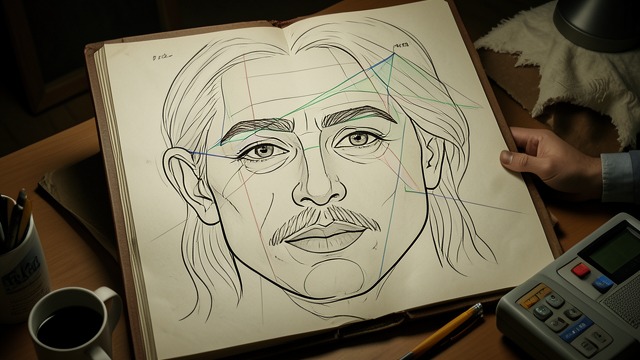
A Face Takes Shape
Reorganized attention
When the lines are read as a face, the viewer treats some marks as brow, nose, and mouth. Eye movements and learned bodily orientations help organize the marks into a meaningful figure.
Space around the lines also changes function: some becomes a filled facial volume, while other parts recede as background.
Knowledge guides intuition
The viewer does not discover a face by passively studying the marks. Knowledge guides how the drawing is apprehended, so the perceived material becomes a support for imaging.
The Face as an Image

Movement as Representative Matter
The line as support
Sartre concludes that the marks themselves are not the whole representative matter. Movements projected onto them help give them direction and allow them to stand for features of a face.
The resulting image remains dependent on the viewer’s knowledge rather than becoming a perception that could teach new facts about an independently present face.
A wider implication
The drawing clarifies how imagination can work with very little sensory material. Its apparent richness comes from the organized act that interprets the marks.
Early in Part I, Chapter 2, Section IV
During Sartre’s alternate reading of the lines
At the conclusion of the schematic drawing analysis
