
The Hypnagogic Field
The ImaginaryThis flow follows Sartre’s account of imagery at the threshold of sleep, from entoptic lights and fascination to the emergence of unstable figures.
increasing Bearing strength in each event
 decreasing
Bearing strength in each eventdecreasingThe Body Relaxes

Approaching Sleep
A changed orientation
As sleep approaches, bodily awareness, attention, and voluntary movement become altered. Sartre describes this not as a passive mental state but as a developing organization of consciousness.
The person becomes less able to direct attention and maintain the distance needed for ordinary observation.
A vulnerable ground
This condition prepares the way for hypnagogic images. The subject is neither simply awake nor yet fully dreaming, and the weakening of ordinary control changes how impressions are taken up.
Lights Become Figures

The Phosphenes as Matter
Forming an image
Sartre considers how entoptic lights can provide the matter for hypnagogic imagery. They do not resist interpretation like a stable external object, and the subject’s intention gives them recognizable form.
A pattern may abruptly become a geometric figure or an object. The certainty of what is seen appears together with the image rather than following careful inspection.
Imagination under constraint
Unlike playful interpretation of patterns, this process is not fully free. Consciousness is drawn into a fascinated mode that tends to realize its emerging interpretations.
Fascination Gives Way
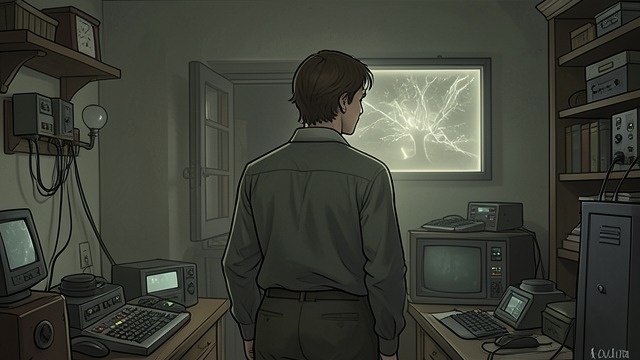
A Vision at the Threshold
An unstable appearance
Hypnagogic images can seem vivid, yet they remain poor in detail and resistant to genuine observation. Sartre emphasizes that their apparent richness does not allow the subject to learn new facts about their objects.
Their fragile hold depends on a narrowed, fascinated consciousness and may vanish when attention or movement returns.
The next transformation
Sartre treats this condition as a passage toward Dream rather than as an isolated curiosity. Its mixture of spontaneity and captivity foreshadows the more complete enclosure of dream consciousness.
Opening of Part I, Chapter 2, Section VI
As the hypnagogic state deepens
At the transition from half-sleep toward Dream
