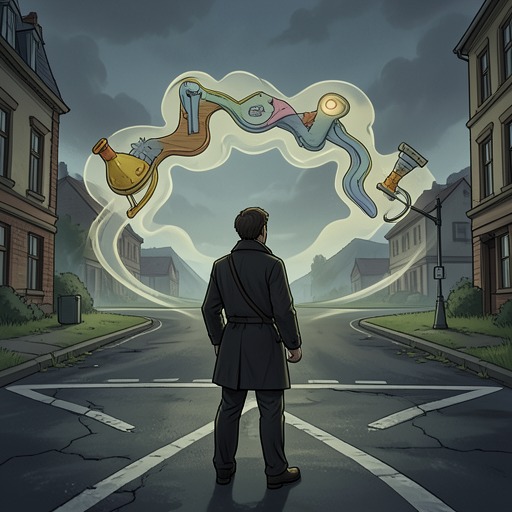
Dream
The ImaginaryDream is a distinctive mode of imaging consciousness in which a person lives through a world of images without perceiving those images as reality. Its apparent solidity comes not from mistaking an image for an external object, but from consciousness becoming absorbed in an imaginary story and losing the capacity to leave that mode. The dream is therefore both fictional and compelling: consciousness experiences the force of being bound to a world it is itself producing.
The thesis of dreaming
The account takes up a problem associated with René Descartes: a dream can seem so much like waking perception that the dreamer may not know, while dreaming, that the experience is a dream. But describing that resemblance does not establish that dream consciousness actually perceives. The distinction becomes clearer when reflective consciousness considers waking perception. To affirm that one perceives is already to have a sufficient ground for denying that one is dreaming; waking perception does not need a second act of belief to certify the object’s existence. The object is given in person.
Dreaming has a different intentional structure. Its world may be experienced with confidence, yet that confidence is not the perceptual thesis that an object is present in reality. Nor does the dreamer’s unreflective consciousness contain the reflective qualification that would amount to judging, I am dreaming, and therefore I am not perceiving. In the account’s terms, unreflective consciousness is wholly occupied by its own present activity; it does not stand outside that activity to negate it. Dream belief can thus be complete without becoming knowledge of a perceived object.
This distinction also blocks the idea that the dream consists simply of mental images mistaken for perceptions. A dream does not first present an image and then confer reality on it. Rather, consciousness is enclosed in an imaging attitude and cannot make the transition into perception that would disclose an object as real. The dream is not an erroneous perceptual judgement that could be corrected by comparing one image with another. It is a different way of intending an object altogether.
From hypnagogic imagery to the dream
The transition from hypnagogic imagery helps show what changes. Images near the onset of sleep can arise from entoptic spots, muscular contractions, inner speech, and other material available to consciousness. The passage into dreaming need not alter the image itself; what changes is the attitude toward it. An entoptic spot may first persuade consciousness that it is a fish as image. In a dream, that persuasion expands: the fish may be given a history, caught in a river and destined to appear on an archbishop’s table. The river, fish, and archbishop are all imaginary, but together they take on the form of a world.
Dream consciousness also takes sensations into this mode rather than perceiving them as themselves. A prolonged noise may successively stand for different objects in a dream, without being apprehended as the sound that it is. Likewise, red light passing through a curtain may be grasped as blood, rather than first being perceived as red light and then converted into an image of blood. The dream’s images are not assembled by a mind that alternates freely between perception and imagination. The dreamer cannot leave the imaging attitude in which the sensations have been taken up.
An external stimulus can interrupt this enclosure when it forces a transition to perception. An alarm’s ringing may initially function as an analogon for a fountain, bells, or drums. If the sleeper wakes, the sound is suddenly apprehended as something existent in its own right, even if its cause remains misunderstood. A creaking noise might still be interpreted on waking as footsteps, but that mistake differs from dreaming: in perception, the sound is taken as real and as itself, whereas in the dream it is taken as footsteps in the imaginary mode. The shift does not depend on a correct explanation of the sound. It depends on a return to apprehending something as existent.
A world without ordinary worldly relations
The dream appears to contain a surrounding world, but its worldliness does not depend on a fully articulated network of relations among images. Images remain isolated and essentially poor: consciousness does not scrutinize them, supply every detail, or establish connections beyond those it can form as it goes. Each image instead carries an atmosphere of a world as one of its qualities. There may seem to be one continuous dream world as consciousness passes from image to image, but the analysis describes as many such worlds as there are images. The familiar expression dream world is convenient, provided it is not mistaken for a complete and independently existing domain.
When hypnagogic persuasion enlarges into dreaming, consciousness projects its knowledge, preoccupations, memories, and ordinary necessity of being-in-the-world into the imaginary. It is taken up by the play and produces syntheses in the imaginary mode, without an external point of view from which to inspect the result. Attention and the power to present an object as transcendent have fallen away; consciousness is carried along as impressions become one imagined object after another. This explains the dream’s symbolic character without requiring that an unconscious image first be hidden and then disguised. In the account’s alternative explanation, dreaming consciousness has lost the function of the real: what it feels and thinks can appear only in imaged form.
That loss also shapes the account of memory. A real memory would locate consciousness in relation to the actual bedroom and bed, and could thereby crystallize the real world before it. In the dream, by contrast, one imaginary image can help crystallize other images into the apparent world of the dream. The two movements are incompatible: a perception taken as real can bring the real world into view, while the dream’s syntheses remain imaginary. The limitation is not merely that dream images omit detail; the dreamer has no external standpoint from which to restore the reality that would organize them otherwise.
Fascination, belief, and the dream story
The dream’s belief is compared to the engrossment of reading. A reader can be fascinated by a novel’s events without taking them for real; similarly, a dream can enclose consciousness without the dreamer perceiving its images as actual objects. The dream is experienced as a story, and its force lies in the impossibility of stepping outside that story while the state continues. Its irreality does not weaken its hold. On the contrary, because it cannot be corrected by perception from within, it has a compact opacity and a peculiar strength.
The story need not initially place the dreamer among its characters. One reported dream begins as an engraving of a slave kneeling before his mistress, then unfolds into the slave’s search for a cure for the leprosy she has given him. The dreamer experiences the events as though reading about them, without taking part. Dreams may begin in this detached, neutral manner and then make the dreamer one of the story’s people. That change does not by itself amount to a new perception of reality: identification with a dream character remains within the imaginary mode.
Fascination is also a kind of self-entrapment. Consciousness remains spontaneous in producing images, yet experiences itself as spellbound and unable to stop the production. The events consequently acquire a fatal character: they seem unable not to happen because consciousness cannot prevent itself from imagining them. This fatality can be confused with belief in the dream world as reality, but the account distinguishes the two. What feels inevitable is the continuation of the imaginary activity, not the discovery of a real world. The dream resembles a novel in its fictional status and passionate hold, but it differs in that the dreamer cannot simply close the book or take an external position toward the story.
Interruption and significance
The dream can end when reality imposes itself or when the dream’s own narrative reaches a point beyond which no further event can be imagined. A real fear may become strong enough to break the spell and prompt reflection; an external stimulus may do the same through surprise, force, or persistent orders. In another case, the dream itself supplies the stopping point. The account describes recurring dreams of impending execution that end when the dreamer is about to be placed on the block. The ending need not be caused by panic: consciousness hesitates because it cannot imagine what comes after, and that hesitation makes reflection and awakening possible.
The decisive claim is that the dream is not reality apprehended under a false label. If it were posited as real, it would lose the character that makes it a dream. It is a spellbinding fiction in which consciousness is bound to produce the imaginary, while the real escapes its efforts to recover it. The dream therefore offers a way to conceive of consciousness deprived both of its ordinary being-in-the-world and of the category of the real. Its apparent world is compelling not because perception has been duplicated, but because the dreamer cannot leave the imaginative mode in which that world is made.