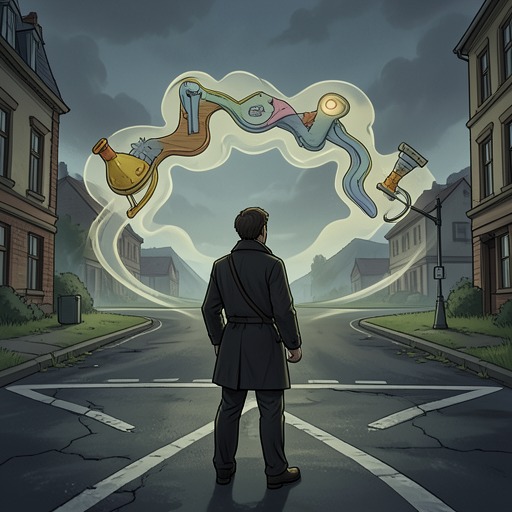
Dream as a closed imaginary world
The ImaginaryDream as a closed imaginary world names a distinctive mode of consciousness: dreaming is not a false perception of reality, but an imaginative attitude that the dreamer cannot simply leave. Its events can feel compelling and unavoidable without being posited as real; the dream’s force comes from consciousness being enclosed in an irreal story, unable to take an outside point of view or correct that story through perception.
From hypnagogic images to the dream
Dream imagery develops from material that can already appear before sleep is complete. Hypnagogic images may draw on visual impressions, muscular sensations, and inner speech. The transition into a dream can occur without any obvious change in what appears: what shifts is the attitude toward it. On waking, a person may recognize that the same imagery had become a dream, although its content had not visibly changed. The distinction is therefore not simply between one set of images and another, but between ways consciousness takes them up.
An alarm illustrates the difference between dreaming and perceiving. During a dream, its sound may serve as an image of a fountain, bells, or drums. Awakening involves apprehending the sound as something that exists in its own right, rather than as an analogical stand-in for something else. Even an incorrect interpretation after waking remains a perception if the sound is taken as real and as itself; correcting that interpretation is not the same as waking. Dreaming, by contrast, is a consciousness that cannot leave the imaging attitude in which it is enclosed.
A story-world without a fully imagined world
A hypnagogic image may appear in isolation, without a place around it. A dream image, however, is experienced as somewhere: it has a temporal course and seems surrounded by a wider setting, including things that are not directly seen. A dream may therefore unfold as a story, or even appear to the sleeper as a story being read. Its figures and events carry a sense of what came before and what may follow.
This apparent setting does not amount to a fully constructed imaginary universe. The surrounding world is not examined in detail or presented as a complete network of relations. Dream images remain subject to Quasi-observation and the Essential poverty of the image: consciousness does not scrutinize them as it would perceived objects. Instead, each dream image carries what the account calls an atmosphere of a world. The sleeper may experience successive images as belonging to one continuing setting, but that continuity does not establish a single, independently elaborated world behind them. The phrase dream world is useful, provided it does not obscure this limitation.
Fascination, belief, and the sense of fate
The dream’s coherence is a matter of belief and fascination, not a judgment that its contents are real. The account compares this absorption to reading a story: a reader can be caught up in a fictional sequence without taking it for an actual event. Likewise, a dream encloses consciousness in a story that cannot be dissolved or corrected by perception while the dreaming attitude persists. The dreamer is not merely watching a fiction from a distance; consciousness is spellbound by what it is producing.
This helps explain why dream events can seem inevitable. Their fatal quality arises alongside the dreamer’s inability to prevent the imaginative sequence from continuing. Consciousness remains spontaneous in forming images, yet experiences itself as bound by its own fascination. The dream is thus neither passive reception of an external reality nor ordinary deliberate storytelling. Its events can feel imposed and unavoidable while remaining products of an imaginative activity whose irreality is not transformed into reality.
Enclosure and its limits
The central claim is that the dreamer cannot compare the dream with a reality that would correct it: the dream has closed off that route. The phrase There is no imaginary world remains important here. The apparent world of a dream is not a separate domain that the dreamer surveys as a complete object; it is the atmosphere accompanying its images and the focus of an enclosing belief. The dream is closed because consciousness cannot adopt an external standpoint within it, not because it has mistaken an imaginary setting for a real one.
This account also distinguishes dreaming from hallucination. In discussing hallucination, the text treats the location of an image in external space as a secondary issue and asks instead how belief in an image’s reality becomes possible. It argues that an image is constituted as irreal, and that the consciousness of producing it is bound up with that status. Dreaming has its own form of enclosure: consciousness cannot perceive or recover the real world from within its sustained imaging attitude. The comparison clarifies that apparent conviction alone does not make an image a perception.
Awakening and the return to reality
The dream can end when something from waking reality breaks into it. A strong external stimulus, a persistent order, or an emotional shock may prompt reflection and make the dreamer aware of dreaming. A dream can also cease because its own story reaches an apparent endpoint, leaving no imaginable next event. In either case, awakening marks a change in consciousness, not simply a new judgment about the same imagined scene.
The dream therefore offers a way to understand consciousness deprived, for a time, of its ordinary access to reality. Its images can organize themselves as a compelling story and carry the atmosphere of a world, while remaining irreal. The dream’s distinctive force lies in that combination: consciousness generates what holds it captive, and the fiction is lived as impossible to leave until perception or the end of the story breaks the enclosure.