Image's essential poverty
The ImaginaryImage's essential poverty names Jean-Paul Sartre’s account of the image as a finite, discontinuous object of consciousness, not a dimmer version of a perceived thing. Perception continually offers more than attention has yet disclosed; an image contains only what consciousness has already placed in it. Its poverty is therefore not a defect that further looking can repair, but a defining difference between imaging and perceiving.
Method and reflective certainty
Jean-Paul Sartre begins from the act of imagining Pierre. While that consciousness is directed toward Pierre, Pierre—not an inner picture—is its object. The image cannot be described as an image simply by continuing to attend to Pierre; a new, reflective act must turn attention toward how the object is given. Reflection makes possible the judgment that one has an image, and Sartre treats the distinguishing characteristics disclosed in that act as immediately certain.
This approach separates description from explanation. Psychologists, Sartre argues, often leave the direct knowledge of imaging implicit and instead propose hypotheses about the image’s nature. Such hypotheses remain probable, whereas reflective data are certain. His proposed method is to produce images, reflect on them, and describe and classify their distinctive features before advancing theories about their cause or inner constitution. Essential poverty is thus a phenomenological finding: it describes what reflection discloses rather than explaining the image through an unobserved mechanism.
Perception’s overflow and the image’s limits
The contrast becomes concrete in the example of a sheet of paper on a table. As attention shifts, perception can disclose a slightly warped upper edge or a dot at the end of the third line. Each new orientation may reveal another feature. A perceived object belongs to an inexhaustible network of relations with other things and among its own elements; no single inspection exhausts that richness.
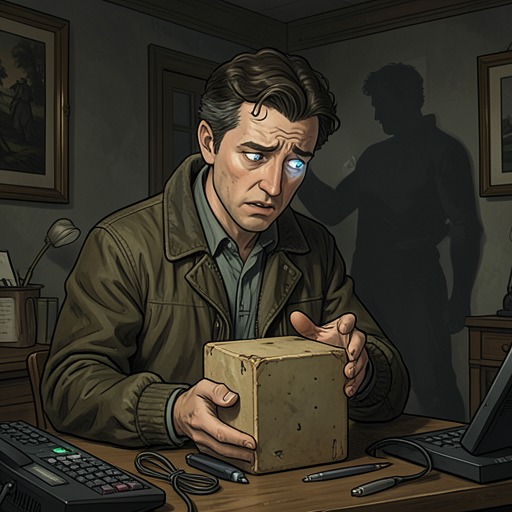
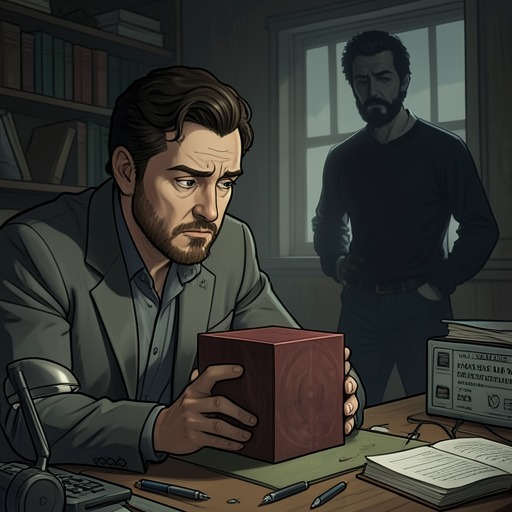
An image behaves differently. It can remain in view without yielding a new detail merely because attention continues or changes direction. If someone imagines a cube and mentally turns it, the operation adds no knowledge of the cube’s features. The image gives what has already been put into it; it does not conceal an unexamined surplus waiting to emerge under closer scrutiny. Its parts may sustain only two or three relations, such as those currently noticed or retained, while other relations are not latent but absent. Features that would conflict or stand in a definite relation in perception can coexist in an image without that relation being represented.
Finite determination and knowledge
The image’s poverty is not simply a matter of faintness or blurred appearance. Even its most determinate object has only a finite number of determinations, and those determinations need not connect into the unified texture characteristic of a perceived thing. Sartre describes the result as discontinuous: qualities seem to begin to exist but stop halfway. The image does not satisfy the conditions that would allow its object to exist as a thing in the perceptual world.
This limit also governs what an image can teach. A memory image may arise unexpectedly and present a face or place all at once. When the image identifies a familiar meadow, knowledge of its origin is already included in the act that gives it as imaged; that information is not deciphered from a gradual inspection of the image. Conversely, an image of a dreary garden beneath a grey sky may remain anonymous. If its name is discovered later, the discovery comes through processes other than prolonged observation of the image. The image has given all that it possesses, including the absence of a determination when it cannot identify the garden.
The distinction also clarifies why an image should not be treated as an imperfect perception. A perceived thing has a determinate individuality within its extensive relations, even when someone has not yet noticed those relations. Image-content, by contrast, may remain indeterminate because the relevant determinations are not present to consciousness. Its sparseness concerns what the object is made of in imaging, not how clearly a copy of a fully constituted thing happens to appear.
Imagination and the aesthetic object
The broader account of imagination gives this contrast philosophical weight. Sartre asks what consciousness must be if it is capable of imagining, and concludes that imagining is not merely an optional addition to an otherwise complete consciousness. Realizing and imaging attitudes are interdependent: apprehending the real as a world involves a surpassing toward the imaginary, while imaging takes the world as its ground. Essential poverty therefore marks a distinctive way consciousness relates to objects, rather than a failed attempt to reproduce the real.
The account of art extends this distinction between a real support and an imaged object. In a painting, the canvas, paint, and frame are real, but the aesthetic object is constituted when consciousness adopts an imaging attitude. The artist does not turn a private mental image into a real object for the public; the material work functions as an analogon through which an irreal object can be apprehended. The image remains an image even when it is manifested through an external support. This does not cancel the contrast between perception and imaging: it shows how a real thing can serve as the means by which an object belonging to the imaginary is presented.