Imaging and realizing attitudes
The ImaginaryImaging and realizing attitudes name two fundamentally different ways consciousness takes up an object. In the realizing attitude, an object is apprehended as part of the real world; in the imaging attitude, consciousness apprehends an irreal object through a representative medium without treating it as an existing thing. The distinction governs Sartre’s accounts of ambiguous drawings, artistic performance, and aesthetic experience: what changes is not merely what a viewer sees, but the kind of relation consciousness establishes with it.
Two attitudes and the organization of a figure
A schematic drawing can first appear as an arrangement of lines organized by ordinary perceptual form. In one reading of a simple face-like figure, three segments meet as a fork, a point below them adheres to that arrangement, and a separate sinuous line forms another figure. The lines are perceived according to their relations on the white sheet; they have not yet become a represented person. Shifting to an imaging attitude changes the intention directed at them. The rising segment becomes a forehead, the right-hand segment an eyebrow, the descending segment a nose, the point an eye, and the sinuous line a mouth and chin. The same marks now support a face, but their new significance depends on an altered way of apprehending them.
The change is not a simple act of assigning labels to stable visual elements. The viewer’s eyes move along the lines, and the body adopts an attitude that helps animate them as a figure. Even the sheet’s blank areas acquire different functions: space to one side of the supposed face can be taken as volume, while space to the other side recedes as ground. Where the drawing has a gap, the viewer can enact a connecting line through eye movement and synthesize the separated marks into one form. The image therefore arises through an organized activity rather than residing ready-made in the ink.
This account distinguishes imaging from perceptual movement that is attributed to the real object. In the Müller-Lyer illusion, the closed and open angles channel eye movements differently. The lines are perceived as having unequal extension because those movements are projected onto them as qualities of the perceived figure. The result remains within perception: the object appears to possess a potential movement or force, and it can function as a sign, but that alone does not make it an image. In schematic imagining, by contrast, lines do not impose the relevant movement as a perceptual rule. Knowledge directs exploratory eye movements, and their directions are projected onto the lines as hypothetical. If an image crystallizes, the viewer sees a figure through those marks while remaining aware that the vector-like directions were freely contributed by the imaging activity.
Perception and imagined representation
The distinction also clarifies why perception can contain more than is immediately visible without becoming an image. Formal structures studied by Köhler, Wertheimer, and Koffka offer one way to explain how perceptual organization persists through changes in position. Perception also includes unformulated intentions that determine a present object through aspects not currently seen: an ashtray, for example, is apprehended as having an underside resting on a table, even when that underside is out of view. Such intentions enrich the perceived object without separately positing another object. They remain bound to the real thing as part of perceiving it, unlike the imaging attitude, which presents an irreal object through a representative medium.
The attitudes cannot simply be combined so that an image supplements an ongoing perception of the same object. If an irreal Pierre surges into view, the real table before the viewer leaves the scene: the table and Pierre alternate as correlates of radically distinct kinds of consciousness. This does not deny that perception reaches beyond what the eyes immediately disclose. It rejects the explanation that images supply perception’s unobserved details, instead distinguishing perception’s implicit, object-bound intentions from the separate irreal objects constituted in imaging.
Art, performance, and the Analogon
In fiction, poetry, and drama, words serve as representative media through which irreal objects are constituted. An actor playing Hamlet likewise uses the body as an Analogon for the imaginary person. The actor need not take the realizing attitude and believe that he is literally Hamlet. Yet he can be wholly mobilized in producing the character, employing feeling, strength, and gesture as representative means. Even actual tears can be apprehended by actor and audience as Hamlet’s irreal tears. The character is not made real inside the actor; rather, the actor is apprehended within the irreal world of the role.
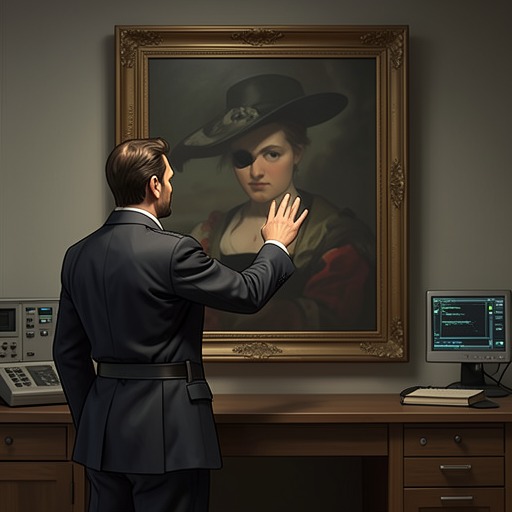
Aesthetic contemplation of painting follows the same distinction. A canvas may present an irreal ensemble that does not exist in the paint or elsewhere in the world, while the real canvas functions as the medium through which that ensemble appears. The viewer’s enjoyment is real, but it is directed toward and helps constitute the irreal object rather than treating the material surface as the beautiful object in the ordinary realizing attitude. Aesthetic disinterestedness thus follows from the way the object is apprehended: the imaging attitude posits it as irreal, rather than discovering a special means of appreciating reality as reality.
Music, time, and the return to reality
A performance makes especially clear the difference between an artwork and the real events that present it. In listening to Beethoven’s Seventh Symphony, the sounds and performance unfold in actual time, but the symphony as apprehended is not simply located between the concert-hall walls or at the violin bows. Its internal succession runs from the first note of the allegro to the finale, without continuing a real time before its beginning or after its end. If a fire stops the performance, the performance has stopped; the symphony is not thereby experienced as an object interrupted in the same way. The performance is its Analogon, dated and unfolding in real time, through which the listener apprehends the work in the imaginary.
The symphony is consequently not placed in a second, intelligible heaven. It is apprehended as outside real existence, though its appearance depends on real conditions such as the conductor’s continuing to perform and the hall remaining usable. Aesthetic contemplation can therefore resemble an induced dream: leaving a play or concert is not a passage from one world to another but a change from the imaging attitude to the realizing attitude. The abrupt return to ordinary existence can feel like awakening, even after a realistic and cruel play, because the discomfort belongs to the release of a consciousness fascinated by the imaginary, not simply to relief that the represented events were unreal.
Beauty and the world
The same structure explains why aesthetic value, in this account, belongs to the imaginary rather than to the real as such. When a real object is contemplated aesthetically, it can cease to be apprehended simply as a practical, reachable thing and instead function as an Analogon for an irreal image of itself or of what it might be. The object becomes, in this respect, untouchable: attention holds it at a distance, and the realizing relation of physical possession is suspended. Beauty and desire therefore pull in different directions. To desire an object requires a return to its contingent existence, whereas aesthetic contemplation apprehends it as irreal and beyond possession.
This aesthetic nihilation of the world resembles paramnesia, in which a real object functions as an Analogon for itself as past. The structures are related but not identical: aesthetic contemplation nihilates, while paramnesia pastifies. Their contrast reinforces the central point of the concept. An object’s appearance alone does not determine whether consciousness realizes it as real, imagines it as irreal, or apprehends it through another mode; the attitude of consciousness establishes the relation and shapes what the object can mean.