Amnesia
The InvincibleAmnesia is the condition produced in several members of the Condor expedition on Regis III: a total neurological collapse in which memory, speech, reading, writing, and personal identity are erased while basic perception and bodily functions persist. Its decisive significance is that it preserves the body without preserving the person. The afflicted can see, hear, walk, grasp objects, and sometimes eat, yet they no longer possess the autobiographical and linguistic structures through which a human being recognizes himself and can testify to what happened. Because the condition appears after contact with the planet’s unexplained forces, it becomes both a medical crisis and the most disturbing surviving clue to the destruction of the Condor expedition.
Definition and First Investigation
The condition is first examined through a dead Condor crewman preserved by the extreme cold of the hibernation chamber. Sax determines that nothing can be done to revive him, but instead uses a grave-sounder, a device designed to stimulate the brain electrically and recover traces of the last contents of consciousness. Electrodes are attached to the skull, and the investigators listen through headphones while the apparatus scans neural pathways that had recently formed a functional whole. The method is explicitly uncertain: the results cannot be fully trusted, but the circumstances make the attempt necessary because the crew needs any possible testimony about the Condor’s tragedy.
The grave-sounder does not recover a coherent message. It produces a few repeated syllables, including the word “mama” and fragments such as “Ala” and “lala.” Sax explains that the repetition results from scanning the parietal cortex, particularly the region associated with auditory memory. The striking discovery is not the possible reference to a mother, which could be an ordinary final thought, but the emptiness surrounding it. Unlike a normal auditory memory filled with countless recorded words, the dead man’s cortex contains almost nothing: only those few syllables. The evidence therefore suggests not merely that the man forgot a particular fact, but that an entire archive of language and experience had been removed.
The investigators also confront the unreliability of the recovered images. One apparent scene of moving people is explained as an engram recorded like a photograph, possibly a composite, not a literal moving image. Sax insists that the image’s motion was an illusion and cannot confirm whether the people were alive at the moment represented. The distinction matters because the grave-sounder offers traces rather than a transparent record. It gives the expedition access to remnants of consciousness while leaving the circumstances of the attack hidden behind ambiguous visual and auditory fragments.
Kertelen and the Living Form of Erasure
Kertelen becomes the clearest living example of the condition. During the ravine expedition, the men notice that he has returned in a changed state. He is not simply unconscious: he can walk and move, but communication with him is impossible, and he has lost the ability to speak. The first observers mistake the condition for heat stroke, yet its persistence and its precise effects distinguish it from an ordinary loss of consciousness. Kertelen’s body remains active while the communicative person has disappeared.
Sax later describes the damage as memory “completely obliterated.” The diagnosis is amnesia in an unusually absolute form, extending beyond the memory of identity to speech, writing, and reading. He calls it an utter collapse or annihilation of personality, leaving only primitive actions. Kertelen can walk and eat, although food must be placed in his mouth, and he can take hold of things, but these capacities do not restore agency, language, or selfhood. His hearing and sight remain within normal limits, making the condition still more disturbing: the sensory channels function, yet the central history that would organize what they receive has been erased.
The neurological explanation emphasizes that the erasure is centrally controlled. Sax describes it as though every trace of memory had been wiped away in a single act, and identifies the man from the Condor as suffering from the same phenomenon. The comparison establishes that Kertelen’s state is not an isolated injury or an individual medical accident. It belongs to a repeated pattern affecting the expedition and links the living patient directly to the dead man’s nearly empty auditory memory.
Recovery Without Restoration
Kertelen’s later condition complicates the apparent finality of the diagnosis. Although his original memories do not return, his mind is capable of learning from the physicians. He gradually acquires speech in a process compared to the development of a small child. Within a week he utters his first syllables and recognizes the doctors, even though he cannot pronounce their names. The sick bay consequently changes from a place filled with an inhuman whimper into a place where new, elementary human communication is beginning.
This recovery is not a restoration of the former Kertelen. By the second week, the doctors explain that even if he eventually reaches a normal physical state, he will not be able to describe the accident. His education may be rebuilt, but the erased past remains inaccessible. The distinction between learning and remembering is therefore central: Kertelen can acquire new language and habits, yet he cannot become a witness to his own transformation. His future may contain development, while his past has become permanently unavailable.
The crew’s response reveals how quickly a medical condition becomes a social and imaginative problem. At first, people gather outside the sick bay each morning for news, treating Kertelen less as the victim of an attack than as an inhuman being transformed by hostile planetary forces. He seems to them like a human creature turned into a monster, and their fear encourages the language of fairy tales rather than clinical understanding. Later, as he begins to learn, interest declines. The crew’s attention moves from horror to routine, exposing how communal fascination with an inexplicable injury can fade once the injured person becomes part of an ordinary medical schedule.
Recurrence Among the Condor Survivors
The condition returns on a larger scale when Rohan reaches another group of Condor expedition members. Gaarb reports that the men are unconscious, do not recognize their rescuers, and cannot speak, immediately identifying their state with Kertelen’s. Jarg and Terner examine them one by one, while Rohan calls for additional personnel because the afflicted cannot manage their own evacuation.
Of the twenty-two men in the expedition, only eighteen are recovered at that point; four remain missing. Most of the survivors allow themselves to be led away, but five resist and must be brought by force from the place where they were found. Five are placed on stretchers in an improvised sick bay, while the other thirteen are taken to a separate cabin and laid on bunks. They cannot undress or remove their boots without assistance and are described as helpless as babies. Their passive calm is broken only by a few of those forcibly removed, who wail in eerie voices. The scene makes the condition collective: it is no longer one patient’s misfortune but a pattern that has stripped an expeditionary group of its ability to act, speak, identify itself, or explain its disappearance.
Rohan leaves the rescued men in medical care and sends every available resource to search for the four missing members, using abandoned vehicles and personnel from his own team. The practical response underscores the condition’s consequences. The afflicted require transport, supervision, feeding, and physical handling, while those who remain capable must reorganize the expedition around rescue and containment. Yet the central mystery remains unsolved, because the survivors possess bodies that can be saved but memories that cannot report the attack.
Memory, Trauma, and the Limits of Testimony
Amnesia restructures the expedition’s relationship to evidence. The Condor’s remains yield human bodies, scattered objects, images, and neurological traces, but the most direct witnesses have been deprived of the capacities needed to speak. The grave-sounder can retrieve fragments from a dead brain, while living victims can relearn syllables without recovering the events that gave their former lives meaning. Testimony therefore exists in broken forms: a repeated sound, a photograph-like engram, an involuntary movement, or a body that no longer knows the names of its rescuers.
The condition also changes Rohan’s experience of the expedition. As the investigation continues, the crews’ systematic work of tests, X-rays, samples, drilling, force-field management, laser targeting, counting, and multi-channel communication begins to seem like a form of self-deception. The men appear to be waiting for another accident while pretending that their procedures can master the danger. Kertelen’s erased personality is part of this atmosphere: the expedition can observe, classify, and care for the damaged body, but it cannot restore the lost history or explain the force that caused the loss.
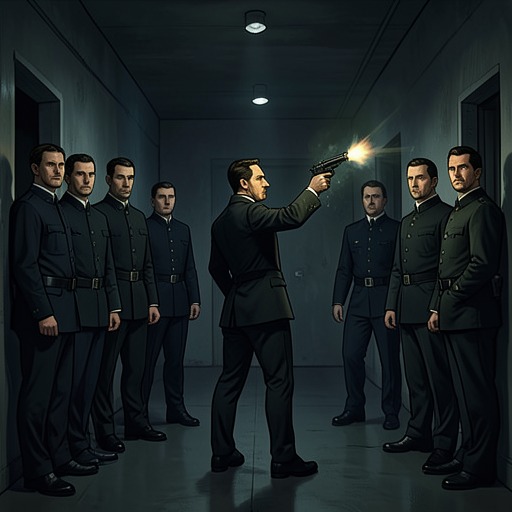
Rohan’s own memory provides a sharp contrast. He retains the memory of killing a man with a Weyr gun to prevent further deaths, and the scene returns at night with sensory force: the dead man’s expression, the weapon’s recoil, the smell of ozone, and the helpless people Rohan later gathered. His trauma is an excess of memory, whereas the victims of the attack suffer from memory’s annihilation. One consciousness cannot escape what it has witnessed; the others cannot witness what happened to them. Together, these states show that survival does not guarantee usable knowledge: remembrance can imprison the survivor, while erasure silences the victim.
Amnesia thus becomes more than a diagnosis. It is the most concrete form of the book’s uncertainty about identity, consciousness, and hostile intention on Regis III. The victims are not shown as defeated by a conventional enemy who leaves a message or motive; they are reduced by an impersonal process whose effects are unmistakably violent but whose purpose remains inaccessible. Their bodies continue, their senses remain functional, and new learning is possible, yet the person who entered the ravine or served aboard the Condor cannot return through ordinary recovery. The condition’s final horror lies precisely in that division: life persists, but the history that made it a human life has been erased.