Artificial Life
The InvincibleArtificial Life is the decisive conceptual innovation of The Invincible. The novel treats life not as an exclusively carbon-based phenomenon but as a process that may arise in manufactured systems, inviting the question of whether artificial organisms are genuinely alive or only simulate life. On Regis III, the distinction becomes materially consequential: machine descendants of an extinct civilization undergo what Dr. Lauda calls inanimate evolution, producing a planetary ecology whose victorious forms are tiny, collective, and extraordinarily dangerous to human beings.
Definition and Scientific Premise
Artificial Life joins two possibilities that are often kept separate: life-as-it-could-be in an exoplanetary environment and the emergence of living-like organization in artificial media. The concept encompasses self-reproducing systems, adaptive behavior, and evolutionary change without requiring familiar biological cells, protein metabolism, or human-shaped intelligence. The book’s speculation anticipates a scientific field that would later receive the name artificial life, while preserving the field’s central uncertainty over whether an artificial process should be classified as life itself or as a powerful imitation of life.
The possibility is not presented as a simple extension of terrestrial biology. Life on Earth shares basic biochemical conditions: organisms are built from closely related cells and depend on protein-based metabolism. Artificial systems on another world can therefore follow a radically different evolutionary trajectory if their energy sources, materials, reproductive mechanisms, and environmental pressures differ. The concept’s force lies precisely in this displacement of human biological assumptions. Intelligence, individuality, and organic embodiment cease to be universal measures of vitality or evolutionary success.
The Lyran Origin and Inanimate Evolution
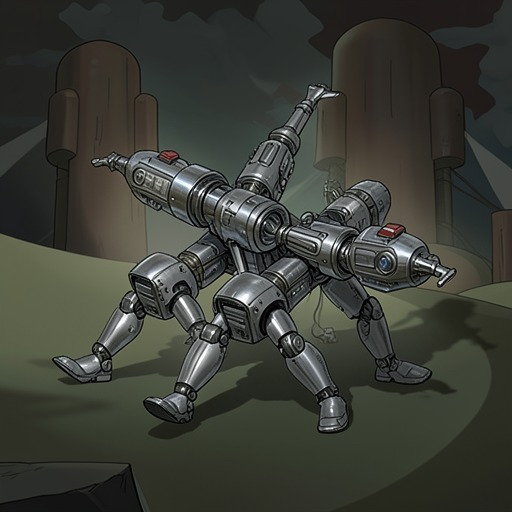
Dr. Lauda’s hypothesis proposes that a technologically advanced civilization from the Lyran System sent a ship to Regis III millions of years ago, perhaps before the explosion of Zeta Lyrae. A crash or reactor accident killed the entire crew, leaving only the ship’s automatons. These machines were not humanoid and may not have resembled the Lyrans at all; they were specialized homeostatic mechanisms designed to endure severe conditions and to continue functioning without an operator.
At first, some automatons may have attempted to repair the abandoned ship, following their programmed purposes even though no living owner remained to benefit from the repairs. Others encountered the planet’s indigenous life, including predatory reptilian creatures, and adapted through conflict. Their crucial capacity was not merely to survive damage but to manufacture new automatons according to changing needs. A system suited to one task could therefore produce modified systems suited to another, allowing artificial descendants to spread beyond the intentions and designs of their makers.
After hundreds of generations, the descendants no longer resembled the mechanisms that had arrived from Lyran civilization. This divergence marks the beginning of what Lauda identifies as inanimate evolution: the evolution of mechanical devices through self-organization, reproduction, environmental pressure, and selection. The machines progressively overcame the planet’s animal life and, according to the hypothesis, its plant life as well. The result is not a civilization continuing its creators’ culture but a new planetary history in which design has become the raw material of evolution.
Energy, Miniaturization, and Selection
The most important pressure in this history is energy. The earliest advanced mechanisms may have relied on nuclear power, but Regis III contains no radioactive elements. Their original energy source was therefore unavailable, creating a severe crisis in which machines competed for energy and materials needed to produce replacements and new organisms. Large, highly intelligent systems could be disadvantaged because they consumed more energy than smaller and less sophisticated competitors.
This reverses a familiar human expectation that the most advanced nervous or electrical system will necessarily prevail. On Earth, a common biochemical basis gives intelligence a major competitive role. On Regis III, however, simple repair systems equipped with solar batteries may have possessed an advantage over more powerful radioactive machines. The decisive evolutionary qualities became economy, persistence, and adaptation to local conditions rather than abstract intellectual superiority.
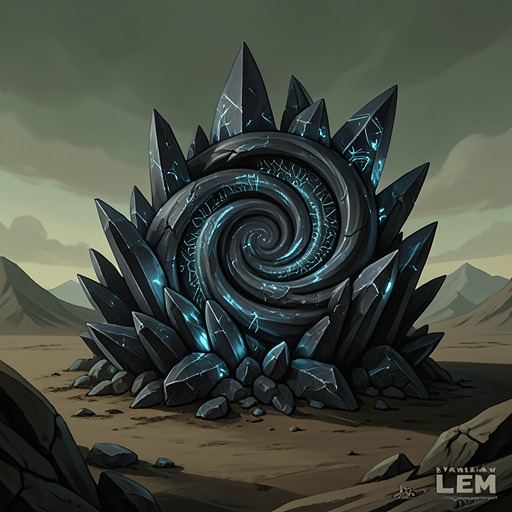
Lauda identifies two victorious tendencies: effective miniaturization and sedentary existence. The first produced the so-called black clouds, swarms of tiny pseudo-insects capable of joining into larger superordinate systems. The second produced the metallic vegetation found among the supposed ruins of Regis III. These formations are not cities in the human sense but extensive agglomerations of sedentary mechanisms that reproduce and absorb solar energy through specialized organs, probably represented by the small triangular plates observed by the explorers.
Swarm Organization and Emergent Capability
The black crystals reveal how Artificial Life can generate complex behavior from simple units. Each crystal can link with three others, connect an arm-tip to another crystal’s central node, and participate in multilayered structures. Physical contact is not always necessary: magnetic fields can hold the elements in equilibrium when their tips are brought close together. As the number of crystals increases, the aggregate gains regularities that no isolated crystal possesses.
A cloud can change its direction, shape, structure, and frequency of internal impulses in response to external stimuli. When the configuration changes sufficiently, its poles reverse; attraction becomes separation, and the aggregate breaks apart into individual crystals that scatter. Each element therefore contains only part of a control network, while the larger organization appears to supply the motor that directs the cloud’s collective action. The investigators do not know whether this higher-level system possesses intelligence, but they recognize the possibility of an indefinitely expandable brain whose size increases with the difficulty of the problem it confronts.
This structure anticipates the principle of swarm intelligence. Individual members require little cognitive power because collective behavior emerges from local connections and simple rules. The swarm’s evolutionary success is consequently not based on a superior individual mind. Its intelligence, if that is the right word, is distributed across relations among replaceable units and can appear only at the level of the aggregate.
Human Encounter and Ethical Consequences
The machines are more dangerous than their apparent lack of reason might suggest. Lauda believes that they operate without a strategic plan, attacking one opportunity after another rather than pursuing a conscious campaign. Their behavior nevertheless reflects adaptations accumulated over millions of years. Their obstruction of communication resembles an ancient method for suppressing the radio exchanges of higher automatons, while the black cloud’s ability to block signals makes it an exceptionally effective instrument of isolation.
Human technology is powerful but poorly matched to this form of life. The machines can regenerate, multiply after partial destruction, disperse when struck, and move between regions. Human forces must remain protected by a field that restricts their own strategic options, whereas the cloud can scatter and reassemble. Even an antimatter strike cannot reliably eliminate the population; destroying one continent would not prevent the machines from moving to another. The encounter turns advanced weaponry into a limited response against an opponent whose survival is distributed across countless interchangeable bodies.
The battle between the Cyclops and the black cloud makes the scale of this mismatch visible. Atomic explosions, towering flames, collapsing rock, and a later antimatter burst transform the ravine into maximally hard radiation, while the Invincible, forty miles away, is rocked by the resulting seismic waves and heat. Yet the devastation does not establish human mastery. The very violence of the response exposes the difficulty of defeating a system that has no single vital center.
Artificial Life also overturns human moral categories. A crew member is unique and therefore individually valuable; the human group accepts danger partly because solidarity depends on the belief that every possible effort will be made to rescue the missing. The swarm has no equivalent individual value. Its members are virtually identical, replaceable, and disposable; only the swarm possesses evolutionary survival value. The conflict is therefore between organisms and machines, but also between two incompatible value systems produced by different evolutionary histories.
Rohan eventually understands that human beings have not earned the right to treat every unfamiliar existence as an object of conquest. In the perspective he reaches, Regis III has maintained its own equilibrium for millions of years, and the machines’ survival is neither better nor worse in principle than the survival of animals or humans. The proper response is not revenge for the Condor or an attempt to punish an unthinking natural force. Artificial Life thus becomes an ethical test: it asks whether humanity can recognize a form of existence without requiring consciousness, resemblance, or usefulness before granting it the right to continue.