Ballmin
The InvincibleBallmin is a senior planetologist on the expedition to Regis III and one of the scientists through whom the novel tests humanity’s habit of turning an unfamiliar world into a problem to be classified, conquered, or avenged. His observations help reconstruct the planet’s deep history, while his argumentative presence keeps the crew from settling too quickly on explanations that the evidence cannot sustain.
Identity and Scientific Position
Ballmin works among the expedition’s specialists and appears as a forceful, sometimes combative participant in its investigations. He is concerned with the material record of Regis III: its strata, fossils, mineral deposits, vanished life, and possible relation to the ruins discovered near the coast. His expertise gives him authority, but the narrative also shows that authority under pressure can become conjectural. Ballmin often pushes an interpretation beyond what has been established, only to meet resistance from other specialists.
His scientific position is therefore not presented as infallible. It is valuable because it produces questions and identifies physical patterns, yet it remains part of the expedition’s larger uncertainty. The contrast between Ballmin’s assertiveness and the planet’s opacity makes him representative of a human science that can describe fragments of a system without immediately understanding the forces that shaped it.
Investigating the Ruins and the Planet’s Past
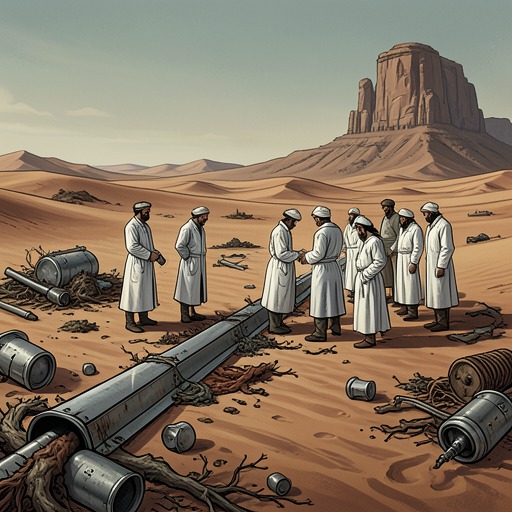
Ballmin accompanies Rohan and Gralev when the expedition reaches the tectonic fissure and decides to inspect the ruins more closely. The fissure is roughly a hundred yards wide and extremely deep, while the dead settlement is buried beneath approximately twenty to thirty feet of sand. The group uses a flying robot scout, ultrasound soundings, and other instruments, but the damaged geology produces contradictory readings. Ballmin’s participation places him directly within the expedition’s attempt to turn a visually startling discovery into a scientifically interpretable site.
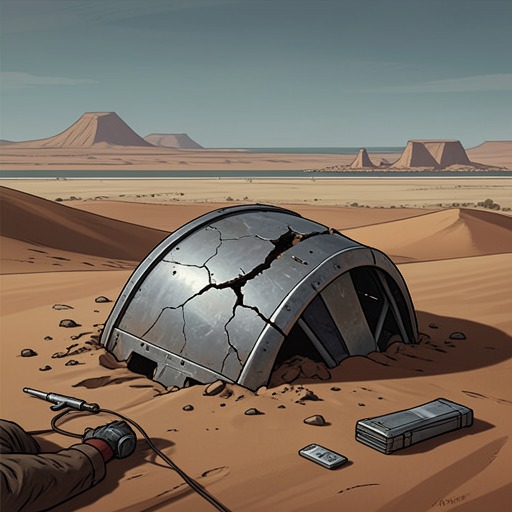
The ruins initially resemble cubic or pyramidal rock remains overgrown by dead vegetation, but closer examination reveals a regularity foreign to living forms. They are neither solid nor conventionally hollow: gaps expose a metal tangle that fills their interiors, while wind-driven sand pours through black openings and accumulates around their bases. The instruments detect no radiation, sound, or other activity. Ballmin is thus involved in examining a place whose form suggests construction but whose condition defeats ordinary architectural categories.
When the commander asks what should be reported, Ballmin agrees that the expedition would be better served by transmitting televisual images of the entire site. Rohan then concludes that the remains were not a city. Ballmin’s response matters because it favors the preservation and circulation of evidence over a confident label. The images can be examined by others; a premature name would conceal as much as it reveals.
Disputes, Hypotheses, and Evidence
Ballmin repeatedly advances possibilities that expose the limits of the available data. During the debate over the dead men, he objects that the absence of a recognized cause does not mean that nothing killed them. His blunt protest that something must have caused their deaths cuts through the specialists’ technical uncertainty, but it does not solve the mystery. The bodies show no convincing signs of violent death or lethal radiation, and the investigation cannot convert Ballmin’s insistence into a diagnosis.
He is equally unwilling to abandon an external explanation for the planet’s anomalies. In a dispute about the flies found on Regis III, Ballmin suggests that they might not be native to the planet and could have been brought from elsewhere, even from a world affected by a nova. The suggestion is speculative, and another scientist immediately demands to know from where such organisms would have come. The exchange presents Ballmin as intellectually active but also as someone prepared to keep an unlikely hypothesis alive when the ordinary account seems inadequate.
His position is sharply tested when geological research uncovers ruddy-black, non-geological material embedded in sedimentary strata. The deposits appear to consist of ancient metallic fragments altered by oxidation and chemical reactions, although the specialists cannot establish their origin. Drilling reveals organic carbon, fossils of plants adapted to dry conditions, and traces of primitive reptiles, showing that land life once flourished. The evidence indicates that evolution occurred on land twice, with an earlier extinction possibly associated with a nearby nova and a later decline coinciding with the emergence of extensive metallic layers.
Ballmin’s findings contribute to a history that is both detailed and disturbing. Regis III had no mammal-like forms, and its continental life gradually disappeared while deposits containing antimonite, molybdenum oxide, iron compounds, and salts of nickel, cobalt, and titanium became more common. The metallic layers date from roughly eight to six million years ago and contain localized radioactive centers, yet the total radiation was too limited and dispersed to explain the extinction of land organisms. The evidence therefore defeats a simple radiation theory even as it makes a connection between the strata and the ruins increasingly difficult to ignore.
Relations Within the Expedition
Ballmin’s exchanges with the other scientists are marked by disagreement rather than deference. In one argument, the paleobiologist tells him that, had he been a student, he would have failed an evolutionary-biology examination, while the surrounding scientists smile despite themselves. The scene gives Ballmin a recognizable intellectual temperament: he is serious about his objections, but the expedition’s scientific culture allows disagreement to become wit, rivalry, and collective scrutiny rather than merely personal hostility.
He also occupies a visible place in the expedition’s command structure. When the storm cuts communication with Regnar’s team, Ballmin stands with Rohan, Horpach, Gralev, Sax, and others at the main monitor while two reconnaissance craft search the desert. The low-flying craft crosses dunes, craters, jagged hills, cliffs, rubble, and tectonic cracks as its signal deteriorates. Ballmin’s presence on the bridge connects the geological investigation with the immediate danger confronting the scattered teams: the planet’s terrain is not passive scenery but part of the conditions governing whether human instruments and bodies can remain in contact.
Narrative Significance and Limits
Ballmin helps the expedition move from visible ruins to deep planetary history. His observations establish that Regis III once supported extensive continental life, that this life vanished over geological time, and that the disappearance coincided with metallic deposits whose origin remains uncertain. Yet the same character also embodies the danger of treating every gap in knowledge as an invitation to invent a hostile agent, imported organism, or comprehensible catastrophe.
Later reasoning about the black mechanical formations reframes the expedition’s discoveries. Horpach insists that the crew needs certainty and, if possible, samples of the flying mechanical fauna before deciding what to do. Against this desire for diagnosis and control stands the emerging possibility that the formations are products of inanimate evolution: a former tool of rational beings that became independent and, over millions of years, entered the planet’s natural equilibrium. Ballmin does not formulate this final ethical position, but his evidence helps make it possible. The geological record he investigates undermines the assumption that human categories—city, enemy, weapon, civilization—will remain stable when applied to Regis III.
His role is consequently double. Ballmin is an indispensable collector of facts, but he is also a reminder that facts do not automatically produce humility. The expedition can map the planet, excavate its seams, photograph its ruins, and debate the fate of its dead, yet the decisive lesson lies beyond classification: Regis III is not an empty place waiting for human meaning. Its history includes biological extinctions, metallic transformations, and forms of persistence that may not possess consciousness at all. Ballmin’s science brings the crew to that threshold, even when his own hypotheses do not cross it.