Black Rain
The InvincibleBlack Rain is the fall of innumerable dark mechanical crystals associated with the cloud formations of Regis III. Its decisive significance is that it transforms an apparently hostile attack into evidence of a vast, inanimate planetary process: the same phenomenon that marks the aftermath of The Invincible’s departure later surrounds Rohan, touches his body, and leads him toward the conviction that humanity should leave Regis III alone.
First Appearance After The Invincible’s Departure
Black Rain first appears after the hurried evacuation of The Invincible’s landing site. Rohan has ordered the vehicles, drilling equipment, gangways, fuel canisters, and other material to be embarked, while the energobots return to the ship and the ramp and elevator shaft retract beneath its armor. The cruiser then rises through dust, compressed-air hiss, repeated detonations, and the green and red light of the desert, leaving behind torched rock, vitrified dunes, condensation, and abandoned drilling shafts.
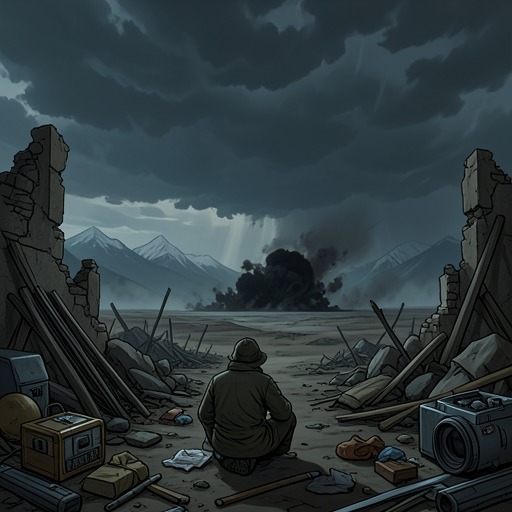
Only after the ship has disappeared does a dark cloud emerge from the west. It moves close to the ground, extends a swirling arm around the landing site, and remains motionless for a time. As the sun finally drops westward, the phenomenon changes from a hovering cloud into precipitation: black rain begins to fall over the desert. The sequence gives the expression a structural force beyond weather description. Human technology departs in a violent display of power, but the planet answers afterward, quietly and without any visible intention, with a dark material process that spreads across the place the humans have just occupied.
Material Form and Movement
The later appearance of Black Rain makes its physical nature more precise. In the ravine, the cloud produces innumerable offshoots; when some retract, others replace them, and black rain falls increasingly densely. Tiny crystals land on Rohan’s head, slide down his suit, and gather in its folds. The rain also alters the landscape: crystals lie scattered over the boulders, and the formerly bone-white stream bed looks spattered with ink.
The crystals are not inert in the ordinary sense. When Rohan carefully lifts a triangular crystal, it seems to warm his palm with a gentle puff and rises when he opens his hand. The scattered particles then organize themselves into a layer resembling ground smoke, gather into columns, and rise until they form an almost perfectly spherical mass over the center of the valley. The event therefore moves from precipitation to collective reassembly. What appears to be falling debris becomes a distributed, responsive formation whose activity cannot be reduced to the movement of individual fragments.
Relation to the Cloud and the Battle
Black Rain is inseparable from the larger cloud formations that confront the Cyclops. Rohan initially interprets the crystals’ gathering as part of a battle: he imagines that the clouds have expelled the inanimate particles and cast them into the ravine. The apparent conflict is not confirmed, however. Other clouds rush toward the spherical mass, the clouds part, and the sphere disappears because it has been absorbed into them. The scene preserves the visual impression of combat while undermining the human tendency to assign strategic motives to every organized movement.
This ambiguity is set against the actual violence of the Cyclops encounter. The attacking cloud is pierced by immense flames, the ravine is shaken by atomic explosions, and an antimatter burst converts the surrounding air, debris, steam, gases, and smoke into hard radiation. The strike devastates the terrain and rocks The Invincible forty miles away. Black Rain thus belongs to a planetary system capable of both quiet aggregation and catastrophic force, while neither mode requires a conscious enemy directing events according to human military logic.
Human Interpretation and Reassessment
The expression’s meaning changes as the crew tries to understand the black formations. Gaarb argues that the mechanisms are inanimate and perfectly adapted to destroying living or intelligent things, possessing no powerful intellect or strategic plan. Their apparent attacks arise from successive opportunities rather than deliberate warfare; they can scatter when struck, regenerate from nearly inexhaustible resources, multiply after partial destruction, and move across the planet beyond the reach of any single assault. On this account, Black Rain is not an act of revenge or a message from an enemy but an expression of inanimate evolution.
Horpach remains unwilling to accept that interpretation without certainty. He wants samples of the flying mechanical fauna and an accurate diagnosis before The Invincible abandons the planet, partly because formations able to evolve might eventually threaten space travel in the region. The dispute places Black Rain between two explanatory frames. It can be read tactically, as part of an adversary’s attack, or materially, as the behavior of a planetary force whose organization only resembles intention.
Rohan’s private reflection pushes the second interpretation further. After the deaths associated with the Condor and the expedition, he questions the impulse to destroy the cloud merely because the crew first mistook it for a lurking enemy. He considers the possibility that the deaths resulted from an inanimate process of self-organization, comparable not to murder but to the action of a storm or earthquake. The language of Black Rain therefore carries an ethical reversal: the blackness that initially signifies threat becomes evidence of a world whose survival does not depend on human recognition or permission.
Rohan’s Encounter in the Ravine
When the cloud’s underside reflects the ravine, Rohan first sees a vast human figure and only later recognizes the image as his own reflection. The moment places him inside the phenomenon’s field of display without proving that the cloud knows he is there. Black Rain falls while the cloud’s roar fills the valley and atmosphere, but the spectacle does not culminate in a direct attack on him. Instead, the shroud is torn apart by local whirlwinds, moves in two ponderous banks toward the bushes, and vanishes into their stillness.
Rohan remains seated among the crystals, uncertain whether it is safe to brush them away. He is not presented as mastering or decoding the event. He watches the particles gather, rise, and disappear into the larger clouds, and the experience produces stunned admiration rather than simple horror. The black rain becomes the material sign of an order so foreign that human scientific categories appear inadequate, yet its very opacity becomes part of what Rohan feels compelled to respect.
The Expression’s Final Significance
After witnessing the phenomenon, Rohan feels ridiculous and unnecessary with the Weyr gun taken from the dead man. He wants to return not only as a messenger carrying news of the missing men’s destruction but also as someone demanding that Regis III be left alone. His conclusion is that not everything everywhere belongs to humanity. Black Rain crystallizes this recognition because it is at once beautiful, dangerous, organized, and indifferent to human purposes.
The image also gathers the book’s central contrast between technological intervention and nonhuman persistence. The Invincible can vitrify dunes, unleash antimatter, and attempt to impose a military explanation on the planet, but Black Rain continues to fall, collect, disperse, and return within a wider mechanical ecology. Its recurring appearance turns a local phenomenon into a philosophical emblem: life and intelligence are not the only forms of durable order, and the absence of conscious hostility does not make a process harmless. Black Rain is consequently both a physical event and the expression of Rohan’s changed understanding of humanity’s place in the cosmos.