Condor
The InvincibleThe Condor is the sister cruiser whose disappearance draws the Invincible to Regis III and whose wreck becomes the expedition’s most consequential discovery. Found a hundred eighty miles from the landing site, it appears intact from a distance but reveals a dead crew, a devastated interior, and damage that no known human weapon or accident adequately explains. The ship therefore serves both as physical evidence of what happened to the earlier expedition and as the object through which the new expedition’s confidence in its own weapons, categories, and right to intervene is gradually unsettled.
Identity and Disappearance
The Condor had left the shipyard only a few years before the Invincible and belonged to exactly the same class. In outline the two vessels could not be distinguished, making the discovery resemble the return of the Invincible’s own possible future. The Condor’s last recorded signal, relayed through hyperrelay no. 7 to the nearest beacon a year earlier, reported that its landing on Regis III was complete. It identified the planet as a desert world in the sub-delta-92 category and stated that the crew was following Degree Two Procedure, exiting onto land in the equatorial zone of the continent of Evana. That transmission initially sounded like a routine landing report, but the expedition later learns that it was not the Condor’s final message.
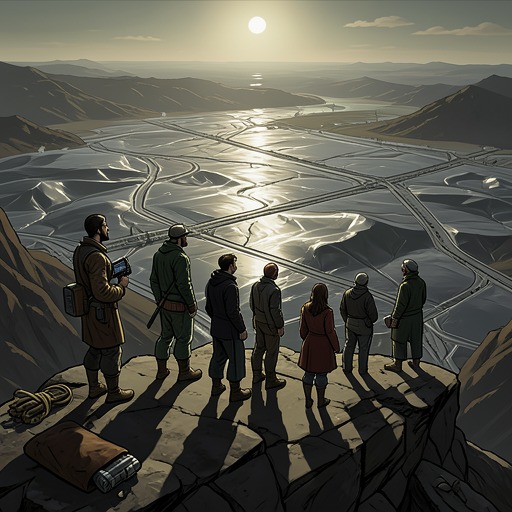
The commander, Horpach, keeps the missing ship at the center of the landing’s unease. While the Invincible’s crew watches the desert settle after their own descent, he reminds Rohan that the Condor did not return from the same place. The warning gives the landscape a second meaning: the crater, lava-colored rock, dunes, and relentless wind are not merely unfamiliar scenery but the setting in which a ship of the Invincible’s own kind has already vanished. The crew has completed months of preparation and three hundred hours of deceleration, yet the ship they came to find has left them with no intelligible explanation.
Discovery in the Desert
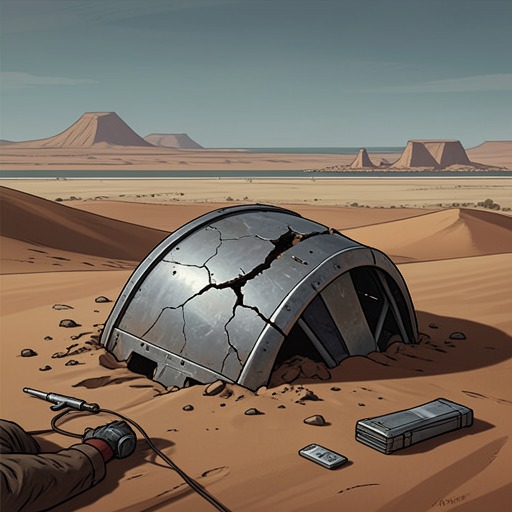
The Condor is located by another team a hundred eighty miles from the Invincible. From a distance the rocket resembles a crooked tower, its appearance distorted by dunes shaped by the prevailing wind. The western rampart of sand rises higher than the eastern one, while tractors nearby are almost buried. Even the immobilized antimatter cannon is half submerged, its hatch raised; only the stern jets remain visible in a hollow protected from the wind. The scene records not a single moment of destruction but a long contest between the abandoned machine and Regis III’s atmosphere, with sand steadily covering the evidence.
The expedition establishes a force field around the site and approaches from the top of the dune. The landing ramp hangs about twenty feet above the ground, apparently arrested before reaching its full position, while the personnel elevator remains fixed in place. An empty cage leads upward. Oxygen canisters protrude from the sand, their aluminum surfaces still gleaming; a plastic container, jars of preserves, theodolites, cameras, telescopes, tripods, and mess kits lie scattered throughout the hollow. Some objects are intact, others damaged, and all are displaced from their ordinary functions. The abundance of recognizable equipment makes the absence of the crew more disturbing: the expedition’s tools survived in fragments, but the people who used them did not.
The first remains include bones, fragments, and a complete skeleton in a jumpsuit. An oxygen-mask mouthpiece still rests between the jaws, and its pressure dial is fixed at forty-six atmospheres. When Jarg turns the canister valve, gas escapes with a prolonged hiss. The desert’s extreme dryness has left the steel regulator free of corrosion, so that its knobs still turn easily. This preserved mechanism produces a stark contrast between technological readiness and human extinction: the equipment remains operational or nearly so, while the body beside it has become part of the sand.
Damage and Interior Ruin
The elevator’s electricity no longer works, forcing technicians to climb the forty-meter structure with ropes. When Rohan, Ballmin, the biologist Hagerrup, and the technician Kralik finally enter, the ship’s outer hull supplies the first unmistakable sign that the Condor was not simply lost to an ordinary landing accident. The titanium-molybdenum casing is pierced or bored in countless closely spaced places by an extraordinarily hard instrument. The marks are small and chisel-like, yet no known chisel could dent the riveted surface. Rohan considers a chemical process, but the evidence remains unresolved.
Inside, the emergency generator restores the lights. Sand has entered only near the cracked-open hatch; it has not filled the passageways. Three Deck appears clean, orderly, and brightly lit, with isolated objects abandoned on the floor: an oxygen mask, a plastic plate, a book, and part of a spacesuit. The apparent order ends below. In the cartography cabins, star cabins, messes, crew quarters, radar rooms, engine room, passageways, and interdeck gangways, incomprehensible chaos replaces the disciplined arrangement expected aboard a military cruiser.
The bridge is worse still. Every glass monitor and dial face appears to have been destroyed. Because the glass was shatterproof, the force that reduced it to silvery powder must have been extraordinarily powerful; the powder covers consoles, chairs, cables, and switches. In the library, microfilm spills across the floor in tangled masses, books are torn, compasses and slide rules are broken, and analytic tapes are scattered. Cameron’s large star catalogues have been handled with particular violence and patience, their thick plastic pages removed one by one. Nearby, the clubroom and projection room are blocked by crumpled clothing and leather stripped from the upholstery. The destruction is not legible as a blast, fire, or simple mechanical failure. It resembles a systematic assault on the ship’s instruments, records, furnishings, and signs of organized human life.
A desiccated body lies curled against the wall of the small navigation cabin. Its linen trousers and stained shirt remain visible beneath a tarpaulin placed there by the first technician to enter. The skin has turned brown and clings to the bones, making the body effectively mummified. Later examinations distinguish the nine mummified bodies found inside the ship from skeletons and partial skeletons recovered in the sand. One additional body is preserved by freezing in the hibernation chamber. The evidence is thus distributed across states of preservation, but all of it points toward the same conclusion: the Condor’s crew did not merely abandon the vessel; the expedition collapsed within and around it.
Evidence, Investigation, and Abandonment
Horpach reports that twenty-nine bodies have been recovered within the Condor’s perimeter and thirty-four aboard the ship, including the body found in hibernation. The figures give institutional form to the horror first encountered as isolated bones and ruined equipment. The investigation also turns to the ship’s log. After the date of landing, only four entries remain. They concern the ruins explored by the crew and the “flies,” a term that records the presence of something the expedition had observed without successfully identifying.
The Condor’s remains are interpreted alongside the wider geological history of Regis III. The planet appears to be roughly six billion years old, with a sun approaching the condition of a red dwarf. Life survives in the ocean, while life on land disappears from the more recent record. Sedimentary strata contain ruddy-black, non-geological metallic material, and layers dating from eight to six million years earlier include metals, radioactive centers, and signs of violent localized reactions. The disappearance of terrestrial life coincides with the appearance of these metallic strata, although the calculated radiation is insufficient to explain the extinction of biological forms. Test drilling eventually uncovers rusted remains resembling microscopic mechanisms, strengthening the suspicion that the Condor’s fate belongs to a much older planetary process rather than an isolated accident.
The ship itself cannot be repaired. Its hull damage lies beyond the engineers’ capabilities, and the expedition has more urgent matters to address. Horpach orders the Condor closed after energobots, transporters, jeeps, and other equipment are transferred to the Invincible. The abandoned cruiser is treated as a wreck, though the crew preserves the hope that a future expedition—or the present one—might eventually return it to its home port. This practical decision also marks a symbolic change: the Condor ceases to be a recoverable sister ship and becomes a sealed archive of an encounter the expedition has not yet understood.
Narrative and Ethical Significance
The Condor changes the meaning of the mission. At first it is the missing object that must be located, examined, and explained; later it becomes the material measure of human vulnerability on Regis III. Its identical relationship to the Invincible creates an ominous contrast between technological kinship and radically different fates. The new expedition arrives with powerful instruments and weapons, yet the Condor shows that even a modern cruiser can be reduced to scattered gear, powdered screens, and bones without leaving behind a comprehensible enemy.
The wreck also exposes the limits of treating every unknown as a deliberate adversary. Horpach wants certainty and samples of the planet’s flying mechanical formations before accepting that the expedition has nothing more to do. He worries that such formations might eventually threaten space travel in the region, even if their development would require hundreds of thousands or millions of years. Against this strategic logic, the Condor’s destruction tempts the crew toward revenge, but the wider evidence suggests that the forces involved may be products of inanimate evolution rather than conscious opponents.
Rohan’s reflection gives the Condor its deepest significance. He recognizes that the crew came armed with excessive confidence in cannons and sensors, made mistakes, and paid for them with the lives of men sent into danger. The Condor’s fate therefore cannot be reduced to an enemy victory. It becomes an indictment of the assumption that humanity has earned the right to impose its categories and destructive power on every environment it reaches. Regis III has its own equilibrium, formed across millions of years, and the ruined cruiser is the clearest surviving proof that an object built to master hostile space can become, on another world, only another abandoned layer of matter.