Discovery of the ruins on Regis III
The InvincibleThe Discovery of the ruins on Regis III is the expedition’s first major encounter with an unmistakably artificial landscape on Regis III, but its significance lies in the failure of the word “city.” Seen first from orbit and then approached across the desert, the formation appears to preserve the remains of an unknown order of existence rather than a recognizable settlement. The discovery redirects scientific attention toward the planet’s deep history, links the ruins to mysterious metallic strata and the disappearance of life on land, and ultimately becomes part of the evidence behind the hypothesis that Regis III contains a self-sustaining mechanical ecology rather than an intelligent society waiting to be contacted.
Detection from Orbit
The discovery follows the unsuccessful search for the Condor. Thirty people, including planetologists, cartographers, radar operators, and pilots, examine eleven thousand photographs transmitted by four satellites before those satellites burn up in the denser atmosphere. An apparent rocket is identified as an unusually tall pinnacle of rock, so the fate of the Condor remains unknown. Soon afterward, however, the cartographic technician Erett summons Rohan to a new set of images, where a bare plateau meets the black expanse of the ocean and an irregular mosaic occupies the landward side.
The formation is too geometrically organized to be dismissed as ordinary geology. Rohan initially thinks of a city, although he does not say so aloud. The image is indistinct and partly obscured by clouds and their shadows, and the technicians cannot sharpen it sufficiently to settle the matter. Malte estimates that the camera was between thirty and thirty-five miles above the epicenter and compares crater sizes with earlier images. The expedition therefore treats the photograph not as a conclusion but as a location to be verified on the ground.
Reclassification of the “City”
The Invincible lands almost three and a half miles north of the formation, close enough for the structures to be visible from the bridge. From that distance they seem artificially made: angular, generally broader at the base than at the top, several miles in extent, black or faintly metallic, and riddled with holes. The ship establishes its usual defensive perimeter with energobots, while five rovers and a mobile antimatter cannon assemble inside the force field for the approach. Scout robots move ahead, local shielding is created at the edge of the ruins, and arctans must free one leg of the cannon after it drops into a concealed gap beneath the sand.
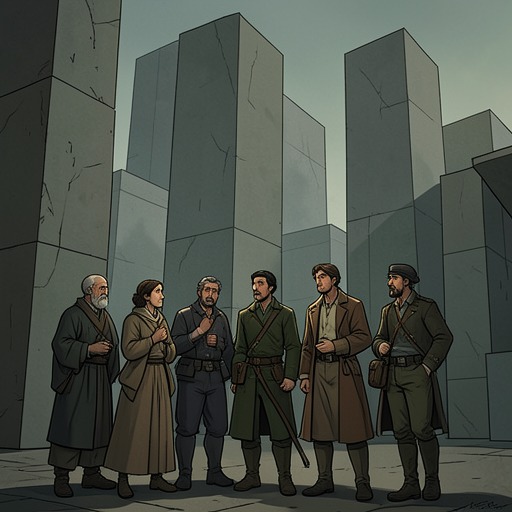
At close range, the apparent settlement becomes stranger and less legible. The structures rise several stories from dunes of uncertain depth, with spiky, brushlike surfaces unlike anything the humans have seen. They have no windows, doors, or conventional walls. Some resemble tangled nets folded and cross-connected in every direction; others suggest interpenetrating honeycombs or sieves with three- or five-sided openings. Their forms display repeated regularities, though not the homogeneous order of a crystal, and many are visibly disintegrating.
Other remains consist of angular branches twisted into arches or opposed spirals. Some thrust vertically from the sand; others lean like drawbridges. Wind from the north has buried horizontal surfaces and short overhangs, making distant structures resemble truncated pyramids. Up close, their apparently smooth surfaces resolve into shaggy rods and slats that retain sand in their interstices. They are neither solid nor empty: gaps allow the observers to look inside, yet the metallic tangles fill the structures throughout. Their emptiness is therefore not the emptiness of cleared rooms but the absence of any detectable life or inhabitable interior.
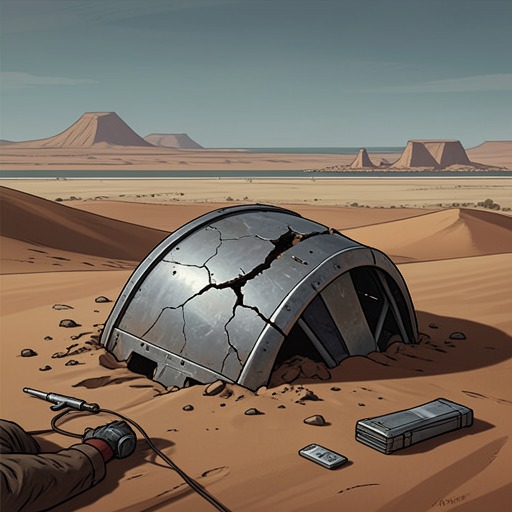
The desert is actively erasing what remains. Sand seeps into black openings and gathers in steep cones around the bases, while dunes have already submerged portions of the complex. A seismic fissure divides the formation into two unequal sections and has split larger structures apart; one collapsed element forms a bridge whose far end rests on the opposite rim of the cleft. The ruins consequently present both artificial regularity and geological violence, as though an ancient system had been broken by the planet and then slowly covered by it.
Scientific Consequences
The expedition’s language changes as observation defeats expectation. Rohan eventually tells Ballmin that this was not a city, and the planetologist agrees that it was probably not the kind of city humans can imagine. No humanoid beings appear to have lived there, nor is there anything that vaguely resembles humanity. Ballmin contrasts this absence with the oceanic organisms, which look much more like terrestrial life, making the land formations even harder to place within familiar evolutionary categories. When Rohan asks what he should report to the commander, Ballmin advises sending televisual images of the entire formation rather than forcing it into a misleading label.
The ruins acquire additional importance when exploration of Regis III exposes layers of ruddy-black, non-geological material in the sedimentary rock. Scientists consider whether immense metallic fragments, perhaps produced by a nickel-iron meteor exploding in the atmosphere, fused with ancient rock and later oxidized into brown-black and dark-crimson seams. Drilling also reveals organic carbon, fossils of plants adapted to dry conditions, and evidence that primitive reptiles once lived in terrestrial jungles. The planet’s land life appears to have flourished, disappeared, and returned in successive phases before vanishing altogether.
The later strata contain progressively fewer traces of plants and animals but increasing quantities of compressed material rich in antimonite, molybdenum oxide, ferrous oxides, and nickel, cobalt, and titanium salts. Metallic layers dating from eight to six million years ago contain localized radioactive centers, suggesting violent but limited nuclear reactions. Yet the calculated total radiation, equivalent to only twenty to thirty megatonnes spread across hundreds of millennia, could not have destroyed all biological evolution on the planet. The pattern is therefore both definite and unexplained: terrestrial life disappeared over millions of years as the metallic strata appeared.
The suspected relationship between the ruins and these deposits drives further research. At roughly seventy feet in an iron-oxide-rich seam, investigators find rusted fragments resembling broken parts of microscopic mechanisms. This material gives the ruins a possible technological context without making them intelligible. The formation is no longer merely a vanished landscape; it becomes a physical trace within a planetary sequence in which biological decline, metal accumulation, radiation, and the remains of organized structures may belong to one immense transformation.
From Ruins to Planetary Ecology
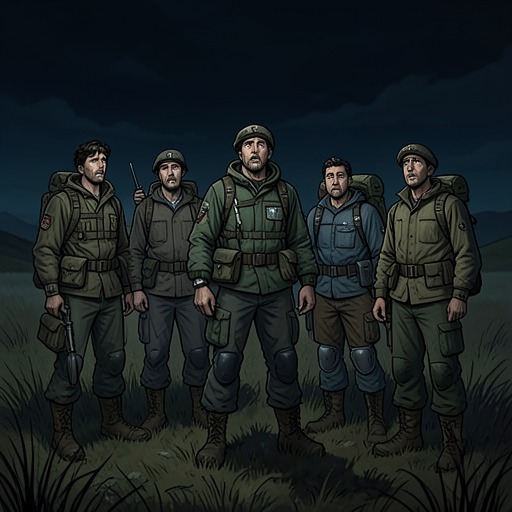
The discovery also changes the expedition’s understanding of danger. Horpach insists that the Invincible cannot return with hypotheses alone: the crew needs an accurate diagnosis and, if possible, samples of the flying mechanical fauna suspected on Regis III. He argues that such formations might eventually threaten space travel in the region, even if their development would require hundreds of thousands or millions of years. The ruins thus stand at the intersection of scientific inquiry and military precaution, where mapping and sampling can become preparation for containment or destruction.
Against that response, Rohan comes to understand the planet in less anthropocentric terms. The hypothesis later discussed by the expedition proposes that tools once made by rational beings may have become independent after their creators disappeared, evolving over millions of years into part of the planet’s natural forces. On this account, life remains in the ocean because mechanical evolution does not extend there, while the continents have become deserts because the mechanical organisms neither construct civilization nor produce anything intended for human value. Their existence is defined by persistence, not by intention, morality, revenge, or an obligation to communicate.
Rohan’s reflection turns the ruins from evidence of a lost civilization into a challenge to human authority. He recognizes that the crew’s assumption of “conquest at any cost” rests on misplaced confidence in cannons and sensors and on the belief that survival grants humanity the right to interfere. The formation becomes an emblem of a world that is organized without being humanly meaningful: regular but not architectural in the familiar sense, active in its consequences but not necessarily conscious, and ancient enough to make the expedition’s immediate categories appear provincial.
Narrative Significance
The event’s power comes from a sequence of narrowing certainties. A satellite image suggests a city; ground observation confirms artificiality but destroys the settlement analogy; geological investigation supplies material correlations without producing a complete explanation. Each stage replaces one form of ignorance with a more exact and more unsettling one. The expedition does not move from mystery to mastery. It moves from a familiar name to a stranger reality that resists possession.
The ruins also reverse the usual relation between explorer and discovered space. The Invincible arrives with maps, force fields, rovers, weapons, automatic repair systems, and communication networks, converting the desert into a measured and defended operational zone. Yet the expedition’s infrastructure repeatedly exposes its limits: photographs misidentify a rock, the landscape hides gaps beneath the sand, and later communication with Regnar’s expedition fails as if a metal wall has descended across the desert. Against this technological apparatus, the ruins remain materially present but conceptually unassimilated.
By the time Rohan recognizes that humanity has not earned the right to a truly galactocentric stance, the discovery has become more than an archaeological episode. It is the first visible sign that Regis III is not an empty planet awaiting interpretation or occupation. Its ruins mark a history in which intelligence, machinery, biology, and planetary forces may have changed places. The expedition can photograph and classify them, but the decisive lesson is ethical: existence need not resemble human life, and the inability to understand a surviving order does not by itself authorize its destruction.