Galactocentrism
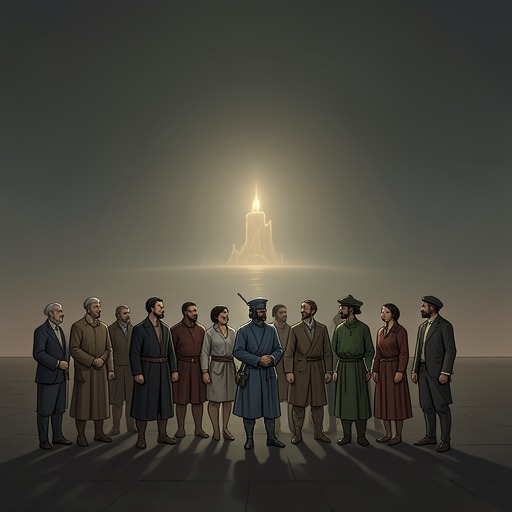
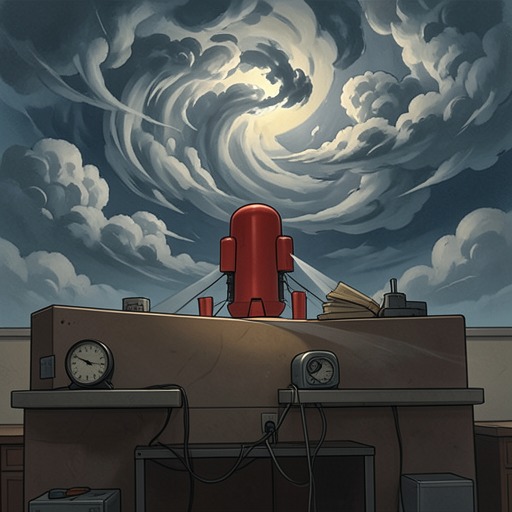
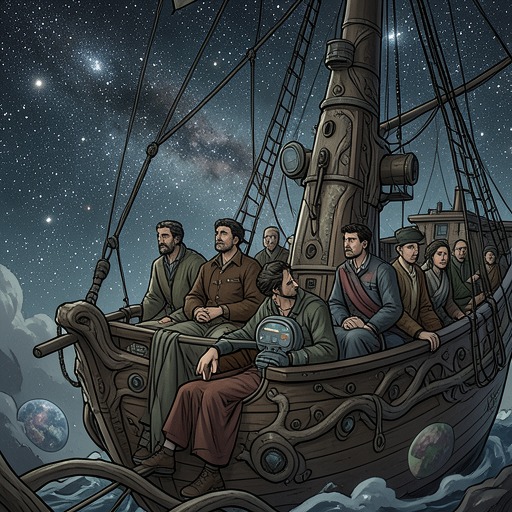
The InvincibleGalactocentrism is the principle that humanity must stop treating its own interests, forms of intelligence, and biological values as the universal measure of existence. In the crisis on Regis III, the idea becomes both an ethical conclusion and a direct challenge to the expedition’s assumption that every hostile phenomenon must be defeated. Rohan’s encounter with the planet’s black mechanical cloud leads him to insist that “not everything everywhere is for us [humans]”: the universe contains processes whose purposes are not human purposes and whose existence does not require human permission.
Definition and Intellectual Basis
Galactocentrism does not mean searching the galaxy only for beings that resemble humanity. Rohan comes to understand it instead as a demand for intellectual humility: humanity should seek to understand forms of existence on their own terms and should refrain from interfering in matters that do not concern human beings. An empty place may be occupied, but an established nonhuman system should not automatically be attacked merely because human observers find it incomprehensible or dangerous.
The principle therefore corrects a narrower, distorted idea of human greatness. Rohan recognizes that humanity has not yet earned the elevated status implied by the term “galactocentrism” if that status merely celebrates human expansion. Genuine galactocentrism requires a broader comprehension of every existing form, including survival systems based on radiation and material forces rather than on protein-based life. Such survival is neither morally better nor worse than the survival of animals or human beings; it is simply another result of evolution.
Regis III and the Challenge to Human Categories
The black mechanical cloud forces the crew to distinguish intelligence from adaptation. The mechanisms may lack a powerful intellect or any strategic plan, yet they are perfectly suited to the conditions of Regis III. Their behavior is not necessarily the expression of hostility. They attack from one opportunity to the next, scatter when struck, regenerate from destruction, multiply when part of the swarm is damaged, and remain unaffected by forces fatal to living organisms. Their apparent irrationality is thus inseparable from an extraordinary environmental fitness.
This distinction unsettles human assumptions about what counts as intelligence and what justifies violence. The crew’s weapons, machines, force fields, and sensors provide immense technical power, but they do not confer conceptual mastery. The humans may be superior in intelligence while still being strategically outmatched by inanimate mechanisms whose organization is perfectly adapted to the planet. What appears harmless to the cloud can be lethal to human beings, while the methods humans regard as decisive may be unable to destroy an adversary capable of dispersing across the planet and regenerating itself.
The encounter also exposes the provincial character of terrestrial ethical frameworks. Human beings value each individual because every person is unique and irreplaceable; the swarm has no equivalent individual value, since its tiny automata are virtually interchangeable and disposable. Its evolutionary value belongs to the swarm as a whole. Galactocentrism therefore requires more than extending familiar human morality outward unchanged. It demands recognition that radically different evolutionary histories may produce forms of organization to which human categories of personhood, intention, guilt, and revenge do not apply.
Conflict with Technological Retaliation
The concept emerges most sharply against the expedition’s desire to annihilate the cloud. After the deaths associated with the Condor and the attacks on the human mission, destruction appears to offer both protection and justice. Yet the cloud’s inanimate nature makes revenge conceptually incoherent. To punish it for killing would be like whipping the ocean for sinking a ship and drowning its sailors. No conscious intention or hostile thought stands between the humans and the process confronting them.
The scale of the technological response reveals the contradiction at the center of the expedition. The Invincible can unleash an antimatter strike so powerful that air, debris, steam, gases, and smoke are transformed into hard radiation; the blast splits the ravine, encloses the cloud in an annihilating field, shakes the ship forty miles away, and sends heat and a wall of sand across the desert. Yet even this spectacular violence cannot guarantee victory. The cloud can scatter, migrate, and regenerate, and destroying it on one continent would merely drive it to another. Technical escalation increases the violence of the encounter without resolving its underlying misunderstanding.
Rohan consequently concludes that the humans should leave Regis III rather than attempt planetary annihilation. Withdrawal is not presented as cowardice or surrender. It is the practical and moral consequence of recognizing that the adversary is not a rational enemy pursuing a comprehensible aim, and that the expedition has no legitimate purpose requiring the destruction of an entire planetary system.
Rohan’s Experience and Transformation
Rohan’s authority to articulate Galactocentrism comes from physical exposure rather than abstract speculation. He has crossed the terrain on foot, entered its ravines and valleys, breathed the planet’s atmosphere, and endured the consequences of its material forces. His insight is therefore grounded in contact with Regis III itself, not in the detached confidence of instruments or strategic theory.
His understanding deepens while he reflects alone aboard the ship. He questions why the crew’s fury persists when Regis III is uninhabited and when the deaths may be compared to deaths caused by a storm or earthquake. He sees the expedition’s “conquest at any cost” and “heroic survival of humanity” as expressions of misplaced confidence in cannons and sensors. The humans made mistakes, trusted their technology too much, and now risk transforming those mistakes into a campaign of retribution.
This realization is not emotionally easy. Rohan carries the memory of killing a man who had returned in a confused state and was about to kill others. The memory of the Weyr gun, the dead man’s vulnerable expression, and the people Rohan later gathered continues to visit him at night. His emerging principle must therefore coexist with direct knowledge of lethal danger and with the need to protect human life. Galactocentrism does not deny the value of human beings or prohibit defense; it rejects the assumption that defense automatically authorizes conquest.
Final Significance
At the moment when Rohan witnesses the black crystalline forms rise from the ravine and become absorbed into the larger clouds, he feels admiration rather than horror. Armed with the Weyr cannon taken from a dead man, he suddenly experiences himself as unnecessary within a landscape where only inanimate forms survive and act according to laws no living observer can fully grasp. He returns toward the battlefield not merely as a messenger reporting the destruction of the missing men, but as someone determined to demand that the planet be left alone.
Galactocentrism thus transforms the meaning of the expedition’s apparent defeat. The humans do not master Regis III, and their most devastating weapon produces a catastrophe that may exceed their control. Yet Rohan gains a form of knowledge unavailable to technological triumph: the recognition that existence is not organized around human access, human comprehension, or human moral drama. The principle’s decisive claim is that humanity’s place in the galaxy depends not on destroying everything that resists its categories, but on learning when power must yield to restraint.