Hibernation
The InvincibleHibernation is the technological state that makes long-distance human space travel possible while temporarily separating the operation of a starship from the consciousness of its crew. On the Invincible, it is not merely a medical procedure but an entire logistical rhythm: the ship travels under automatic control, awakens its systems before its people, and then restores the sleeping crew only when arrival and deceleration have begun. The abandoned hibernation chamber of the Condor exposes the darker side of that system, showing how easily preservation can become unexplained death when its conditions are disrupted.
Definition and Function
On the Invincible, the eighty-three crew members sleep in a tunnel-shaped hibernation chamber on the main deck while the vessel crosses a remote quadrant at close to the speed of light. Because the journey is relatively short, they are placed not in full hibernation but in a deepened sleep in which body temperature does not fall below fifty degrees. This intermediate condition preserves the practical advantages of hibernation without subjecting the crew to the lowest temperatures associated with complete suspended animation.
The distinction matters because hibernation is presented as a controlled physiological state rather than ordinary sleep. The crew’s bodies remain alive but functionally withdrawn from the ship’s temporal experience, while automatons continue working on the bridge and elsewhere. For seven months the human beings remain absent from the vessel’s active life; when their voices and movements finally return, their awakening marks the end of an imposed biological pause rather than the beginning of the journey.
Awakening aboard the Invincible
The Invincible begins preparing for its crew before any person is conscious. As the ship approaches the sun at the edge of the Lyra constellation, its automatic systems restart: programs are drawn into equipment, electric motors overcome the resistance of long-unused lubricating oil, auxiliary reactors extend their cadmium rods, magnetic pumps circulate liquid sodium, and automatic check-and-repair devices inspect welds, hull airtightness, and metal joints across many miles of structure. The ship fills with murmurs, vibration, and mechanical movement, but its crew remains asleep.
An automaton eventually completes its programmed sequence and signals the hibernation chamber. Waking gas mixes with the cool air, warm air moves through the grilles beneath the bunks, and the sleeping bodies begin to stir. Their former blankness becomes filled with nightmares and hallucinations before consciousness returns. The passageways, elevators, cabins, bridge, work stations, and airlocks brighten with artificial daylight, as though the ship has impatiently restored its own world before its human occupants are ready to inhabit it.
The awakening is inseparable from deceleration. Powerful rockets strain against the Invincible’s eighteen thousand tonnes of invariant mass, multiplied by its immense velocity; maps shake in their rolls, dishes rattle in the galleys, unsecured objects shift, and straps and cords tremble along the walls. The ship’s mechanical violence breaks the stillness of sub-lightspeed travel while the crew passes through a short transitional sleep and gradually returns to waking life. Hibernation therefore ends not in a quiet bedroom scene but amid the physical stresses of arrival, with the body re-entering consciousness as the vessel confronts the gravity and atmosphere of Regis III.
The Condor and the Failure of Preservation
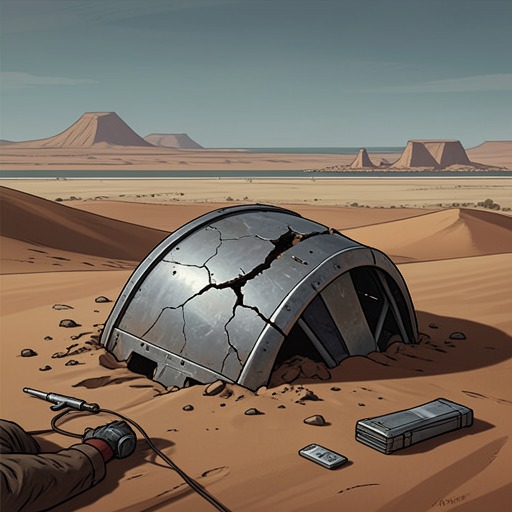
The wrecked Condor reveals what hibernation looks like when its protective system no longer provides a coherent explanation. More than twenty human bodies are found beneath tarpaulins around the ship, while the Condor’s ramp still works and its stationary reactor continues to produce electricity. In the hibernation chamber, however, one frozen body is discovered in conditions that do not correspond to any deliberate survival program.
The chamber registers one degree Fahrenheit. Rohan understands that this temperature is too high for full reversible death and too low for hypothermic sleep. The man is wearing only his underwear and lies spread-eagled on the floor, as if he reached the chamber by accident rather than having been prepared for a planned period of suspended animation. His eyes are closed, his skin has retained its natural color in the dry hermetic air, and his limbs are stiff from the cold; microscopic ice crystals fill the tissue beneath the skin.
The doctors cannot revive him. After examining the body, Sax states that nothing can be done, and Rohan concludes that the man is dead. The orderly room, with its tidily made bunks and occasional clink of instruments, intensifies the contradiction: the chamber still resembles a place designed for regulated sleep, yet the person inside it has crossed into irreversible death. The technological environment preserves the appearance of procedure after the procedure itself has become meaningless.
Nygren later explains that the other bodies show signs consistent with mummification and prolonged starvation, since their adipose tissues have almost entirely disappeared. The body in the hibernation chamber is different. In response to Rohan’s observation, Nygren says that this man probably froze to death and may simply have fallen asleep as his body temperature dropped. Hibernation thus becomes a forensic boundary: the same apparatus can contain intentional suspension, accidental hypothermia, and a corpse whose condition resists the expedition’s normal categories.
Knowledge, Risk, and Human Limits
The uncertainty surrounding the Condor’s hibernation chamber contributes to the expedition’s wider failure to understand Regis III. The crew initially considers whether life might exist underwater, concealed in the ocean and organized into a civilization below the surface, because the land appears barren despite the presence of oxygen. The hypothesis is rejected as implausible, but the episode shows the investigators trying to force an unfamiliar planet into recognizable biological and civilizational patterns.
That impulse extends to the expedition’s use of maps, photographs, force fields, rovers, and remote communication. Rohan notes that visual observation from orbit offers little compared with a complete set of photographs, yet full photogrammetry would take almost a month. On the ground, the Invincible establishes a protected perimeter with energobots and inforobots, while later field operations impose the rule that every researcher outside a force field must remain within the view of someone protected inside it. Hibernation belongs to this same infrastructure of control: it promises that human bodies can be transported, timed, and recovered by technical means.
But the Condor demonstrates that control is conditional. The ship may retain electricity and functioning equipment while the human purpose of its hibernation chamber has vanished. Later, when communication with Regnar’s expedition collapses behind unexplained interference, the Invincible’s instruments and relay systems likewise cease to guarantee human mastery. The expedition repeatedly discovers that its machinery can continue operating without yielding intelligible knowledge.
Narrative Significance
Hibernation gives the novel a precise image of humanity’s dependence on systems that appear more reliable than individual bodies. During the Invincible’s voyage, automatons wake the ship, inspect its structure, restart its motors, and begin deceleration before the crew can respond. Human consciousness is treated as a delayed component of a larger mechanism, necessary for judgment but absent from the vessel’s most basic continuity.
The Condor reverses that reassuring arrangement. There, the chamber’s technical setting does not preserve a living crew but surrounds an inexplicable death with the remains of normal order. The frozen man is neither clearly a sleeping astronaut nor a body prepared for reversible death; he is a person caught between categories, and that ambiguity exposes the limits of the expedition’s medical and technological language.
Rohan’s later reflection that humanity has not earned the right to a truly galactocentric stance grows from precisely this failure of categories and control. Human beings arrive armed with cannons, sensors, maps, and procedures, assuming that what they encounter must be an enemy, a civilization, or a problem awaiting diagnosis. Hibernation quietly undercuts that confidence at the level of the body itself. It shows that even the travelers who command the machines may become, under altered conditions, only another uncertain physical event in an environment they do not yet understand.