Horpach
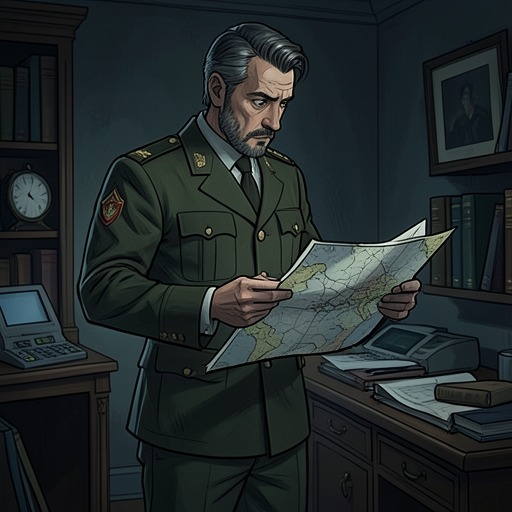
The InvincibleHorpach is the star captain and commander of the Invincible expedition on Regis III. His decisive function is to turn a baffling planetary disaster into a question of judgment: whether the crew should treat the unknown formations as an adversary to be defeated or as a natural process that human beings have no right to attack merely because they cannot understand it. He commands through procedure, maps, reports, and weapons, yet the crisis gradually makes those instruments look morally and intellectually insufficient.
Identity and Command
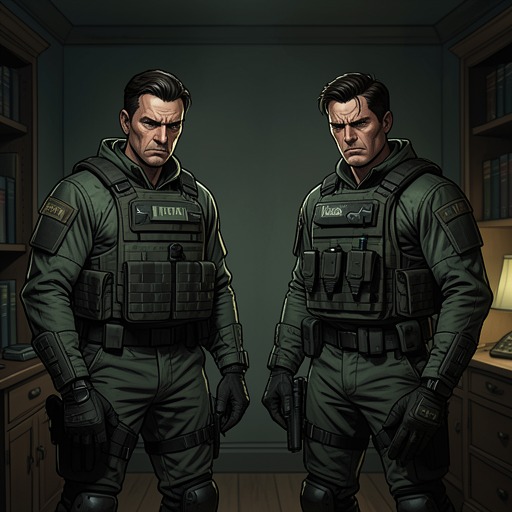
Horpach first appears at the moment of landing, bent over the log book and recording the customary landing symbol, the time, and the name of the planet, Regis III. His habit of writing turns an immense and unfamiliar world into an official operation, but his next decision immediately breaks with routine. When Rohan asks whether they will follow regular procedure, Horpach orders the more cautious degree three ground procedure instead. The order activates energobots, shield batteries, force-field technicians, and the assigned positions of the rest of the crew, placing the entire expedition under defensive discipline from its first completed landing.
The order also reveals Horpach's awareness that the Invincible has entered a situation unlike an ordinary planetary survey. Rohan is surprised, while Horpach responds with a brief, almost private smile and suggests that perhaps there will later be time for leisurely walks at sunset. The contrast is characteristic: his command remains severe, but he can imagine normal exploration only as something that must be earned after danger has been assessed. His authority is therefore not merely ceremonial. It organizes the ship's response before the crew understands what has happened.
Method: Evidence Against Panic
Horpach's leadership is defined by a demand for composure and verifiable facts. After the expedition's discoveries and the confusing reports surrounding the Condor, Rohan returns to the base and goes directly to him. Horpach has already examined the televisual transmission, the reports of returning groups, and several hundred photographs scattered across a regional map. Rather than make Rohan repeat the entire experience, he tells him to regain his composure and insists that sound judgment is necessary to get to the bottom of the story. The gesture combines practical efficiency with an understated recognition of psychological strain.
This evidentiary discipline governs Horpach's response to competing explanations. When Rohan speculates that hidden aquatic beings might have created an underwater civilization, Horpach rejects the idea as implausible, arguing that intelligent aquatic beings would probably have attempted to conquer the land. His objection is not presented as absolute knowledge; it is a refusal to let a dramatic possibility replace what the available evidence can support. Similarly, when unexplained metallic material is discovered in the planet's strata, the expedition's scientists must continue drilling rather than convert a suggestive resemblance into a settled conclusion.
Horpach also has to manage the institutional pressure represented by the question of what should be reported to the commander. The expedition cannot simply return with images of ruins, unexplained deaths, or conjectural mechanisms and call the matter solved. The captain's role is to translate uncertainty into a decision that can withstand scrutiny, even when the facts themselves resist a coherent narrative.
The Hypothesis of Inanimate Evolution
Lauda's Hypothesis gives Horpach the most consequential intellectual challenge of his command. Lauda argues that life exists in the ocean but that all life on land disappeared more than five million years ago. He proposes that a rocket from another system may once have landed on Regis III, perhaps after a stellar catastrophe, and that the surviving machines later developed independently. The idea gains force from the planet's geological record: older strata contain evidence of terrestrial plants and reptiles, while later layers contain metallic deposits, localized radioactivity, and increasingly few traces of biological life.
Horpach listens rather than dismissing Lauda outright. Yet he refuses to treat a plausible reconstruction as certainty. He explains that the expedition needs an accurate diagnosis and the establishment of facts, not revenge or payback for the fate of the Condor. If the crew can secure samples of the supposed flying mechanical fauna and bring them aboard the Invincible, he will accept that the expedition has nothing further to do on Regis III; the base can then decide how to proceed. His concern extends beyond the immediate mission, since he also considers whether the formations might eventually threaten space travel in the region, even if such a development would take hundreds of thousands or millions of years.
The exchange exposes a fundamental difference between Horpach and Lauda. Lauda interprets the formations as a force of nature that should be endured rather than morally condemned. Horpach accepts the intellectual force of that position but remains responsible for returning with knowledge that can guide policy. His skepticism is therefore not simple militarism. It is the skepticism of a commander who knows that an uncertain diagnosis can endanger both the crew and those who will follow.
Relationship with Rohan
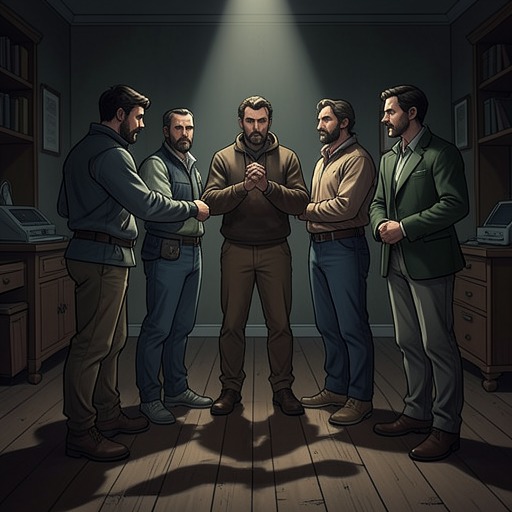
Horpach's relationship with Rohan is marked by professional trust, disagreement, and a deliberate transfer of responsibility. He recognizes Rohan's surprise at the landing protocol and later responds to him with a guarded mixture of authority and warmth. When he tells Rohan that the dangerous ground procedure is only the beginning, the remark lightens the atmosphere without minimizing the danger.
Their disagreement becomes more important as the expedition's interpretation changes. Rohan questions accepted explanations, considers underwater life, and eventually reaches a moral understanding that humanity has no right to attack every form of existence that contradicts its categories. Horpach does not simply silence him. In a private conversation, he acknowledges that Rohan often disagrees with him and then gives him an extraordinary choice: Horpach has not decided whether to leave or remain, and he tells Rohan that he will do whatever Rohan says. The commander's authority thus culminates not in an order but in an act of delegated judgment.
That delegation is also a test. Horpach does not toss a coin between leaving and staying, because the decision concerns lives, knowledge, and the expedition's obligation to the unknown planet. By placing the choice before Rohan, he recognizes that command cannot be reduced to personal certainty. The scene makes their relationship reciprocal: Horpach has protected Rohan through institutional authority, while Rohan's developing insight may now determine the direction of Horpach's command.
Ethical Limits and Narrative Role
Rohan's later reflections sharpen the moral problem Horpach embodies. The expedition has trusted its cannons and sensors, made mistakes, lost men, and then begun searching for a method of annihilation. Horpach is not physically present in that moment, but Rohan imagines telling him everything: that the supposed conquest at any cost and the desire for retribution are forms of human rashness. This imagined confession shows how deeply Horpach's earlier demand for facts has shaped Rohan's thinking, even as Rohan moves beyond the captain's initial military frame.
Horpach stands at the threshold between exploration and colonization. The crew maps Regis III, photographs its ruins, drills into its strata, and considers removing samples of its mechanical life. His insistence on evidence can protect against superstition, but it can also support continued intrusion when evidence is treated as a warrant for possession or weaponization. The captain therefore represents both the best discipline of scientific command and its danger: knowledge may restrain violence, yet the desire for certainty may prolong the presence that places humans in conflict with the planet.
His importance is finally ethical rather than tactical. Horpach begins by securing the Invincible through degree three ground procedure and by demanding composure after the Condor's fate. He then confronts the possibility that the enemy is not a conscious enemy at all. Whether or not he can fully accept that conclusion, he understands that command requires more than victory. It requires deciding what human beings are entitled to do in a world whose history vastly exceeds their arrival, and whether returning with certainty is worth the lives needed to obtain it.