Humanity–Regis III necrosphere conflict
The InvincibleThe Humanity–Regis III necrosphere conflict is the central confrontation between human exploration and Regis III’s metallic life-like systems. What first appears to be an organized attack by an unknown civilization gradually becomes something more disquieting: a planetary survival process produced by inanimate evolution, capable of destroying living beings and intelligent machines without revenge, intention, or any recognizable conception of humanity. The conflict therefore changes its meaning as the expedition proceeds. It is initially treated as a military emergency, then analyzed as a scientific problem, and finally recognized by Rohan as an ethical test of whether humans can encounter an existence that is neither human nor conventionally alive without trying to conquer it.
Origins in an Unreadable Planet
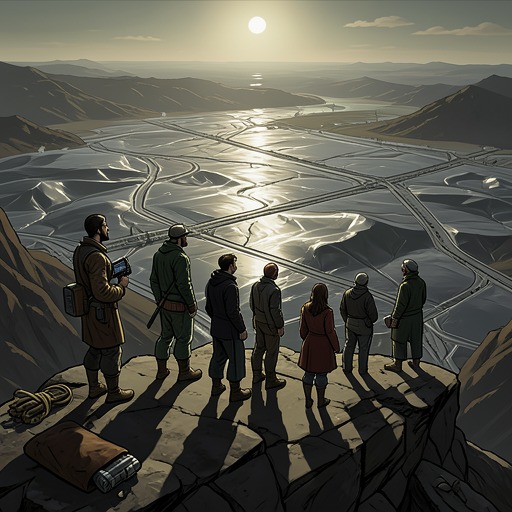
The human presence on Regis III begins with observation, mapping, excavation, and the attempt to make the planet legible. Rohan considers beginning with photogrammetry: a complete orbital survey that might reveal what direct observation cannot. The expedition’s map is based on old unmanned probes and shows only the principal continents, seas, polar icecaps, and large craters, with the landing site marked at eight degrees north. Even before the metallic conflict is understood, this procedure establishes the imbalance between the planet and its visitors. Regis III is being converted into images, coordinates, samples, and hypotheses, while its own processes remain largely invisible.
The first scientific puzzle is the sharp division between ocean and land. The biologist reports that life exists in the ocean but not on land, although Ballmin has found traces of ancient terrestrial life. Rohan speculates about concealed underwater beings and an oceanic civilization, but the commander rejects the idea that intelligent aquatic beings would have remained confined below the surface. Another explanation is that Regis III is an extremely old planet, perhaps six billion years old, orbiting a sun already approaching the condition of a red dwarf. The absence of land life, the survival of oceanic forms, and the presence of atmospheric oxygen produced by algae later become essential clues to the nature of the conflict.
The geological record deepens the mystery. Sedimentary strata contain ruddy-black material that is not geological in origin and may consist of metallic fragments deposited millions of years earlier. The fragments could have come from a gigantic nickel-iron meteor that exploded in the atmosphere, but the deposits also invite speculation about the catastrophe of the Lyran System and possible clashes among ships attempting to colonize Regis III. The evidence shows that terrestrial life disappeared over a period of millions of years as metallic strata began to form, although the recorded radiation was far too limited and dispersed to account for the extinction. The resulting picture is not of a single explosion but of a long planetary transformation in which biological history and metallic evolution became entangled.
From Investigation to Hostility
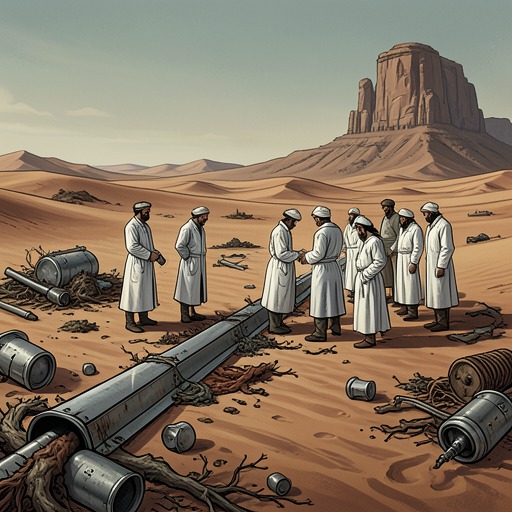
The expedition’s uncertainty is repeatedly converted into military suspicion. The Condor’s destruction, Kertelen’s loss, Regnar’s devastation, and the destruction of reconnaissance planes are interpreted as connected acts by a hidden adversary. Rohan is placed in the position of coordinating exploration while remaining near the Invincible, and the demand for certainty becomes increasingly urgent. When asked what should be reported to the commander, he is advised to send visual images of the entire collection of ruins and equipment, yet Rohan abruptly recognizes that the site was not a city. The inability to classify what has been found becomes one of the conflict’s immediate causes: the humans cannot decide whether they are confronting ruins, weapons, organisms, or the remnants of a civilization.
Lauda’s hypothesis supplies the first systematic explanation. He proposes that the metallic formations are the products of millions of years of mechanical evolution and are exceptionally adapted to combat living beings. In this account, the machines may have killed directly when land on Regis III teemed with life, but eventually the energetic cost of killing led to more efficient methods. The destruction of the Condor, Kertelen’s accident, and the devastation of Regnar’s team are therefore not separate acts of malice but consequences of a system optimized to disable or eliminate living organisms.
The most terrifying method is the apparent obliteration of brain contents. Lauda interprets Kertelen’s condition as the destruction of almost the entire contents of a human brain, a process that would cripple a living creature and cause it to perish without requiring conventional physical violence. This makes the human situation worse than a normal battle. Humans are fragile biological beings, whereas the metallic systems can survive damage, regenerate, disperse, and multiply after part of a formation has been destroyed. They evolved while contending both with living organisms and with intelligent automatons, and their long struggle produced an extreme general adaptability even without producing a powerful intellect.
The conflict also targets communication and coordination. Lauda explains that the metallic cloud can obstruct radio exchange, a function that would have been useful against the higher automatons of earlier ages. The attacks on Regnar’s contact with the expedition and on the reconnaissance planes thus appear to repeat an ancient anti-communication strategy. Human force fields, aircraft, machines, and command networks become vulnerabilities because the explorers depend on infrastructure that the metallic formations can disrupt. The humans must remain protected by force fields, while the clouds can scatter, move between locations, and shift from one region of the planet to another. Even a successful attack on one continent would not end the threat; the formations could simply move elsewhere.
The Conflict as a Clash of Evolutionary Logics
Lauda insists that the metallic beings should not be mistaken for a rational opponent. Their attacks appear opportunistic rather than strategically planned, and their behavior is understood as the continuation of adaptations formed over millions of years. Their apparent intelligence is collective and functional rather than reflective: individual parts may retain information about the parts to which they are attached, allowing a dispersed system to reassemble when triggered. A cloud can thus behave like a brain without possessing a human-like mind, and a destructive response can emerge from local mechanisms rather than from a commander’s intention.
This distinction makes the conflict philosophically unusual. Human beings are, in one sense, intellectually superior to the automatons, but that advantage is irrelevant in an environment where the decisive capacities are dispersal, regeneration, resistance to radiation, and adaptation to the destruction of life. The formations are not mental powerhouses; they are perfectly suited to the conditions of Regis III. What is harmless to an inanimate system may be lethal to a living organism, while the weapons humans consider most powerful cannot reliably destroy an enemy that can fragment and reconstitute itself.
The planetary ecology supports this interpretation. Life remains in the ocean because mechanical evolution does not extend there, but the metallic systems prevent those organisms from reaching the land. The continents are deserts not because the planet lacks a history of life, but because the dominant inanimate systems build nothing, possess no civilization in the human sense, and maintain only themselves. Regis III is therefore not an empty world awaiting occupation. It is a functioning environment whose apparent desolation is itself the consequence of a long conflict between biological and mechanical forms.
Horpach resists treating this interpretation as sufficient. He argues that the expedition cannot return with hypotheses alone and wants samples of the flying mechanical fauna aboard the Invincible. Certainty, rather than revenge, is his stated objective, and he worries that such formations might eventually threaten space travel elsewhere in the Galaxy. His position preserves the scientific and strategic logic of the expedition: the unknown must be diagnosed, sampled, and assessed before a final decision can be made. Yet it also shows how investigation can remain bound to possession. To obtain certainty, the humans must capture part of what they do not understand.
The Cyclops and the Limits of Force
The battle between the Cyclops and the black cloud is the conflict’s most spectacular military expression. The cloud is pierced by flames two miles high as atomic explosions turn the air into a fiery, windmill-like turbulence. The Cyclops retreats toward the ravine entrance while continuing to fight, apparently seeking more open ground so that the cliffs will not collapse onto it and restrict its movement. On the bridge of the Invincible, the battle becomes almost impossible to separate into categories: cannon fire, smoke, cloud remnants, and crushed rock merge within the same field of destruction.
The climax arrives with an antimatter strike. The entire area around the Cyclops—air, debris, steam, gases, and smoke—is transformed into maximally hard radiation, splitting the ravine and surrounding the cloud in an annihilating zone half a mile wide. Although the Invincible is forty miles from the epicenter, the cruiser rocks under the impact; seismic waves shift vehicles and energobots near its ramp, and a delayed blast of heat and wind sweeps across the desert. The television probe, eight miles from the center, is damaged but continues transmitting. The scale of the attack demonstrates both human technical power and its destructive indiscrimination: the weapon does not merely strike an opponent but remakes the surrounding environment.
Yet force does not produce mastery. The metallic formations scatter when hit, and the dispersed pieces remain capable of regrouping. Human weapons can destroy visible concentrations without eliminating the system that generates them. The battle therefore dramatizes the failure of conventional military categories. The Cyclops and the cloud are not two armies pursuing political objectives; they are distinct adaptive systems colliding within a planetary ecology, while human observers attempt to force that collision into the language of victory and defeat.
Rohan’s Ethical Reversal
Rohan’s understanding changes most sharply after he witnesses the metallic formations from within the ravine. During a single day, his attitude toward the black cloud transforms. He no longer seeks shelter when two clouds approach from opposite slopes, because a concealed device is still functioning and his position seems irrelevant to the process unfolding around him. The clouds thicken into columns, their inner masses draw together, and flashes illuminate billions of silver-black crystals. When the two sides interpenetrate, the event resembles a battle, but the apparent conflict proves illusory: the clouds absorb the gathered sphere, and the valley becomes quiet again.
The experience does not fill Rohan with horror. Instead, he feels stunned admiration before a landscape in which inanimate forms alone can survive and act according to rules no living observer can fully see. The Weyr gun taken from the dead man suddenly makes him feel ridiculous and unnecessary. He wants to return not merely as a messenger carrying news of the missing men’s destruction, but as someone who will demand that Regis III be left alone. The conflict has thus reversed the expected roles. The human explorer, who entered the planet seeking facts and certainty, becomes the advocate for the nonhuman system against his own expedition’s impulse to remain, retaliate, and destroy.
This reversal is prepared by Rohan’s growing rejection of revenge. He recognizes that the Condor’s crew and the other dead were not necessarily killed by a hostile mind. Treating the metallic formations as moral enemies would be like punishing the ocean for sinking a ship. The comparison removes intention from the disaster without diminishing its consequences: the deaths are real, but they do not establish a claim to retribution. The proper response is diagnosis, caution, and withdrawal rather than a crusade against a force that cannot understand the accusation.
Significance of the Conflict
The conflict ultimately exposes the limits of human galactocentrism. Rohan understands that humanity has not earned the right to treat human likeness as the measure of all existence. For him, galactocentrism should mean more than searching for beings that resemble humans or granting significance only to intelligible minds; it should mean refraining from interference in processes that do not concern humanity. Regis III has developed its own equilibrium of survival over millions of years, sustained by radiation and material forces rather than by biological intention, and that survival is neither morally superior nor inferior to the survival of animals or humans.
The expedition’s original language of conquest, heroic survival, and retribution is therefore revealed as a projection of human error onto an indifferent system. The humans trusted their cannons and sensors too much, made mistakes, and are paying for them; the fault is not simply located in an enemy. The conflict becomes a critique of scientific and military exploration when observation turns into extraction, when uncertainty becomes a reason to seize samples, and when the inability to understand a planetary process is treated as permission to destroy it.
The final ethical proposition is not that Regis III is safe, benevolent, or compatible with human life. It is precisely that the planet is dangerous without being malicious. The metallic formations can annihilate living beings, disrupt communication, regenerate after attack, and occupy vast regions beyond human control. Nevertheless, their danger does not make them an enemy in the political or moral sense. The conflict’s deepest consequence is the recognition that survival may require retreat, and that leaving a world alone can be a more responsible act than winning a battle upon it.