Invincible–Condor relationship
The InvincibleThe Invincible–Condor relationship begins as a bond of technological kinship and becomes the central material and ethical contrast of the expedition to Regis III. The Condor and the Invincible are cruisers of the exact same class, so alike that their interiors reproduce the same cabins and working spaces; yet the Condor stands abandoned in the desert, surrounded by bones and unexplained damage, while the Invincible remains the active vessel through which the surviving expedition tries to understand what happened. The sister ship is therefore both a mirror and a warning: everything found on the Condor could, in principle, happen to the Invincible.
Sister Ships and Shared Mission
The Condor’s disappearance precedes the Invincible’s arrival on Regis III and gives the new expedition its immediate purpose. The Condor’s last recorded signal, relayed through hyperrelay no. 7 to the nearest beacon a year earlier, reported that its landing was complete, that Regis III was a desert planet in the sub-delta-92 category, and that the crew was following degree two procedure while exiting onto land in the equatorial zone of the continent of Evana. The message presents the landing as routine, but the absence of a later communication turns that procedural clarity into an ominous interruption. When the Invincible lands, its commander reminds Rohan that the Condor did not return from the same place.
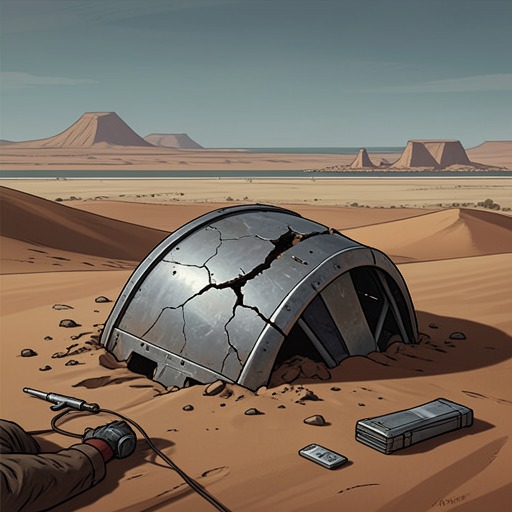
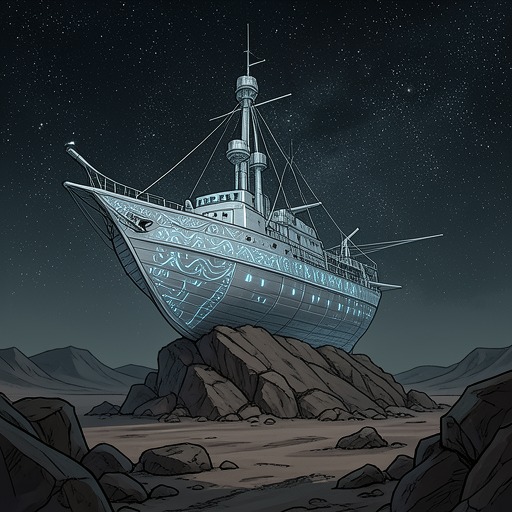
The shared design of the two vessels makes the Condor’s loss unusually intimate for the Invincible’s crew. The Condor had left the yard only a few years earlier, and its outline could not be distinguished from that of the Invincible. The survivors do not find a shattered hull or an obvious reactor explosion. Instead, the ship is still standing, tilted lifelessly in the sand as though the ground beneath its stern supports had given way. Its apparent preservation conflicts with the surrounding human remains and with the violence suggested by the marks on its exterior, making the sister ship resemble a preserved scene of impossible failure rather than an ordinary wreck.
Discovery of the Condor
The Invincible’s personnel find the Condor about one hundred eighty miles from their own position. Prevailing winds have built a higher sand rampart on the western side and nearly buried nearby tractors; even the immobilized antimatter cannon is half immersed, although its hatch remains raised. The stern lies in a hollow protected from the wind, allowing the searchers to clear a thin layer of sand and reach objects scattered around the ramp. Transporters and infobots are left roughly one hundred feet from the site while vehicles form a broad ring and their emitted rays combine into a force field.
The remains establish that the Condor’s disappearance was a mass catastrophe. Bones and fragments lie around the ship, including a complete skeleton still wearing a jumpsuit. An oxygen-mask mouthpiece remains between its jaws, and the pressure dial on its regulator is fixed at 46 atmospheres; when Jarg opens the canister, gas escapes with a prolonged hiss. The dry desert air has left the steel components free of corrosion and the regulator’s knobs still operable, an unnerving preservation of equipment beside the destruction of its user.
The ship itself supplies the first decisive physical clue. Its titanium-molybdenum outer casing has been bored or pierced in many places by something terrifyingly hard. The marks are shallow but so densely arranged that the entire hull is stippled with small irregular dents, as if struck by the sharp tip of a tool no human chisel could have produced. The Invincible’s people are confronted not with a familiar mechanical failure but with damage that seems to challenge their assumptions about what kind of force could attack a cruiser.
Investigation and Consequences
The discovery forces the Invincible to reorganize itself around the Condor’s evidence. Horpach calls a council in the Invincible’s library, where nineteen specialists—biologists, physicians, planetologists, electronic and communications engineers, cyberneticists, and physicists—assemble as the ship’s strategic brain. The setting intensifies the relationship between the vessels: the colored enamel walls conceal books and microfilms, but the cabin’s uncanny similarity to the Condor’s rooms repeatedly brings the recovered violence into Rohan’s memory. The sister ship is thus present inside the Invincible not only as data but as an architectural double.
The casualty count makes the scale of the loss precise. Teams working around the Condor recover twenty-nine bodies, while thirty-four are found aboard the ship, including one body perfectly preserved in a hibernation chamber. Only nine of the bodies inside are mummified; most of the rest are skeletons or partial skeletons excavated from the sand. The difference between interior and exterior remains is explained through humidity, temperature, bacteria, rain, and the chemical reactions of iron oxides and iron sulphides in the sand, but the scientific accounting cannot explain the event that produced the dead. It gives the Condor’s destruction a measurable aftermath without reducing its mystery.
The Invincible’s expedition also searches for meaning in the planet around the wreck. Early speculation includes underwater life and a hidden aquatic civilization, but the available evidence points toward a much older and stranger history. Regis III appears to be roughly six billion years old, with a sun approaching the condition of a red dwarf; life survives in the ocean, while terrestrial life disappeared millions of years ago. Sedimentary strata contain non-geological, metallic layers, and later drilling finds organic carbon, fossils of dry-land plants, and evidence that primitive reptiles once lived on the planet. The historical record eventually shows repeated extinction and renewal, followed by the increasing presence of metallic sediment.
The metallic strata date from approximately eight to six million years ago and contain antimonite, molybdenum oxide, ferrous oxides, and salts of nickel, cobalt, and titanium, with localized centers of radioactivity. Their distribution appears too broad to be explained simply by one meteor or a single local incident. At the same time, traces of land plants and animals become progressively rarer. Yet the total radiation, estimated at no more than twenty to thirty megatonnes spread across hundreds of thousands of years, is insufficient to account for the destruction of biological life. The Condor’s fate consequently becomes part of a planetary problem: the ship may have encountered the mature consequences of an ancient process rather than an isolated attack.
From Wreck to Hypothesis
The ruins, the metal strata, and the Condor’s hull damage gradually converge in the expedition’s reasoning. Archaeological work near the ruins yields rusted remains resembling broken microscopic mechanisms, while further investigation connects the planet’s deep history with a form of metallic existence. The biologist states the ecological division starkly: there is life in the ocean, but no life on land after the older terrestrial traces disappear. This distinction helps explain why Regis III retains oxygen through oceanic algae while its continents remain deserts.
Horpach refuses to treat the developing explanation as sufficient. He argues that the expedition cannot return with hypotheses alone and seeks certainty through an accurate diagnosis, including the possibility of securing samples of the suspected flying mechanical fauna aboard the Invincible. He also warns that, if such formations can develop and threaten space travel in this region of the galaxy, the danger may extend beyond the immediate loss of the Condor. The sister ship therefore becomes evidence in a dispute between scientific caution, strategic responsibility, and the pressure to identify an enemy that can be fought.
The alternative interpretation is more disturbing because it removes intention from the disaster. The black formations may be products of inanimate, unthinking evolution: tools once made by rational beings that became independent after their creators vanished, then changed over millions of years until they formed part of Regis III’s natural forces. On this account, the Condor was not necessarily defeated by an enemy that hated or planned against it. Its crew encountered an autonomous planetary equilibrium, one as indifferent to human purpose as the ocean is indifferent to a sinking vessel.
Ethical Mirror of the Invincible
The Condor’s destruction finally alters the meaning of the Invincible’s mission. The crew first approaches the black phenomenon as a hidden adversary that may have ambushed the Condor and may next threaten them. But Rohan comes to recognize the danger in converting incomprehension into a license for conquest. He sees humanity’s reliance on cannons and sensors, its strategic language of annihilation, and its desire to retaliate for comrades who were sent into danger by human decisions. In that reflection, the Condor is no longer simply a casualty demanding revenge; it is also a record of human error.
Rohan’s conclusion is that humanity has not yet earned the supposedly exalted stance of galactocentrism if that stance means seeking only beings that resemble humanity and interfering in matters that do not concern it. Regis III has established its own equilibrium over millions of years, and the mechanical formations’ survival is neither better nor worse than the survival of animals or humans. The Invincible’s relationship with the Condor thus becomes a relationship with its own possible future: the active ship sees in the sister vessel the cost of treating an unfamiliar planetary process as an enemy before its nature is understood.
The contrast remains unresolved rather than triumphantly repaired. The Condor cannot be restored: the hull damage exceeds the engineers’ ability to repair it, and the wreck is abandoned after its energobots, transporters, jeeps, and equipment are transferred to the Invincible. It is closed up with the hope that the present expedition or a later one may eventually return the cruiser to its home port. That practical act is both salvage and relinquishment. The Invincible continues the mission carrying equipment from its sister ship, while the Condor remains in the desert as a physical remainder of the expedition’s dead and as a warning against assuming that technological kinship grants control over an alien world.