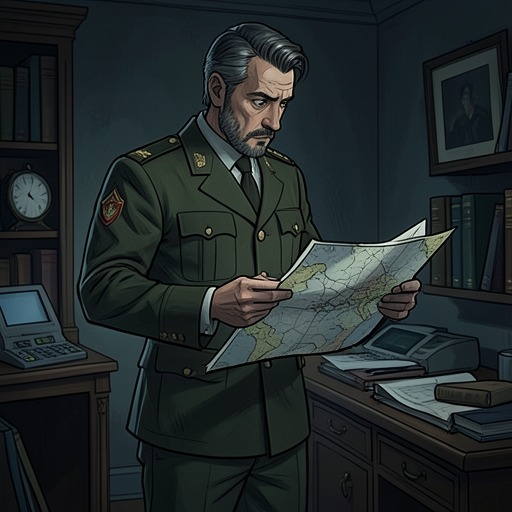
Jarg
The InvincibleJarg is a driver attached to the Invincible’s planetary expedition on Regis III, remembered by Rohan for his unfailing good humor and steady companionship. His role is outwardly practical—transporting scientists and equipment through a hostile desert—but the narrative makes his fate central to the human cost of encountering the planet’s inanimate evolution. Jarg’s brief survival during the cloud attack and his senseless death moments later turn him into one of the clearest measures of how completely the expedition’s technical safeguards and human expectations have failed.
Identity and Place in the Expedition
Jarg belongs to the transport crews supporting the expedition from the Invincible. When Rohan prepares for the ocean mission, Jarg is one of the two hovercraft drivers on the new team, and Rohan explicitly likes him for his unfailing good humor. This detail distinguishes Jarg from the machinery surrounding him: the convoy is organized around energobots, force fields, radar vehicles, kitchens, barracks, and a direct-strike laser, but Jarg supplies a recognizable human steadiness within that elaborate apparatus.
The journey to the coast places him inside a cortege whose speed is dictated by the slowest vehicles, the energobots. The convoy travels before sunrise through desert and rock, enclosed by a protective ellipsoidal force field. The ride is uncomfortable and mechanically oppressive: caterpillar tracks screech in the sand, turbines whine, conditioned air blasts from the grates, and the energobot rocks like a heavy boat. Jarg’s task is therefore not a peripheral convenience. His driving helps keep scientists, vehicles, communications equipment, and protective systems moving as one vulnerable unit across Regis III.
The Condor and the Return Journey
After the discovery of the Condor, Jarg drives the transporter that carries Rohan back with Ballmin and Gaarb. The normally broad, smiling face of Jarg has shrunk and darkened, and his handling of the many-ton vehicle has lost its usual steadiness: it bounces through the dunes and zigzags, throwing great sprays of sand to either side. His altered appearance and driving register the shock of the wrecked ship and its inexplicable dead crew. The men remain silent during the return, while Rohan privately struggles with what he has seen, including the untouched stores and the soap marked by human teeth.
Jarg’s connection with the expedition is also personal. He is identified as a friend of Genlis, a radar technician, and the distress of the journey is shared by men who are not merely interchangeable personnel. That network of ordinary loyalties becomes important when the expedition later encounters the black mechanical cloud. The cloud does not attack because of an articulated intention or a recognizable grievance; it simply overwhelms the human order on which these friendships, duties, and rescue plans depend.
The Ravine Attack
During the passage through a defile, the expedition must briefly interrupt its protection. The lead energobot crosses first and reactivates its field on the far side; the transporters and Rohan’s small amphibian vehicle follow while exposed from above; the rear energobot is supposed to link its shield to the forward one once it has passed through. Jarg is operating the rear vehicle when the ravine walls begin to smoke and a black cloud rushes toward the convoy.
Rohan orders Jarg to activate the rear force field immediately and connect it with the front shield. The system fails, probably because the klystrons have overheated. Instead of trying again, Jarg panics and jumps from the craft. Rohan catches his jump suit, but Jarg pulls free, overcome by fear, and runs back down the ravine. By the time Rohan reaches the controls, the opportunity has gone. The cloud descends over the machines and the men, while the exposed members of the convoy stagger through it in confusion, no longer able to understand the vehicles or weapons around them.
Jarg’s panic is presented as a human reaction to an incomprehensible danger rather than as a calculated betrayal. The protective machinery has already become unreliable, and the cloud’s effects destroy the men’s capacity for reasoned action. In that setting, a few seconds, a failed activation, and a frightened decision replace the orderly confidence with which the convoy began its journey.
Survival and Accidental Death
Jarg initially survives the cloud, a fact that perplexes the scientists because he and Rohan are indistinguishable from the other men in clothing, weapons, and appearance. Their presence in the small amphibian craft seems an insufficient explanation. Yet survival does not restore Jarg to safety. He returns to the ravine after the attack, out of breath and sweating, at the moment when a cloud-affected man is firing a Weyr gun without understanding what it is doing.
Rohan shouts for the gunman to get down, but Jarg runs directly toward him and is struck in the left shoulder. The shot severs his arm, and Jarg looks with boundless amazement from the bleeding stump to the arm lying apart from him before collapsing. The gunman continues firing as though handling a child’s rattle. Rohan finally shoots him at close range to prevent further deaths. The immediate event therefore contains two linked reversals: Jarg, who has survived the cloud that incapacitated others, is killed by a human weapon; and Rohan, who has questioned whether the cloud should be treated as an enemy, must use violence against a comrade to save the remaining survivors.
The later account clarifies that Jarg came back to die after having miraculously survived the first disaster. His death is not the result of a deliberate attack by the cloud, nor a heroic sacrifice governed by a clear plan. It is an accidental, chaotic consequence of disorientation, fear, and the uncontrolled release of technological force. That absence of intention makes the death more disturbing, not less: the expedition cannot find a hostile mind to blame, only a chain of failures and reactions.
Rohan’s Memory and Narrative Significance
Jarg remains with Rohan after the survivors are recovered and brought aboard the Invincible. At night Rohan is haunted by the image of the man he killed, but the memory is inseparable from Jarg’s mutilated body. He recalls Jarg’s familiar face, the smoking hole in the other man’s jump suit, the smell of ozone, the hot recoil of the Weyr, and the people he later gathered and tied together. The victim’s mindless smile and the desperate vulnerability on the shooter’s face do not permit Rohan to transform the act into a clean victory.
Jarg’s death intensifies Rohan’s rejection of revenge and of the expedition’s instinct to destroy whatever it cannot understand. Rohan comes to see the black cloud as an inanimate process of self-organization rather than a thinking adversary, comparable in principle to a storm or an earthquake. But Jarg’s fate also prevents that insight from becoming detached abstraction. The philosophical question is carried by a specific body, a familiar driver, and a single shot that Rohan cannot stop remembering.
In this sense Jarg’s narrative function is both intimate and structural. He embodies the ordinary human bonds that make an expedition more than a collection of instruments, while his death exposes the limits of force fields, weapons, command systems, and scientific certainty. His loss helps explain why Rohan cannot simply reduce the Regis III crisis to a technical problem or accept the language of conquest at any cost. Jarg is remembered not as an enemy slain in battle, but as a companion destroyed by the expedition’s encounter with a world whose processes do not recognize human intention.