Kertelen
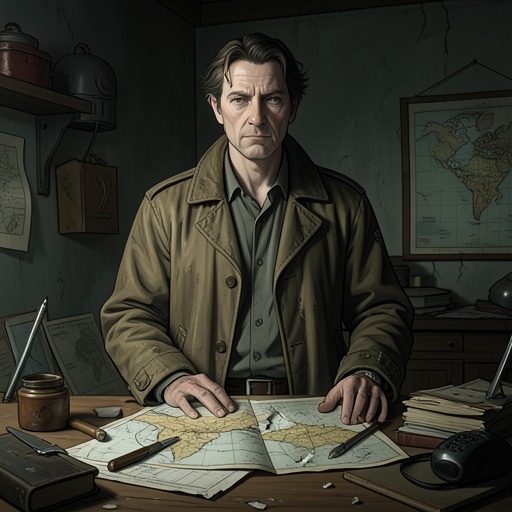
The InvincibleKertelen is the crewman of the Invincible whose disappearance during the ravine expedition ends in a condition more devastating than a conventional wound. After investigating the ruins of Regis III, he returns alive but deprived of autobiographical memory, speech, reading, writing, and the coherent personality that once made him recognizable to the others. His case gives the expedition a living measure of the planet’s threat: whatever attacked him did not simply destroy his body, but erased the human identity carried by his mind.
Identity and Introduction
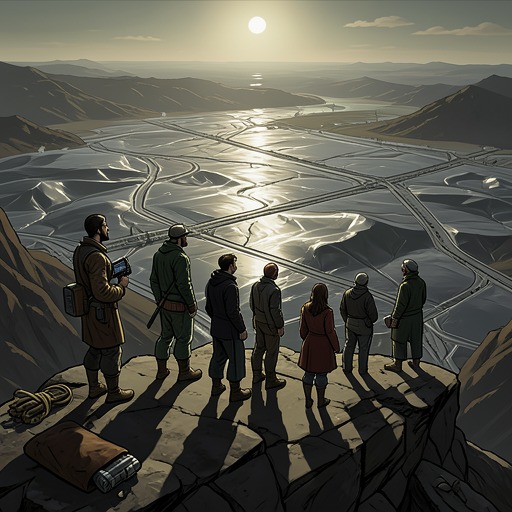
Kertelen is identified by Gaarb as the missing member of an eleven-person search party sent into a labyrinth of narrow ravines. The team had followed Gallagher’s seismological soundings and was looking for significant deposits of iron, because Kertelen suspected that machinery might be hidden somewhere in the region. The terrain consisted of soft cliffs of organic origin, hollowed out by water and perforated by caves, potholes, and short side gullies. The men had left their caterpillars behind, remained close together, and worked under the practical difficulties of masks, identical protective suits, mud, and restricted visibility.
Kertelen’s interest in hidden machinery leads him into a cave near its entrance, where he finds what initially resembles an automaton. The object is not an intact machine but the remains of a corpse-like mechanism. It had apparently once been capable of movement, though not by walking on two feet or moving in a crablike fashion. Its rustproof alloy had resisted ordinary rust, yet the object had still been consumed by corrosion and decay until only remnants remained. This discovery establishes Kertelen as an investigator drawn toward the material traces of an older technological world, but it also places him at the precise threshold where archaeological curiosity becomes personal catastrophe.
The Ravine Attack and Its Immediate Aftermath
Gaarb’s account emphasizes how suddenly Kertelen vanishes from the group. Because Gaarb was protected by a force field and responsible for watching the others, he repeatedly counted the men. At one point he found that one was missing. Kertelen had been excited by the supposed automaton and was searching for further evidence; Gaarb initially assumed that he had wandered into one of the many short, shallow, well-lit branches of the ravine. Kertelen then appeared from behind a bend already transformed into the state that would define the rest of his story.
Nygren was present and first considered heat stroke, but the symptoms did not fit an ordinary loss of consciousness. Kertelen could walk and move, yet communication with him was impossible. He had also lost the ability to speak. When Rohan asks who the injured man is, Gaarb answers simply, “Kertelen,” and Rohan reacts with disbelief because he had seen Kertelen almost until the end. The exchange turns the missing man into a recovered body while leaving the decisive moment of his disappearance inaccessible to every surviving witness.
The crew’s response is shaped by fear and projection. Each morning, people gather outside the sick bay of the Invincible for news, treating Kertelen less as a wounded colleague than as an inhuman being produced by the hostile forces of Regis III. Their imagination converts an unknown neurological injury into a fairy-tale transformation: one of their own kind has become a monster. The narrative corrects that response without minimizing the damage. Kertelen is not a monster but a crippled human being whose mind has been reduced to something as bare as that of a newborn child.
Memory Erasure and the Limits of Evidence
The crew attempts to extract information from the frozen dead through a grave-sounder, a device that sends electrical impulses into the brain and follows pathways of least resistance formed by the last functional patterns of consciousness. The results are explicitly unreliable, but the mystery of the Condor makes the experiment necessary. The apparatus can preserve or reproduce engrams, sometimes as a composite of several images, and what appears to be movement may be only a photographic record rather than evidence that the recorded people were alive.
This distinction matters for Kertelen’s case because the expedition is surrounded by representations that look like testimony but cannot be trusted as ordinary memory. The grave-sounder can expose the last contents of a brain without restoring a conscious speaker; an engram can show an image without proving motion; and Kertelen survives without retaining the mental continuity required to explain what happened. His condition therefore occupies the most painful point between evidence and silence. He is physically present, yet the person who could have narrated the encounter has been removed from the record.
Sax describes the damage as amnesia of an “unusual kind,” then revises the diagnosis into something more radical: not merely the loss of personal identity, but the annihilation of personality. Kertelen can walk and eat, although food must be placed into his mouth. He can grasp objects, but only the most primitive actions remain. He has lost not only knowledge of who he is, but also speech and the abilities to read and write. The language of medical observation makes the horror precise: the attack has not erased every bodily function, but it has dismantled the symbolic and autobiographical structures through which a human being ordinarily persists.
Recovery Without Restoration
Kertelen’s recovery proceeds as a form of elementary reeducation rather than a return to his former self. The doctors teach him as they would teach a small child. Within a week he begins to produce his first syllables and recognize the physicians, though he cannot pronounce their names. The earlier whimpering and senseless babble gradually give way to the beginnings of speech, but this improvement does not restore his memories or provide an account of the accident.
By the beginning of the second week, interest in Kertelen diminishes after the doctors explain that even a complete recovery of his normal state would not enable him to describe what happened. His education is essential, but it is not a path back to testimony. The crew’s attention fades because the surviving body no longer promises a revelation. Kertelen thus becomes both central and marginal: central to the expedition’s understanding of the danger, marginal once it becomes clear that he cannot solve the mystery.
Significance Within the Expedition
Kertelen’s fate changes the emotional atmosphere aboard the Invincible. The crew’s technical routines continue—tests, X-rays, samples, geological drilling, force-field procedures, laser calculations, visual supervision, counting, and communication across multiple channels—but the work begins to feel like a massive self-deception, a disciplined way of waiting for another disaster. Kertelen’s sick bay becomes the focus of that contradiction. The expedition wants knowledge, yet its most important human witness has been rendered incapable of producing it.
His condition also becomes relevant to Lauda’s developing theory of the cloud. Rohan learns that the doctors are asking why the cloud attacks a healthy person only once and then leaves the victim to fate. Lauda proposes that the cloud can distinguish healthy from injured people by differences in electrical brain activity: an injured brain resembles that of a newborn. Sax considers whether a concealed metal net could send weak impulses that imitate such activity, creating a possible “cap of invisibility” against the cloud. Kertelen’s devastated mind therefore becomes not only evidence of harm but also a physiological clue to the mechanism of survival. What has happened to him may reveal how the cloud recognizes its targets, even though it cannot reveal the event in words.
Kertelen’s narrative function is consequently defined by an inversion of the conventional returning explorer. He comes back from the ravines, but he cannot bring back knowledge; he survives the ordeal, but the self who entered it does not. His body preserves the fact of the encounter while his erased consciousness preserves none of its explanation. In a story increasingly forced to confront nonhuman processes rather than human intentions, Kertelen embodies the cost of meeting an alien system whose action may be neither hatred nor conscious hostility, yet whose effects are capable of abolishing the personality that makes a human life intelligible.