Kronotos
The InvincibleKronotos, the Chief Cybernetician aboard the Invincible, gives the expedition’s confrontation with the black mechanical cloud its most guarded technological interpretation. He does not merely ask whether the cloud is intelligent in an abstract scientific sense. He asks what assumption will keep the crew alive when the cloud can reorganize itself, isolate machines, defeat communication, and respond to unfamiliar threats. His importance lies in converting uncertainty into a rule of conduct: intelligence need not be proved before caution becomes rational.
Identity and Scientific Position
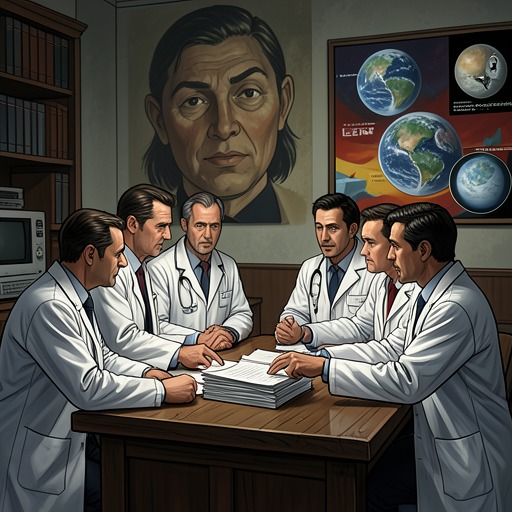
Kronotos belongs to the ship’s cybernetic specialists, a group whose professional authority and internal customs matter during the expedition’s crisis. When Lauda presents his interpretation of the cloud first to Horpach rather than to his colleagues, the resulting council becomes contentious for institutional as well as scientific reasons. The scientists aboard the Invincible function as a kind of state within a state, bound by an unspoken code of professional behavior. Kronotos therefore speaks not only as an analyst of the cloud but as the Chief Cybernetician defending a methodological standard: explanations must be judged by the actions they permit under dangerous conditions.
His disagreement with Lauda is precise. Lauda believes the cloud lacks a central control center and may instead form an inanimate brain when its micromechanisms join in particular configurations. Kronotos does not simply reject this account. He presses its unanswered questions: what triggers the linking reaction, where the memory of the whole system resides during dispersal, and how separate parts can reassemble a complex organization after destruction and separation. The issue is not whether local behavior can be described without invoking intelligence, but whether the description is adequate for survival.
The Intelligence Debate
At the council, Kronotos asks how a supposedly unintelligent cloud could have learned to attack humans. Lauda answers that millions of years of conflict with the original inhabitants of Regis III could have produced instinctive precision, just as terrestrial insects attack vulnerable ganglia without conscious calculation. He further suggests that the cloud learned to destroy aircraft by isolating the large robots and preventing them from communicating. Kronotos accepts that such mechanisms may explain particular attacks, yet he refuses to let those partial explanations settle the larger question.
His central argument is strategic rather than theoretical. The crew is not required to discover the most economical hypothesis, nor to satisfy a purely scientific preference for the explanation with the fewest assumptions. It must choose the hypothesis that enables the safest action. Assuming intelligence is therefore prudent even if intelligence has not been demonstrated. If the cloud is only an automatic swarm, excessive caution may delay the expedition; if it is in fact capable of strategic thought, dismissing that possibility could cost the crew a terrible price. Kronotos treats uncertainty itself as a hazard that must be built into operational decisions.
Lauda replies that the cloud has no intelligence beyond something like an ant colony, perhaps not even the intelligence of a single insect. Kronotos’s challenge exposes the difference between their positions. Lauda distinguishes consciousness from organized response; Kronotos distinguishes the philosophical status of intelligence from the practical consequences of coordinated adaptation. Their dispute is consequently not a simple opposition between reason and superstition. Both describe a system that can attack, regroup, and exploit weaknesses, but Kronotos insists that the crew’s defensive posture must answer to what the system can do rather than to what humans are willing to call it.
A Distributed and Adaptive Mind
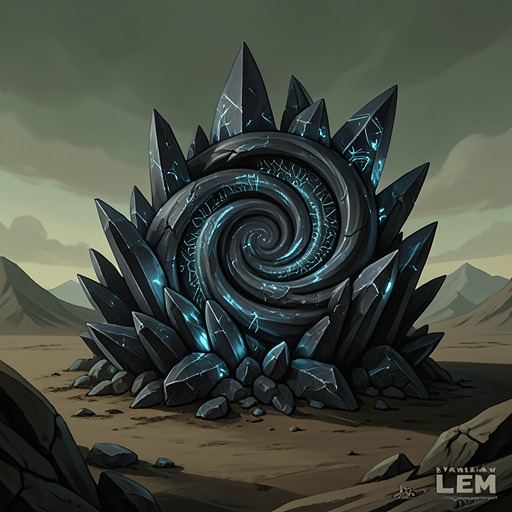
The scientific evidence available to Kronotos makes the cloud stranger than an ordinary machine. The captured black crystals have a symmetrical tripartite form and contain microscopic subsystems resembling a central nervous system. Within their arms, microcrystals function as rechargeable energy stores and transformers: according to compression, they generate electrical or magnetic fields, alternating force fields, or directed heat whose radiation produces recoil and movement. Alone, a crystal can drift, rise, descend, approach a stimulus, or avoid it, but it is largely harmless and cannot precisely direct its flight.
Aggregation changes that condition. Each crystal can link with three others, or connect an arm tip to another crystal’s central node, allowing layered constructions. Physical contact is not always necessary; magnetic fields can hold the formation in equilibrium when the crystals are merely brought close together. As the number of components increases, the aggregate acquires regular patterns of movement and can alter its direction, shape, structure, and internal impulse frequency in response to external stimuli. A reversal of the poles can turn attraction into separation, dissolving the aggregate back into scattered crystals.
Kronotos’s concern is concentrated in the second network within each crystal. That network appears to be only a fragment of a larger whole, one that may arise when immense numbers of elements join. The cloud’s effective motor may therefore be neither a single organism nor a machine directed from a fixed center, but a higher-level system whose capacities grow with the scale of its assembly. Kronotos suspects that more crystals join together when the problem confronting the cloud becomes more difficult. The result would be an infinitely expandable brain whose size adapts to its purposes, a construction for which the scientists know no equivalent.
This possibility explains why Lauda’s image of an inanimate brain does not reassure Kronotos. A distributed system need not have a permanent headquarters to possess memory, coordination, or strategic effect. Lauda proposes that each part may retain information about the parts directly attached to it; a danger signal could then make the elements enter the configurations required to constitute a brain almost instantly. The hypothesis makes the cloud’s lack of a control center compatible with collective organization, but it also makes the boundaries between mechanism, organism, and mind unstable. Kronotos’s caution arises from precisely that instability.
The Cloud in Action
The confrontation involving the Cyclops gives practical force to Kronotos’s warning. Near the ravine, the Cyclops moves toward the metallic bushes, extends its inhaustor through an opening in its forward force field, and tears out a sample for examination. After the machine approaches the accident site and remotely disables the Diracs of a distant energobot, the black scrub begins to smoke and surges toward it in waves. The cloud covers the Cyclops like tarry smoke while its energy fields strike the machine’s protective field.
The battle becomes a visible contest between a defended vehicle and an ever-growing swarm. The force field swells and contracts beneath the pressure of the black mass; the cloud gathers into a huge whirlwind rising above the cliffs, its upper reaches spinning in a pale-blue maelstrom. Kronotos later observes that the struggle should not last much longer, and the burning funnel is eventually covered by the cloud. Yet the Cyclops survives, reverses slowly, and fires continuously at the surrounding rocks, sand, and dunes before finally withdrawing. Its cannon even destroys the observing probe, turning the act of observation itself into a liability.
The encounter does not prove that the cloud has a humanlike mind. It does show a system able to concentrate force, respond to resistance, alter its form, and persist against a protected opponent. Kronotos’s position is consequently vindicated at the level that matters to him: the cloud’s behavior is too adaptive and too dangerous to be treated as a passive environmental phenomenon merely because no individual crystal displays independent intelligence.
Narrative Role and Significance
Kronotos represents disciplined uncertainty. Lauda seeks to explain the cloud through instinct, collective mechanism, and inanimate evolution; Kronotos accepts that these may be valid descriptions but argues that they cannot safely govern action until the system’s upper-level capabilities are known. His strategic conservatism becomes a counterweight to the expedition’s impulse to classify every threat according to familiar categories such as organism, machine, or conscious enemy.
The later image of the cloud deepens the problem Kronotos identifies. When scattered crystals rain into the ravine, Rohan can lift one from the ground and watch it warm his palm before rising into the air. The fragments gather into a nearly spherical mass, and other clouds rush from the undergrowth toward it. What looks to Rohan like a battle may instead be absorption: the surrounding clouds part, the sphere disappears into them, and the valley becomes empty. The scene offers no command center, no visible leader, and no stable individual actor, yet it produces an event whose scale and coordination exceed any component.
Kronotos therefore stands at the point where cybernetics becomes an ethical and operational discipline. The cloud’s danger does not depend on a hostile intention that humans can identify. Its dispersed crystals, shifting assemblies, and emergent responses are enough to defeat human categories and punish confident interpretation. By insisting that the crew prepare for the strongest plausible capability rather than the most comforting explanation, Kronotos gives the expedition its clearest warning against mistaking the absence of a central mind for the absence of agency.